USA:
USA:  India: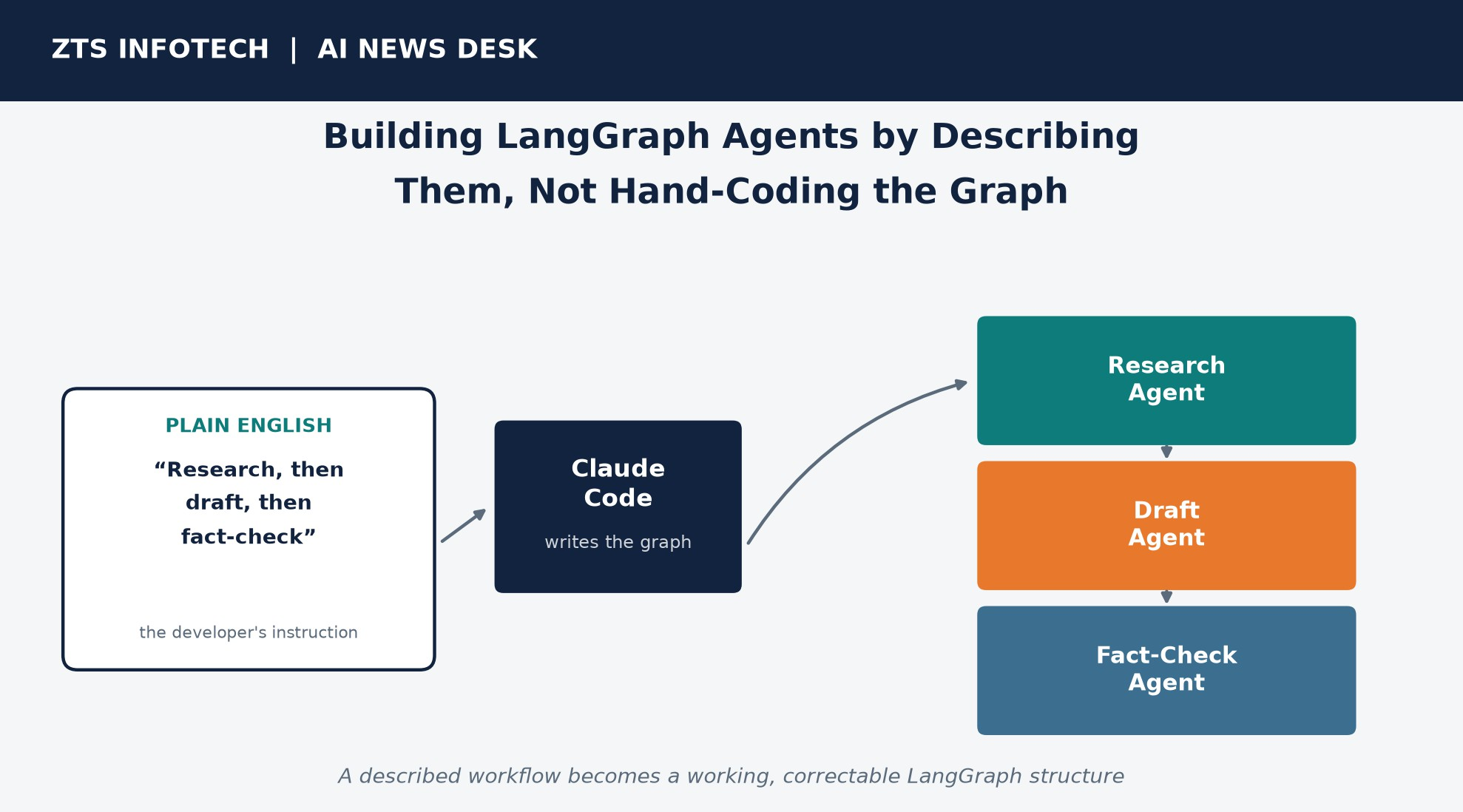
LangGraph has a reputation problem, and it is not about what the framework can do. Developers who need an AI agent with real memory, branching decisions, and steps that depend on each other reach for it constantly, because a simple back-and-forth chat interface cannot represent that kind of logic. The trouble has always been building it. Graph-based agent design is a genuinely difficult way to think, and that difficulty has kept many teams from attempting multi-agent systems at all.
ZTS Infotech's latest AI News Update, presented by Anirban Das, lays out how the company's own engineers get around that barrier: they stop hand-writing the graph and start describing it. The distinction sounds small. In practice, according to Das, it is the difference between LangGraph being usable day-to-day and LangGraph being a wall most teams never get past.
Why LangGraph Is Hard in the First Place
Das frames LangGraph as building a full org chart for an AI system: who reports to whom, what happens when a step fails, where a loop repeats. That is an apt comparison, and it explains the learning curve directly. An org chart with a handful of roles and one reporting line is trivial to draw. An org chart with conditional branches, retry loops, and steps that hand off to each other based on runtime outcomes is not something most developers can sketch correctly in code on the first attempt — and LangGraph, by design, expects exactly that level of structure normally written line by line.
From Description to Structure
The workaround ZTS Infotech uses is to describe the desired system in plain English to Claude Code, rather than writing the graph by hand. Das gives a concrete example: build an agent that researches a topic, hands off to a second agent that writes a draft, then a third agent that fact-checks the draft before anything ships. Claude Code takes that description and writes the actual LangGraph structure behind it
— the nodes, the handoffs, the routing logic that would otherwise need to be written by hand.
The Part That Matters More: Correcting a Misbehaving Node
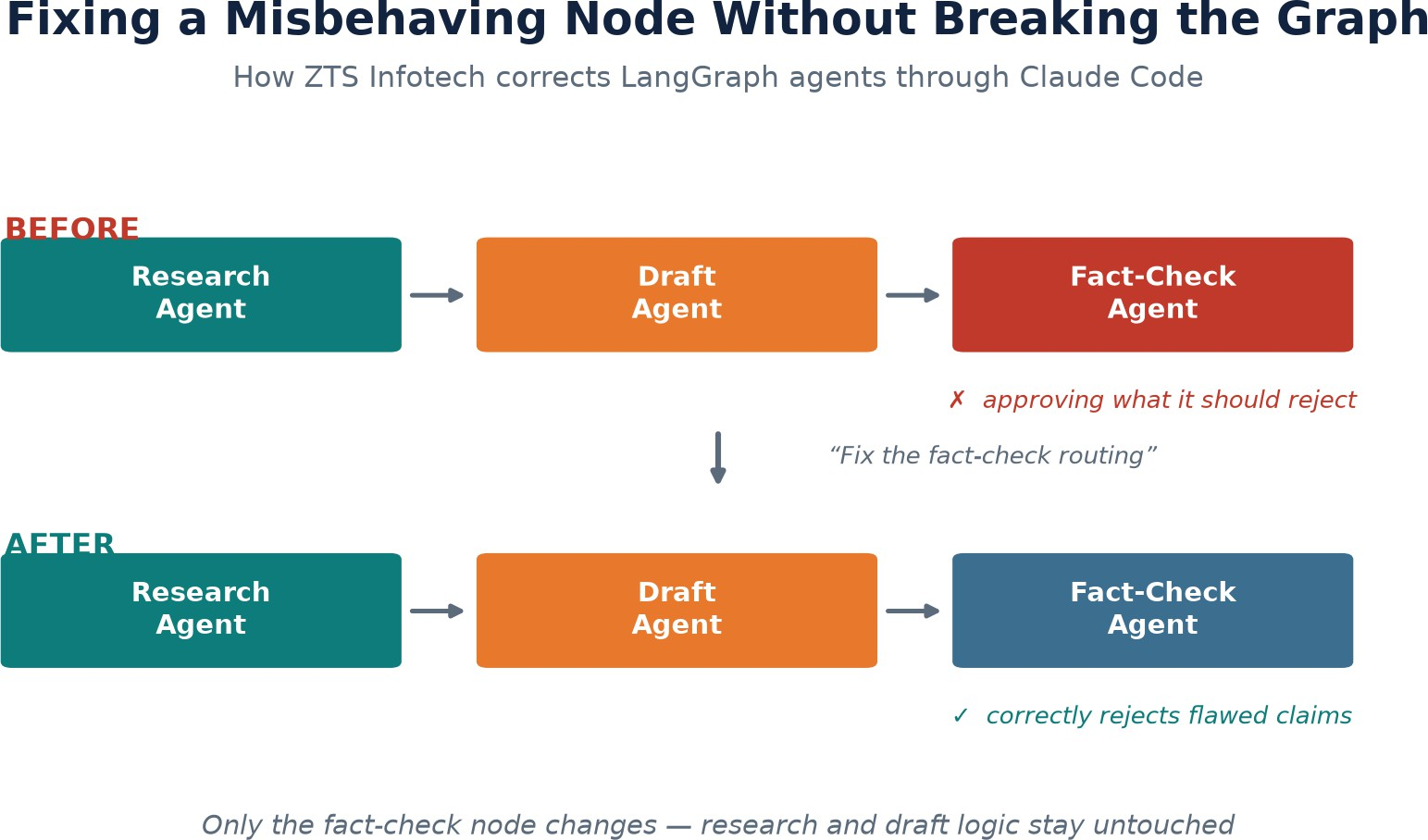
Building the graph is only half the workflow Das describes, and he is explicit that the correction half matters more. When a step in the chain misbehaves — his example is a fact-checking agent that starts approving claims it should reject — the response is not to open several hundred lines of graph code and trace the routing logic manually. Instead, the team states the problem in plain language: the fact-checking step is approving things it should reject, fix the routing logic. Claude Code modifies that specific node without disturbing the rest of the graph.
That capability is arguably the more important half of the story for a business audience. Building a working system once is a one-time cost. Maintaining and correcting it, agent by agent, client by client, is the ongoing cost that determines whether a technique is practical to run as a service rather than as a one-off engineering exercise.
The Honest Trade-Off
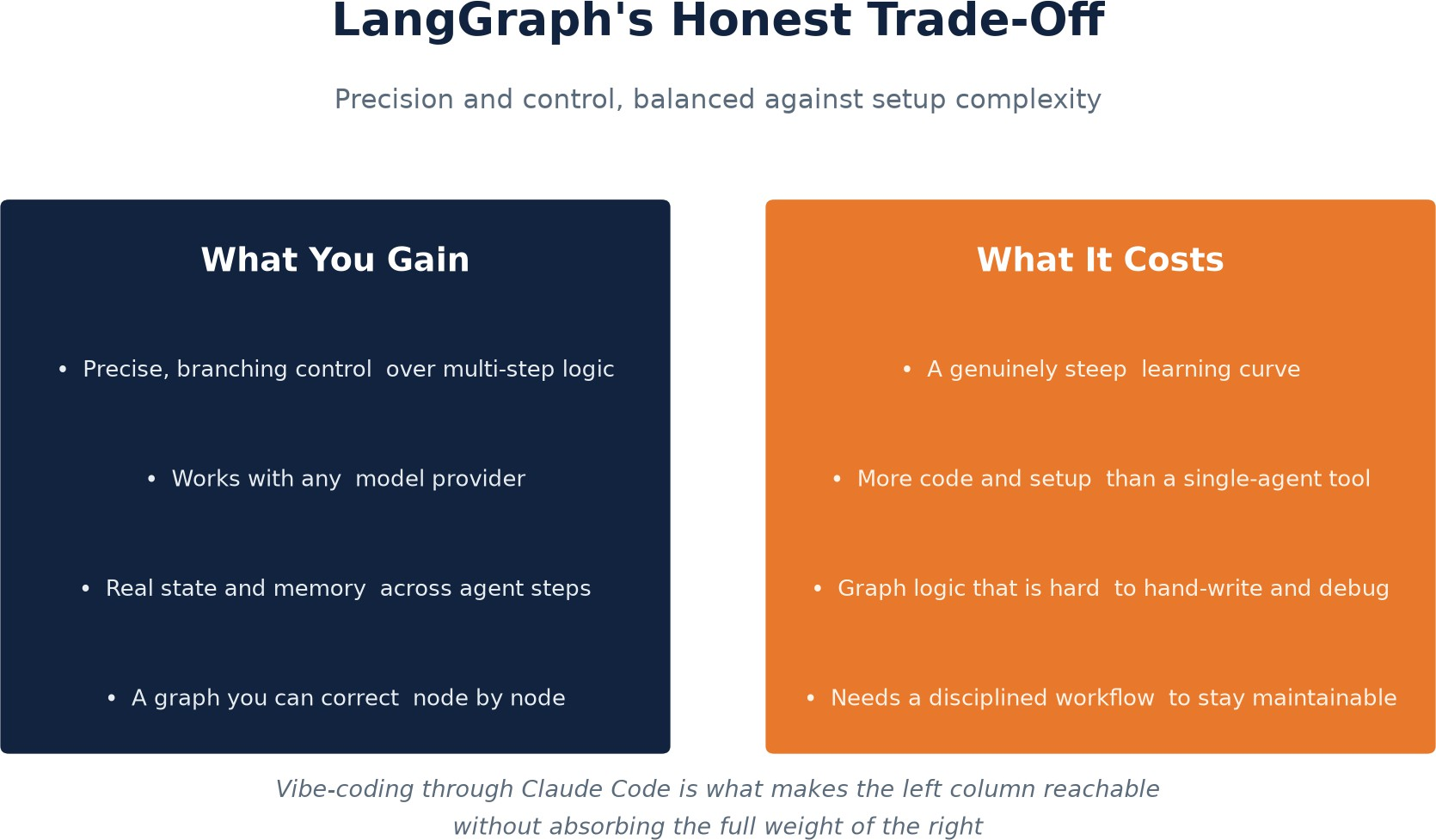
Das does not present this as a free upgrade over simpler tools. He states directly that LangGraph is more code and more setup than a simpler single-agent tool, and that its value is precise control that works with any model provider rather than being locked to one. The claim in the video is narrower and more defensible than a blanket endorsement: vibe coding through Claude Code does not make LangGraph simple, it makes LangGraph's complexity usable on a daily basis instead of a barrier that stops most teams from building this kind of system properly at all.
Expert Perspective: Why Description-Driven Graph Building Matters
The significance here goes beyond one agency's internal tooling choice. LangGraph occupies a specific niche: it is the framework of choice precisely when a business's use case is too stateful and too conditional for a single-agent tool, which describes a meaningful share of real client work — multi-step research pipelines, approval chains, content workflows that require a check before publication. Historically, that niche has been gated by engineering skill that many smaller teams simply do not have in-house.
Coding assistants that can translate a natural-language description into a working graph, and then make a targeted correction to a single node without a full rewrite, lower that gate substantially. That does not eliminate the need for a developer who understands what a graph is and what correct routing logic looks like — someone still has to recognize that the fact-checking node is misbehaving and describe the right fix. What changes is the amount of graph-specific syntax and framework-specific debugging a team needs to hold in its head to operate at this level.
The practical effect for agencies and internal engineering teams is a shift in what specialization is required to offer multi-agent systems as a service. Deep LangGraph expertise becomes less of a hard prerequisite; disciplined problem description and a clear sense of what the workflow should do become more central. Teams that adapt their hiring and training around that shift will be able to offer more sophisticated agent architectures at a lower build cost than teams still hand-writing every node.
Key Takeaways
- LangGraph is the framework of choice for AI agents needing real memory, branching logic, and multi-step coordination, but it has a genuinely steep learning curve.
- ZTS Infotech now builds LangGraph agent systems by describing the desired workflow in plain
English to Claude Code, which generates the underlying graph structure.
- In one example, a described research-then-draft-then-fact-check pipeline becomes a working three-agent LangGraph chain without hand-written graph code.
- Correcting a misbehaving node — such as a fact-checker approving what it should reject — is done by
describing the problem, not manually tracing hundreds of lines of code.
- Targeted corrections modify only the affected node, leaving the rest of the graph untouched.
- LangGraph still requires more setup and code than a single-agent tool, but works with any model provider and offers precise control that simpler tools do not.
- Description-driven development through Claude Code is what makes LangGraph's complexity usable
day-to-day rather than a barrier that stops teams from building multi-agent systems properly.
Conclusion
The tools named in this video will keep changing, and Claude Code's ability to generate and patch LangGraph structures today is a snapshot of a fast-moving capability rather than a finished feature. What is likely to persist is the underlying shift: as coding assistants get better at translating intent into correct, framework-specific structure, the bottleneck on building sophisticated multi-agent systems moves away from graph-syntax fluency and toward clear thinking about what the workflow should actually do. Businesses evaluating whether to build multi-step AI agents in-house or through a partner should watch how quickly that shift spreads across the tools they already rely on.
-

Writen by Anirban Das