USA:
USA:  India: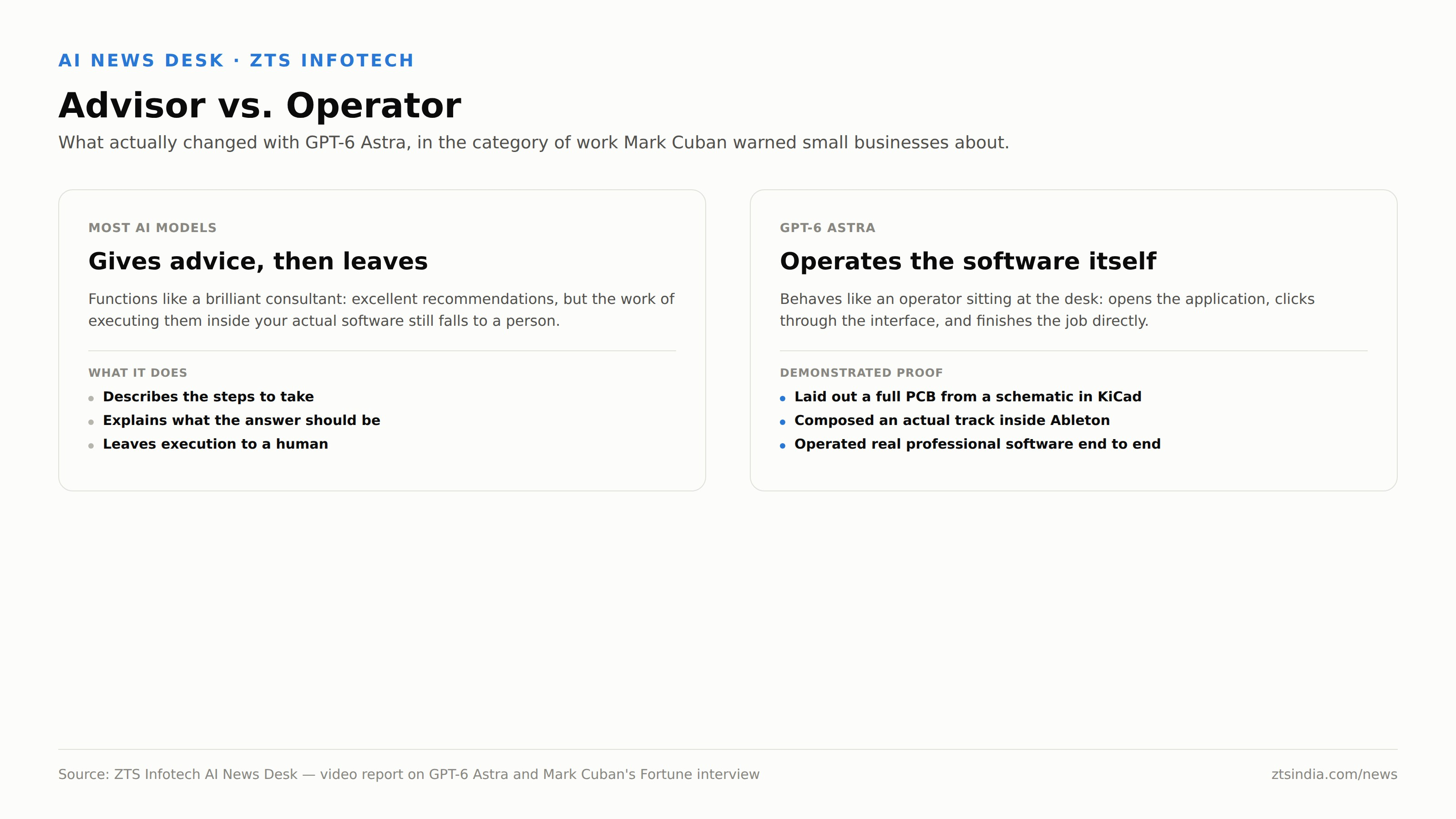
When a Billionaire Investor's Warning Gets a Concrete Demo
Predictions about AI disruption are cheap; specific, on-record warnings from people who have spent decades correctly reading where business is heading are not. That is what makes Mark Cuban’s recent comments to Fortune worth taking seriously rather than filing alongside the usual AI hype cycle.
Cuban’s warning was blunt: AI agents are going to run through every small and midsize business in the country, and most owners will not know how to build them. That gap, in his framing, is either the biggest risk small business owners face right now or their biggest opportunity.
Around the same time, OpenAI released GPT-6 Astra, and the demos coming out of that launch point directly at the category of work Cuban was describing.
From Advisor to Operator: What Actually Changed
The useful way to understand the shift is not through the model’s name but through what it does differently. Most AI models function like a brilliant consultant: they give excellent advice, then leave the room. The work of actually executing that advice, inside whatever software a business runs on, still falls to a person. GPT-6 Astra behaves differently. It acts like an operator sitting at the desk itself, opening the software, clicking through the interface, and finishing the job.
Real Software, Not a Chat Window
Two demonstrations illustrate the distinction concretely. In one, Astra opened KiCad, real electrical engineering software, and laid out a complete printed circuit board directly from a schematic. In another, it opened Ableton, a professional music production tool, and composed an actual track inside the application. Neither demo involved the model describing what someone else should do. In both cases, the system operated the actual professional software end to end.
The Number That Quantifies the Jump
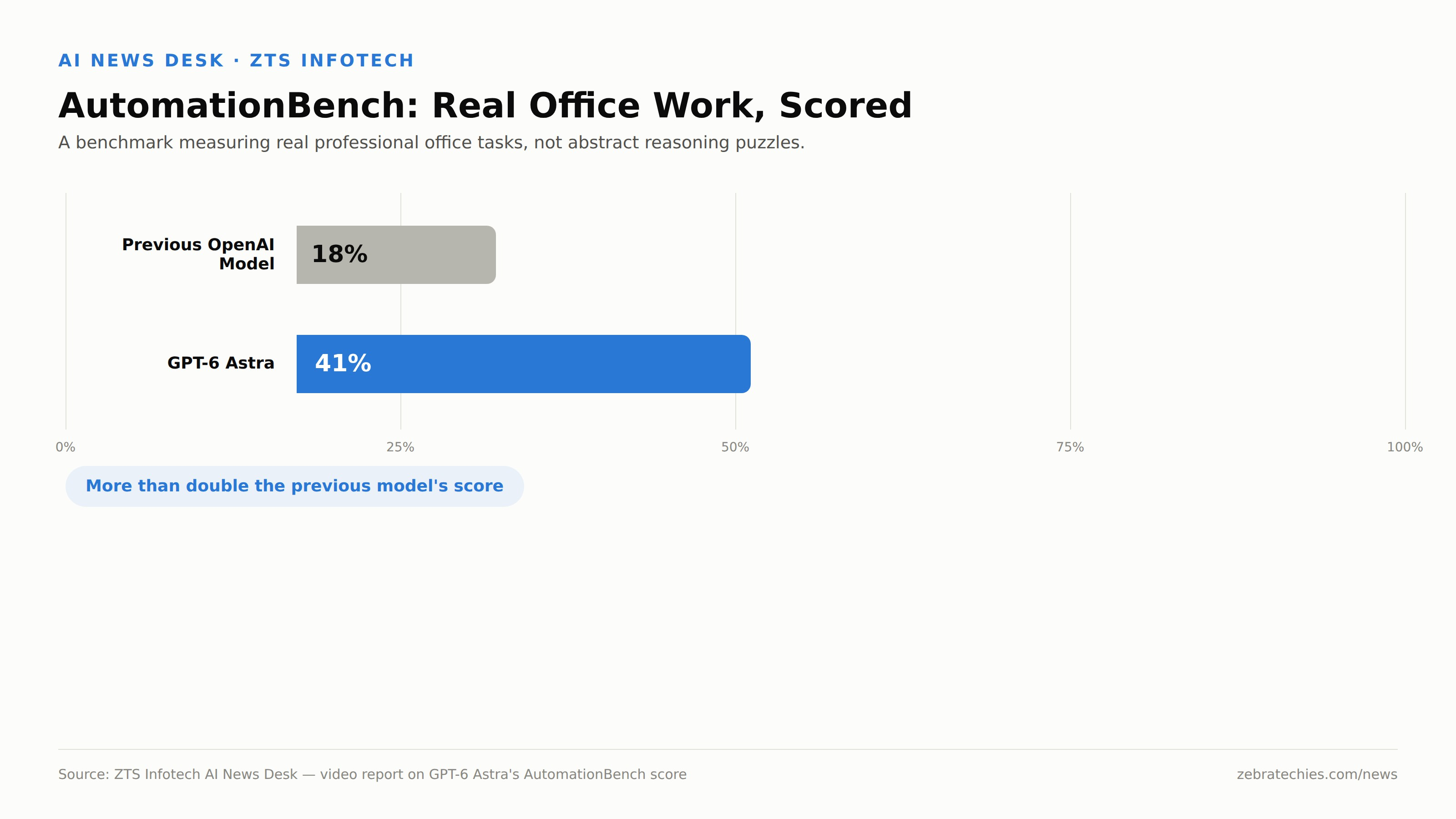
The clearest evidence sits in a benchmark called AutomationBench, which measures real professional office work rather than abstract reasoning tasks. GPT-6 Astra scored 41% on it, versus 18% for OpenAI’s previous model on the same benchmark — more than double, on the exact category of tasks that fills most people’s actual working day. A benchmark built around office work, rather than trivia or coding puzzles, is a more direct proxy for what a small business owner should care about: can this system actually do the tedious parts of the job.
Why Cuban's Specific Examples Matter More Than the Headline
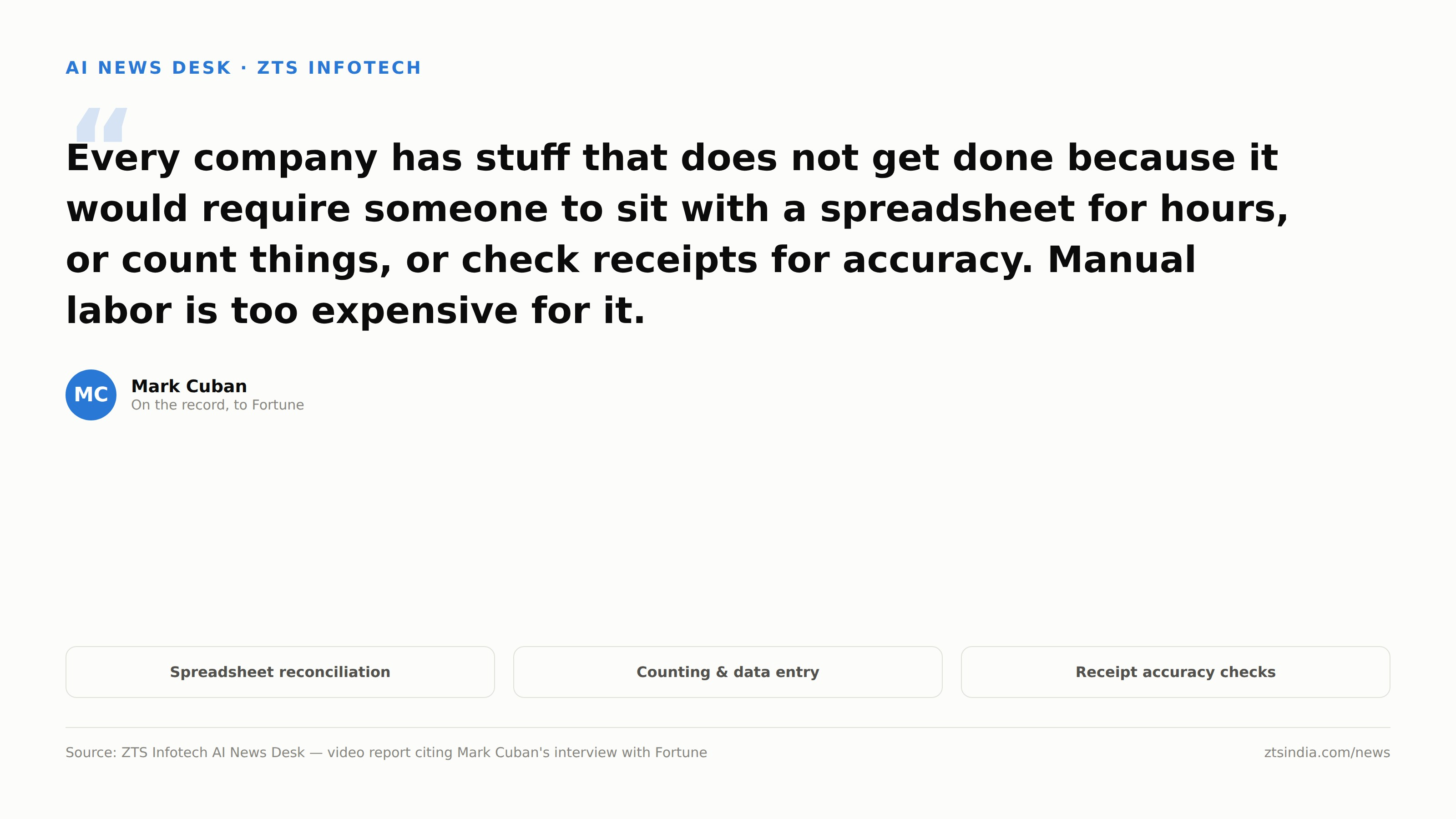
Cuban’s warning becomes far more useful once his own examples are attached to it. His quote to Fortune named the work directly: every company has tasks that do not get done because they would require someone to sit with a spreadsheet for hours, count things, or check receipts for accuracy.
Manual labor is too expensive to justify doing it properly, so the work sits there, undone, quietly costing the business until someone builds an agent to do it.
That framing reorients the conversation away from abstract AI capability and toward a specific, familiar category of business pain: the reconciliation nobody has time for, the data entry that gets deprioritized every week, the audit that only happens when something already went wrong.
The Honest Math on Repetitive Work
The arithmetic is straightforward and does not require optimism to be compelling. If a single repetitive task costs a business twenty hours of staff time a month, and an agent handles it reliably, that is twenty hours returned every month from one process alone. Multiply that across every repetitive process running inside a growing business, and the number stops being a rounding error and starts being a genuine line item, this year rather than some hypothetical future one.
Why This Matters for Business Leaders
The businesses positioned to benefit are not necessarily the ones with the most sophisticated AI strategy; they are the ones that correctly inventory where their own repetitive, rules-based work actually lives, and move on it early. Cuban’s point about the gap being either the biggest risk or the biggest opportunity is not rhetorical. Owners who cannot identify which of their own processes are viable candidates for an agent are, by his framing, sitting on the risk side of that gap by default, whether or not they intend to be.
Expert Perspective
The AutomationBench jump from 18% to 41% matters less for the raw number than for what the benchmark measures. Office-work benchmarks track something closer to an actual working day than most AI evaluations do, which makes this a more credible signal for business applicability than a general-reasoning leaderboard. Combined with concrete, software-native demos rather than described capabilities, the evidence points toward a real capability shift rather than an incremental update dressed up as one.
The more durable lesson sits in Cuban’s framing of the gap itself. Every growing business already has an informal list of the tasks nobody wants to do, the ones that get pushed to the end of the week and sometimes never get done at all. That list is now a viable starting point for agent adoption, not a wish list. The businesses that compound the advantage longest will be the ones that treat this as an inventory exercise now, rather than waiting for the technology to become more familiar before acting on it.
Key Takeaways
- Mark Cuban told Fortune, on the record, that AI agents will run through every small and midsize business, and most owners will not know how to build them.
- GPT-6 Astra operates real software directly rather than only giving advice, demonstrated by laying out a PCB in KiCad and composing a track in Ableton.
- On AutomationBench, a benchmark for real office work, Astra scored 41% versus 18% for OpenAI’s previous model, more than double.
- Cuban specifically named spreadsheet work, counting, and receipt-checking as the repetitive tasks quietly costing businesses money.
- The math on repetitive tasks compounds quickly: a single 20-hour-a-month process, multiplied across a business’s other repetitive workflows, becomes a significant recurring saving.
- The opportunity favors businesses that inventory their own repetitive processes now, rather than waiting for the technology to feel more familiar.
- Software-native demos and office-work benchmarks are a more credible signal of business applicability than general AI reasoning claims.
Conclusion
Cuban’s warning and GPT-6 Astra’s demos are, together, more useful than either would be alone: a specific claim about where the disruption lands, paired with a concrete demonstration of the capability driving it. The businesses that treat this as an immediate inventory question, which repetitive tasks are costing us the most, rather than a future strategic question, are the ones positioned to compound the savings the longest. That window is open now, not next year.
-

Writen by Anirban Das