USA:
USA:  India:
 A viral benchmark — 50 seconds versus 25 minutes for the identical task — is reframing how enterprise engineering teams think about connecting AI agents to their tools.
By ZTS Infotech AI News Desk | Reporting based on ZTS Infotech's AI News Desk video analysis, published to the company's YouTube channel
.jpg)
A viral benchmark — 50 seconds versus 25 minutes for the identical task — is reframing how enterprise engineering teams think about connecting AI agents to their tools.
By ZTS Infotech AI News Desk | Reporting based on ZTS Infotech's AI News Desk video analysis, published to the company's YouTube channel
The Question Every AI-Building Team Gets Wrong
Ask a room full of developers whether they should connect their AI agent to a tool using the Model Context Protocol or a direct API call, and you'll usually get a religious argument instead of an engineering answer. That's the wrong framing, according to a new breakdown from ZTS Infotech's AI News Desk, and the numbers behind it are stark enough to settle the debate for most enterprise teams.
The short version: it was never a competition between two technologies. It's a question about who — or what — is on the other end of the request.
The Benchmark That Actually Settles It
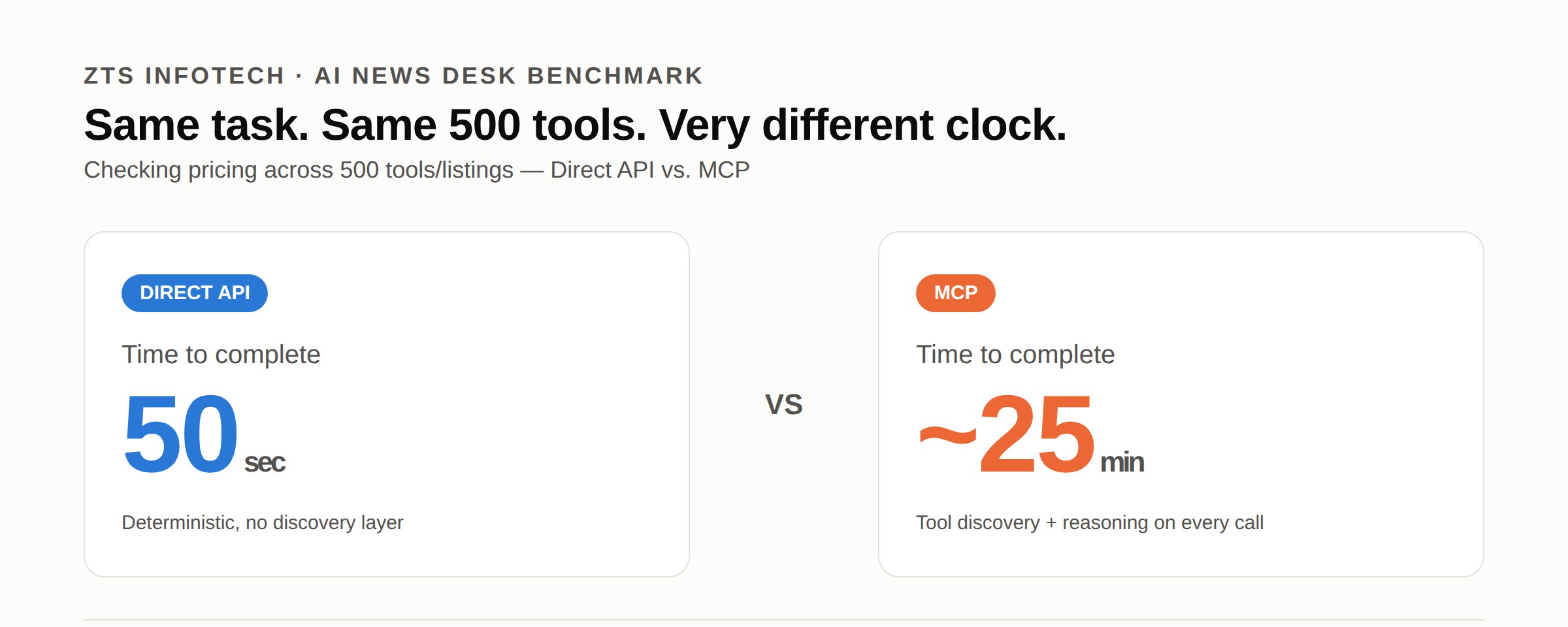
The comparison at the center of the discussion is a simple one. Take a batch job that checks pricing across 500 tools or product listings. Route it through a direct API call, and it finishes in roughly 50 seconds. Route the identical task through MCP, and it takes roughly 25 minutes.
That gap exists because MCP was built to let an AI model discover what tools are available and reason about which one to use before it acts. That discovery-and-reasoning layer sits in front of every single call. For a person waiting on one considered answer, it's invisible — nobody clocks an extra second or two in a conversation. For a machine firing off hundreds of calls in a pipeline, that same overhead compounds into a delay no operations team would tolerate at 3 a.m.
To be clear, this isn't evidence that MCP is poorly engineered. It's evidence that MCP solves a different problem than a direct API call, and using it as a batch-processing shortcut misapplies the tool.
The Actual Decision Rule
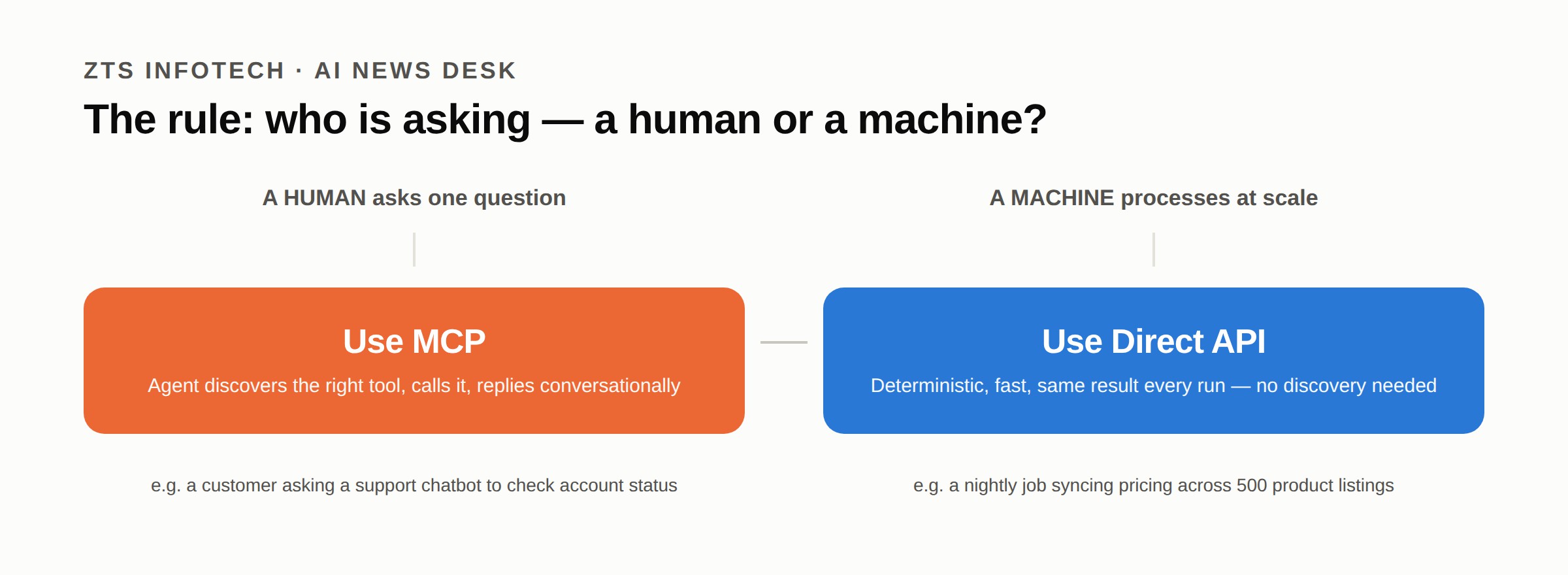
Strip away the framing of “which protocol wins,” and the rule that emerges is straightforward: is a human sitting there asking one question, or is a machine processing at scale?
Where MCP Is the Right Call
Picture a customer messaging a support chatbot to check their account status. That's one person, one natural-language question, asked once. An MCP-connected agent can discover the right tool on its own, call it, and respond conversationally — without an engineer having to hard-code every possible request in advance. The flexibility is the entire point, and the latency cost is trivial next to the value of not writing bespoke integration code for every new question a customer might ask.
Where Direct API Wins
Now picture a nightly job syncing pricing data across 500 product listings. There's no ambiguity to reason through, no natural-language question to interpret, and no benefit to tool discovery — the job needs the same deterministic result, run the same way, every single night. Routing that through MCP adds discovery overhead with no corresponding benefit. A direct API call gets the job done in a fraction of the time, with predictable, repeatable behavior.
Why the Timing Matters
This isn't a debate happening in a vacuum. In December 2025, Anthropic donated MCP to the newly formed Agentic AI Foundation, a directed fund under the Linux Foundation, alongside contributions from Block and OpenAI — a move confirmed in the Linux Foundation's own announcement. MCP is no longer a single vendor's protocol; it's shared infrastructure with platinum backing from Amazon Web Services, Google, Microsoft and OpenAI, among others.
At the same time, OpenAI has confirmed it will retire its own proprietary Assistants API, with the beta fully sunset on August 26, 2026, pointing developers toward its Responses API, which now natively supports remote MCP servers. Two of the industry's largest AI labs are converging on the same
tool-connection standard — which is precisely why getting this architecture decision right now carries real business weight.
Expert Perspective: Why This Isn't a “Pick One” Decision
The teams getting this right aren't choosing sides — they're running both architectures side by side, deliberately. MCP handles the agent-facing, natural-language layer where flexibility and tool discovery add value. Direct API calls handle the deterministic, high-throughput automation underneath, where speed and predictability matter more than reasoning.
That has real implications for how technology leaders should scope AI integration projects going forward. Treating MCP as a universal connector — the default for every integration because it's the newer, more talked-about standard — is a common and costly mistake. So is refusing to adopt it at all because a batch job somewhere ran slow. The organizations building durable AI infrastructure in 2026 are the ones asking, tool by tool, integration by integration: is this request coming from a person or a pipeline? The answer determines the architecture, not the other way around.
Key Takeaways
- A 500-tool batch job runs in roughly 50 seconds via direct API versus roughly 25 minutes via MCP — a 10 to 20 times overhead difference driven by MCP's discovery-and-reasoning layer.
- The deciding factor isn't which protocol is “better” — it's whether a human is waiting on one answer or a machine is processing at scale.
- MCP fits human-facing, natural-language interactions, such as a support chatbot resolving a single customer query.
- Direct API calls fit deterministic, high-volume automation, such as nightly data syncs across hundreds of records.
- Anthropic donated MCP to the Agentic AI Foundation under the Linux Foundation in December 2025, alongside Block and OpenAI, making it shared industry infrastructure rather than a single company's tool.
- OpenAI is retiring its proprietary Assistants API, with a full sunset confirmed for August 26, 2026, in favor of its MCP-supporting Responses API.
- Most experienced engineering teams aren't choosing between MCP and direct API calls — they're deploying both, matched to the right layer of the system.
Looking Ahead
As MCP matures under open, multi-vendor governance and legacy proprietary alternatives wind down, the practical question for business leaders isn't whether to adopt it — it's where. Enterprises that map their integrations against this human-versus-machine rule now will spend less time re-architecting later, as agentic AI systems take on a growing share of both customer-facing conversation and back-office automation. Expect this decision framework to become a standard part of technical due diligence for AI vendor selection through the rest of 2026.
-

Writen by Anirban Das