USA:
USA:  India: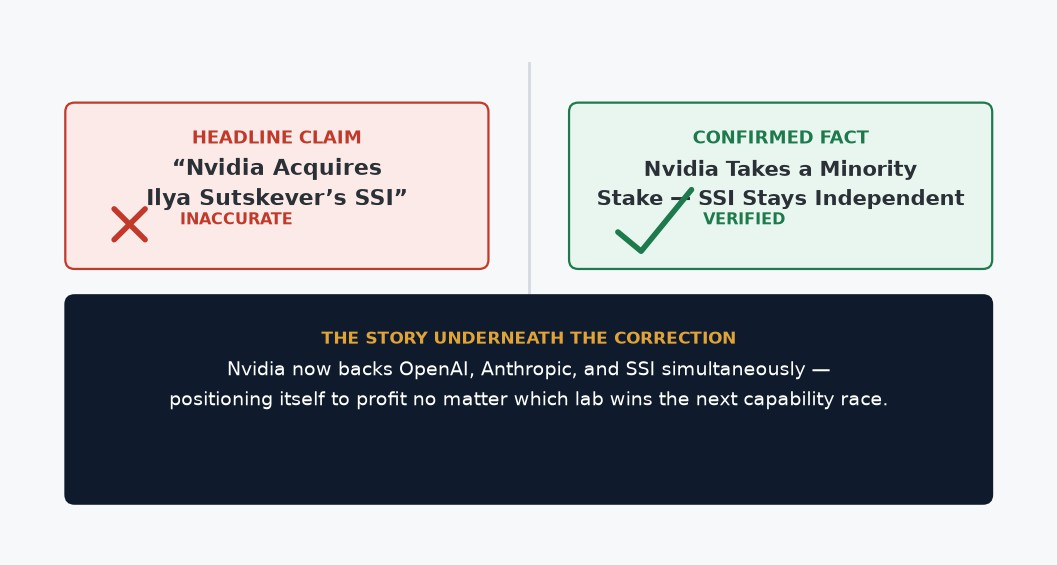
A headline built for maximum shock value has been circulating this week: Nvidia, the world's most valuable chipmaker, had supposedly acquired Safe Superintelligence, the secretive AI lab founded by former OpenAI chief scientist Ilya Sutskever. It made for a dramatic story. It also wasn't true.
Nvidia did not buy SSI. What it did instead is arguably more consequential for anyone running a business that depends on AI tools — and that is most businesses at this point. On July 27, Nvidia disclosed a significant stake in SSI, a move that gives Sutskever's still-independent company access to Nvidia's next-generation Vera Rubin chips, with the explicit goal of multiplying its computing capacity roughly tenfold within twelve months. SSI keeps its own board, its own roadmap, and its own name on the door. What changes is how much raw computing power it can put behind its research.
The Correction That Actually Matters
Investment and acquisition are not interchangeable terms, and in this case the gap between them tells the real story. An acquisition would have folded SSI into Nvidia's corporate structure. An investment leaves Sutskever's team fully independent while tying its technical trajectory to Nvidia's hardware roadmap and, now, its balance sheet.
That distinction is exactly why the correction is worth dwelling on rather than dismissing as pedantry. SSI has operated in near-total secrecy since Sutskever left OpenAI roughly two years ago to found it, disclosing almost nothing about its research direction or timeline. An acquisition would have been a clean, familiar story: big company buys promising startup. An investment that preserves independence while committing next-generation silicon to a secretive lab is a stranger and more interesting arrangement — one that says more about Nvidia's strategy than it does about SSI's.
One Chipmaker, Every Major Lab
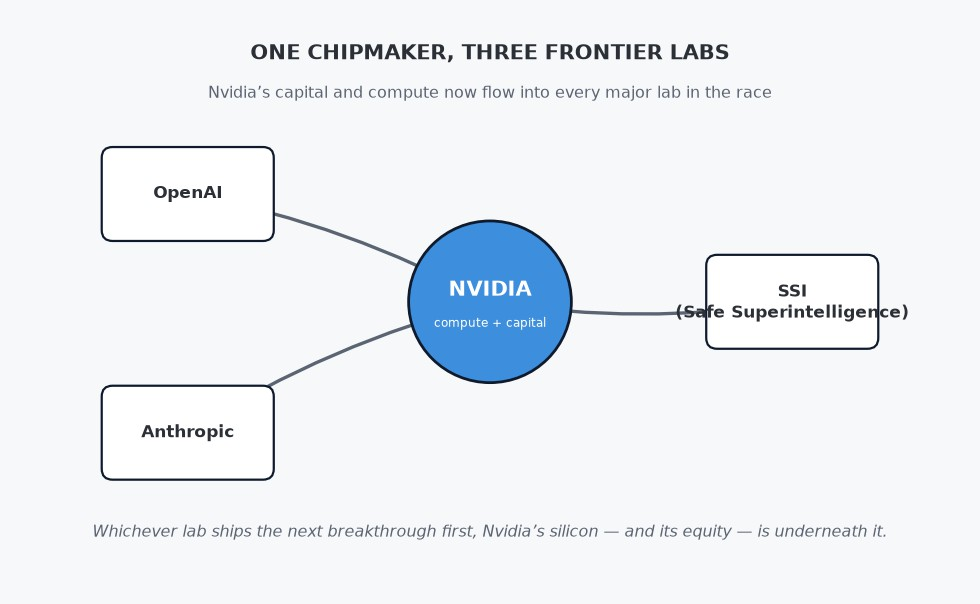
The detail that deserves more attention than the acquisition rumor ever got is this: Nvidia is now a direct financial backer inside OpenAI, Anthropic, and SSI at the same time. Three labs that are, by every public account, racing each other toward the next major capability jump are all building on the same underlying silicon supplier — and that supplier now holds equity in each of them.
For a chip company, that is close to an ideal position. Nvidia does not need to correctly guess which lab produces the next breakthrough model. Whichever one does, it is running on Nvidia hardware, and Nvidia's investment portfolio benefits either way. It is a hedge built directly into the infrastructure layer of the industry, rather than a bet placed from the outside.
Why This Should Matter to Engineering and Product Leaders, Not Just Investors
It is tempting to file this under financial-markets news and move on. That would be a mistake for any organization that has built workflows, products, or internal tooling on top of large language models.
The practical takeaway is that compute access, not model architecture alone, is becoming the variable that determines which lab ships its next breakthrough first. Two labs can have comparably talented research teams and comparably promising architectures; the one with materially more usable compute gets there faster. That has direct downstream consequences for the tools engineering teams rely on daily — pricing, model availability, and API stability all trace back, eventually, to how much compute a
given lab can secure and how quickly.
A Leading Indicator Worth Tracking
There is a practical signal buried in this story for any team making build-versus-buy decisions around a specific model ecosystem: watch where Nvidia puts its money next. A chipmaker's investment choices are, in effect, an early read on which labs are about to gain a compute advantage over their competitors
— and by extension, which ecosystems are likely to see faster iteration, broader availability, and more competitive pricing in the coming product cycles.
That is a different way of evaluating AI vendor risk than most procurement checklists currently account for. Model benchmarks and feature comparisons matter, but they describe where a lab is today. Compute backing describes where a lab is headed.
EXPERT PERSPECTIVE
The acquisition rumor was always the less interesting version of this story. What actually happened — a chip supplier taking equity positions across three competing frontier labs simultaneously — is a more unusual structure, and one with fewer historical parallels to reason from. It resembles a picks-and-shovels strategy more than a traditional bet on a single winner, except that the "shovels" here also come with a seat at the table.
For enterprise buyers, the near-term implication is straightforward: the stability of your AI vendor relationships is now partly a function of a hardware supplier's portfolio decisions, several layers removed from the product you actually use. That is not a reason for alarm, but it is a reason to widen
the diligence lens beyond the model provider itself. Over the next twelve months, expect compute partnerships — not just model release notes — to become a standard line item in how sophisticated buyers evaluate which AI ecosystems are worth building on. SSI's targeted tenfold compute increase is also a useful marker: if a lab that has spent two years in near-total silence delivers a visible capability jump on that timeline, it will be reasonable to credit the compute relationship, not just the research, for the acceleration.
KEY TAKEAWAYS
- Nvidia invested in Ilya Sutskever's Safe Superintelligence (SSI); it did not acquire the company, and SSI remains independent.
- The stake, disclosed July 27, gives SSI access to Nvidia's next-generation Vera Rubin chips, with a targeted tenfold increase in compute within 12 months.
- Nvidia is now a direct financial backer inside OpenAI, Anthropic, and SSI simultaneously — three competing labs built on the same silicon supplier.
- Whichever lab ships the next major capability breakthrough, Nvidia's hardware and equity position benefit either way.
- For engineering and product leaders, compute access — not model architecture alone — is an increasingly decisive factor in which AI ecosystem moves fastest.
- Nvidia's investment choices function as a leading indicator of which labs are gaining a compute advantage, worth tracking for any team committed to a specific model ecosystem.
Vendor risk assessment for AI tooling should now factor in compute partnerships, not just model performance and pricing.
CONCLUSION
The acquisition headline will fade the way corrected rumors usually do. The underlying arrangement it obscured — one chipmaker with equity inside every major frontier lab — is the part worth watching. As Nvidia's Vera Rubin generation rolls out and labs like SSI begin converting fresh compute into visible product decisions, the connection between who backs a lab's hardware and who wins the next capability race will only become harder to ignore. Business and technology leaders who track that relationship now will be better positioned than those who wait for the next headline to explain it after the fact.
-

Writen by Anirban Das