USA:
USA:  India:
Quick answer: OpenAI has pushed per-token prices down sharply across its GPT-5 lineup in 2026, with budget models like GPT-5.4 Nano now running as low as $0.20 per million input tokens and $1.25 per million output tokens — and stackable discounts (batch processing, prompt caching, smarter routing) that can cut real-world bills by 50% to 90%.
Anthropic and Google have answered with their own cheaper Haiku, Flash, and Flash-Lite tiers, so the "price war" headline is really a three-way race, not an OpenAI solo act.
Why AI Prices Are Falling So Fast Right Now
A year ago, running a serious AI product meant budgeting for models that cost several dollars per million tokens no matter what you did with them. That math has changed. Every major lab — OpenAI, Anthropic, and Google — is now shipping a tier of "small but smart" models built specifically for high-volume, everyday tasks, alongside their flagship reasoning models for harder problems.
Three engineering shifts are driving the drop:
- Smarter hardware utilization. Newer inference chips and better batching mean labs can serve more requests per GPU-hour, and they're passing some of that savings on.
- Quantization. Running models at lower numerical precision shrinks memory and compute needs without gutting quality on most everyday tasks.
- Speculative decoding. A small "draft" model predicts likely next tokens and a larger model verifies them in parallel, which speeds up generation and lowers the effective cost per response.
- Prompt caching. Reusing previously processed context (like a system prompt or reference document) instead of reprocessing it from scratch is now standard across all three providers, and it's arguably done more for real-world bills than any single price cut.
None of this is charity. Inference is still the biggest recurring cost for AI companies, and cheaper tokens mean more developers building more products, which means more total usage. Lower unit prices, higher volume — it's a familiar playbook.
What OpenAI Actually Changed
OpenAI's current lineup spans a wide range. At the top, GPT-5.5 runs $5.00 per million input tokens and $30.00 per million output tokens — a flagship price for a flagship model. But most of the cost story is happening below that tier. GPT-5.4, the model OpenAI now recommends as the default production workhorse, costs $2.50 input and $15.00 output per million tokens. Drop down further and GPT-5.4 Mini comes in at $0.75/$4.50, while GPT-5.4 Nano bottoms out around $0.20/$1.25 per million tokens.
Layer on OpenAI's discount mechanisms and the effective price drops even more:
- Batch API: a flat 50% off input and output for workloads that can tolerate a 24-hour turnaround, like nightly reports or bulk classification.
- Flex processing: similar savings for non-production or lower-priority jobs, in exchange for slower or occasionally unavailable responses.
- Prompt caching: repeated context (a system prompt, a shared document) is billed at roughly 90% off the standard input rate once OpenAI recognizes it as duplicate.
- Model routing: picking GPT-5.4 Mini or Nano instead of the flagship for simple classification or extraction work is, by OpenAI's own numbers, the single biggest lever available — sometimes a 15x to 25x difference on the same task.
Stack a couple of these together — say, Batch pricing plus caching — and it's realistic for a team to cut a production bill by half to two-thirds without touching output quality. That's where the "up to 50%" headline comes from in practice: it's rarely a single price cut, and more often the compounding effect of cheaper models plus smarter usage patterns.
One wrinkle worth knowing: OpenAI charges a premium for very long prompts. Once a request on GPT-5.5 crosses roughly 270,000 input tokens, the entire session gets billed at double the input rate and 1.5 times the output rate — including under Batch and Flex tiers. Teams working with large codebases or long documents can cut this bill in half just by keeping context under that threshold.
How Claude and Gemini Pricing Compares
OpenAI isn't cutting prices in a vacuum. Anthropic and Google have been racing down the same curve.
Anthropic's Claude lineup currently spans from the budget-focused Claude Haiku 4.5 up to Claude Opus 4.6 at the high end, with Claude Sonnet 4.6 as the mid-tier default for most production apps. At the flagship level, Opus runs around $5.00 input and $25.00 output per million tokens — competitive with, and in some cases cheaper than, OpenAI's top-tier GPT-5.5 pricing.
Google's Gemini lineup is arguably the most aggressive at the low end. Gemini 2.5 Flash-Lite sits at roughly $0.10 input and $0.40 output per million tokens — among the cheapest production-grade models from any major lab — while the new Gemini 3.5 Flash, launched in May 2026, runs $1.50/$9.00 and reportedly beats the older Gemini 3.1 Pro on coding benchmarks at a lower price. Google also offers a genuinely free tier through AI Studio with no credit card required, which OpenAI and Anthropic don't fully match at the API level.
| Provider | Budget-tier model | Budget price (input/output per 1M tokens) | Flagship model | Flagship price (input/output per 1M tokens) |
| OpenAI | GPT-5.4 Nano | $0.20 / $1.25 | GPT-5.5 | $5.00 / $30.00 |
| Anthropic | Claude Haiku 4.5 | ~$1.00 / $5.00 | Claude Opus 4.6 | ~$5.00 / $25.00 |
| Gemini 2.5 Flash-Lite | $0.10 / $0.40 | Gemini 3.1 Pro | $2.00 / $12.00 |
Prices reflect standard, non-batch API rates as of July 2026 and change frequently — always confirm against each provider's official pricing page before budgeting.
The pattern that jumps out: no single company is cheapest across the board. Google tends to win at the extreme budget end for simple, high-volume tasks. OpenAI has the widest published spread between its cheapest and most expensive models, giving developers more granular control. Anthropic's pricing sits closer to OpenAI's at the top but hasn't pushed quite as low at the bottom — its positioning leans more on quality-per-dollar at the mid-tier than on chasing the rock-bottom price point.
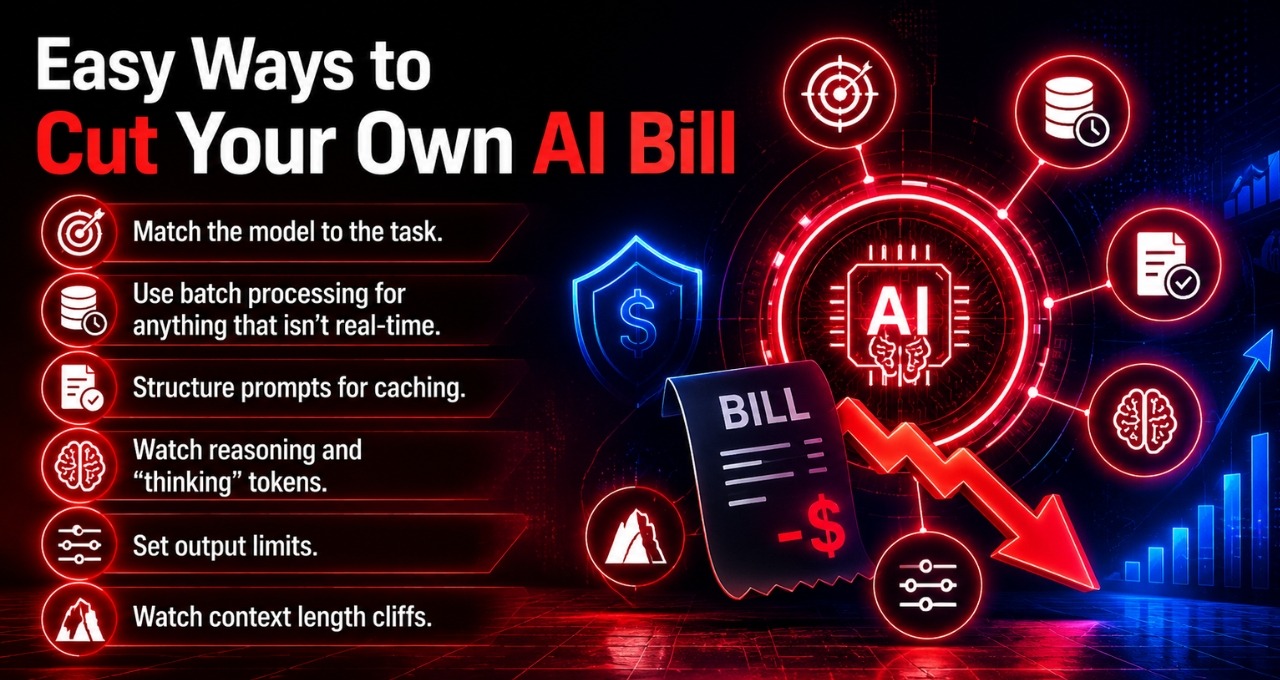
Easy Ways to Cut Your Own AI Bill
Whichever provider you're using, the cost-saving levers are strikingly similar across all three:
- Match the model to the task. Don't send a simple summarization or tagging job to a flagship reasoning model. Route it to the cheapest model that clears your quality bar — this is consistently the biggest single cost driver, bigger than any discount program.
- Use batch processing for anything that isn't real-time. Nightly jobs, bulk content generation, and large-scale classification all qualify for roughly 50% off across OpenAI, Anthropic, and Google.
- Structure prompts for caching. Put shared system instructions, reference documents, or few-shot examples at the start of your prompt so repeated content gets billed at the cached rate instead of full price.
- Watch reasoning and "thinking" tokens. Extended reasoning models bill internal chain-of-thought tokens at the output rate even when you never see them. A model that reasons at length can cost far more than its headline output price suggests.
- Set output limits. Unconstrained responses generate more tokens than most use cases actually need. A simple instruction to keep responses concise can meaningfully cut output spend, which is typically priced several times higher than input.
- Watch context length cliffs. Several providers double their rates once a prompt crosses a length threshold (around 200,000–270,000 tokens depending on the model). Trimming context or splitting long documents can avoid the premium entirely.
What Affordable AI Means for Developers, Startups, and SaaS Builders
For teams building on these APIs, falling prices change the calculus in a few concrete ways.
Products that were previously too expensive to run at scale — think AI features baked into every user interaction rather than gated behind a premium tier — are now financially viable with the right model-routing strategy. A startup that once had to choose between a flagship model it couldn't afford at volume and a cheap model that produced weak results now has a wider middle ground of genuinely capable budget tiers to build on.
It also raises the bar on engineering discipline. Cost optimization used to be a nice-to-have; now it's closer to a required skill. Teams that don't actively route requests, cache prompts, and monitor reasoning-token usage will simply pay more than competitors doing the same work more efficiently. The gap between a naively built AI feature and a well-optimized one can now be a 60–80% difference in operating cost for identical output.
Finally, falling prices lower the barrier to experimentation. With free tiers, small trial credits, and rock-bottom nano/lite models across all three providers, testing an AI feature before committing engineering time to it is cheaper than it has been at any point since these APIs launched.
ZTS Infotech Pvt Ltd: Your Trusted Source
ZTS Infotech Pvt Ltd helps businesses build practical AI solutions that balance performance, scalability, and cost. From AI consulting and custom application development to API integration and workflow automation, the team helps startups, SaaS companies, and enterprises choose the right models for their needs instead of overspending on unnecessary computing power.
By implementing smart model routing, prompt optimization, caching strategies, and cost-efficient AI architectures, ZTS Infotech Pvt Ltd enables organizations to maximize ROI while keeping operational expenses under control. Whether you're adopting AI for the first time or optimizing an existing solution, ZTS Infotech delivers tailored strategies designed for long-term growth and efficiency.
The Bottom Line:
Is OpenAI "winning" the price war? It depends on what you're optimizing for. OpenAI has the most aggressive published discounts and the widest model range, which plays well in headlines. Google consistently undercuts everyone at the extreme low end.
Anthropic hasn't chased the rock-bottom price point as hard, betting instead that developers will pay a modest premium for its mid-tier quality. None of the three is cheapest everywhere, and the real competition is happening less on headline price and more on how easy each provider makes it to actually capture the savings — through batching, caching, and smart model routing.
Prices change quickly in this market. Always check each provider's official pricing page (OpenAI, Anthropic, and Google AI) before making budget decisions.
FAQ
Did OpenAI actually cut prices by 50%?
OpenAI's published per-token rates for budget models like GPT-5.4 Nano are already a fraction of its flagship pricing, and its Batch API adds a further flat 50% discount on top of standard rates. Combined with prompt caching (up to ~90% off repeated input) and model routing, real-world bills can drop by 50% or more, though this comes from stacking several optimizations rather than one blanket price cut.
Is Claude or Gemini cheaper than GPT-5.5?
At the flagship tier, pricing across OpenAI, Anthropic, and Google is broadly comparable, generally in the $2–$5 per million input tokens and $12–$30 per million output tokens range. At the budget tier, Google's Gemini Flash-Lite models are typically the cheapest, with OpenAI's Nano-tier models close behind.
What's the easiest way to lower my AI API bill?
Route simple tasks to the smallest capable model, use batch processing for anything that doesn't need an instant response, and structure prompts so repeated content benefits from caching. These three changes typically account for most of the savings developers see in practice.
-

Writen by Anirban Das