USA:
USA:  India: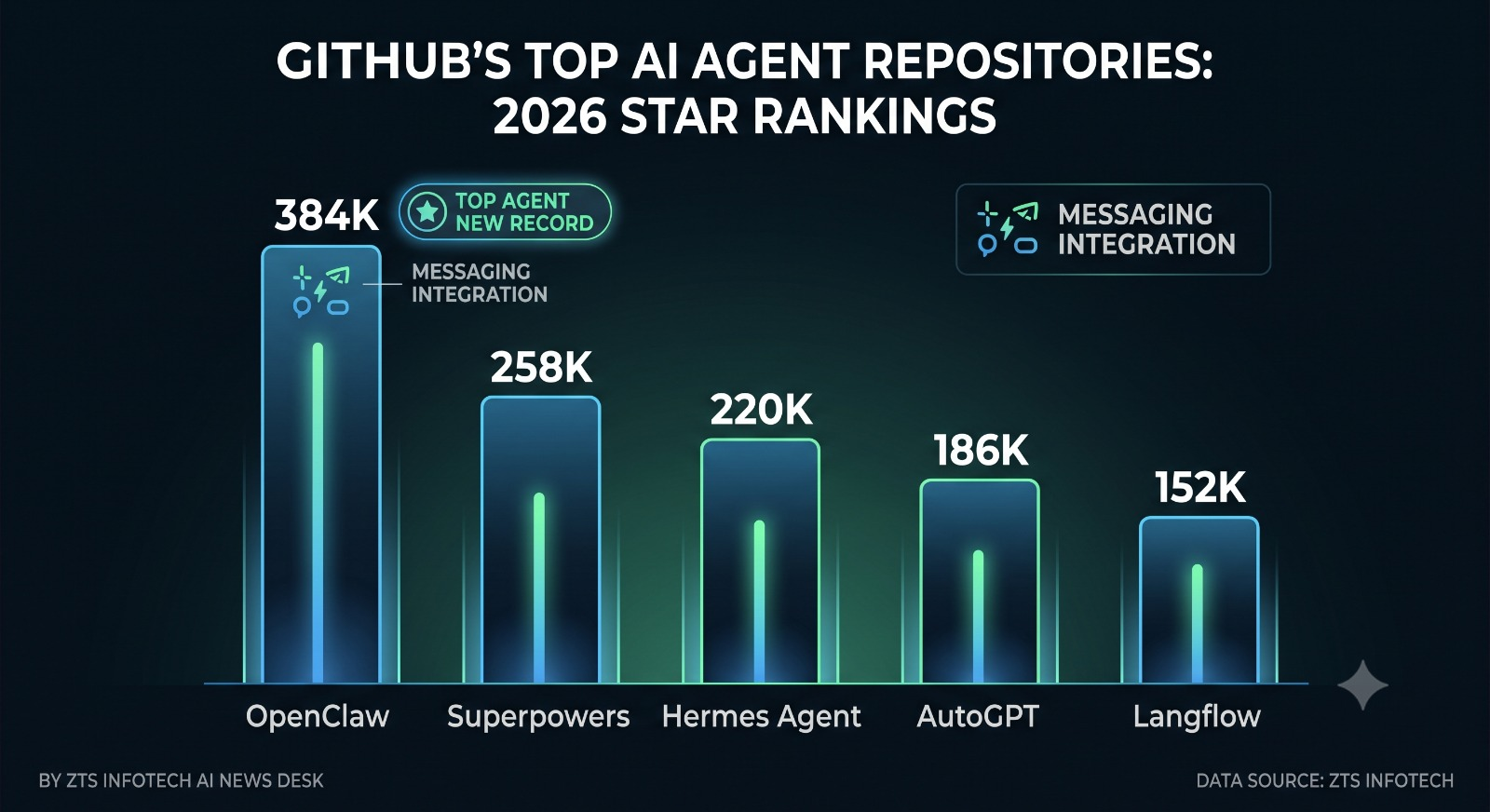
GitHub's annual leaderboard usually rewards familiar names — frameworks like React, kernels like Linux. This year, the top spot went somewhere unexpected. According to a new report from ZTS Infotech's AI News Desk, an AI agent called OpenClaw has become the platform's most-starred project, overtaking both React and Linux and breaking a ten-year-old growth record in just 60 days. The tools developers are rallying around fastest are no longer coding frameworks — they are agents built to run inside apps people already use, such as WhatsApp, Telegram and Slack, with no new software to install.
That distinction matters to a CEO or CMO more than it might first appear. A framework shapes what developers build; an agent living inside a messaging app shapes how customers and employees interact with a business every day. When a project built by one developer, described in the report as “a weekend hack,” outpaces a decade of enterprise-backed frontend tooling, it is worth asking where technology attention is heading next.
A Messaging-Native Agent Takes the Crown
OpenClaw, per the report, has amassed 384,000 stars on GitHub. Its distinguishing feature is not a novel underlying model but distribution: users talk to it directly through WhatsApp, Telegram or Slack without downloading a separate application. That “no app required” design appears to be what propelled its growth, with the report crediting it for beating React's ten-year star-accumulation record in roughly two months.
For business leaders, the appeal is straightforward: deploying an agent inside a channel people already use daily removes a major adoption barrier — training staff to open yet another tool. It also raises a sharper question for IT and security teams: how do you govern an agent operating through consumer messaging infrastructure rather than a controlled internal environment? That tension between adoption speed and oversight will likely define much of the AI agent conversation through 2026.
Four More Names Reshaping the Agent Stack
Four other projects rounded out the list flagged by the ZTS Infotech AI News Desk, each addressing a different gap in how organisations are putting AI agents into production.
Superpowers — Discipline Before Code
With 258,000 stars, Superpowers does not compete with coding agents such as Claude Code or Cursor — it constrains them, forcing them to plan before they write code. Its popularity suggests developers now value predictability as much as raw agent speed.
Hermes Agent — Built to Improve Itself
Hermes Agent, at 220,000 stars, is a self-improving agent that builds new skills from experience and offers a one-command migration path from OpenClaw. That cuts maintenance overhead, but it also means behaviour can shift without a human authoring the change — a governance question worth raising before any pilot.
AutoGPT — The Original, Still Climbing
AutoGPT, which popularised the autonomous-agent concept in 2023, remains in the top five with more than 186,000 stars — proof that first-mover projects with an active community can stay relevant.
Langflow — Opening the Door to Non-Coders
Rounding out the list at 152,000 stars, Langflow's drag-and-drop builder pulls non-developers into agent-building, lowering the barrier for companies without a deep engineering bench.
What the Star Counts Actually Signal
GitHub stars are not revenue and are no substitute for due diligence — worth stating plainly before any leadership team treats a leaderboard as a shopping list. But sustained star growth is a reliable early indicator of developer attention, which tends to precede enterprise tooling decisions by months, not years. Businesses slow to notice the early growth of React or Kubernetes spent years catching up.
Opportunities and Open Questions
Companies that pilot these tools now gain practical understanding before they become default customer expectations, and early mistakes are cheaper to reverse. But none of this is friction-free: routing conversations through WhatsApp or Slack means sensitive data passes through third-party infrastructure, raising compliance questions. A tool maintained by one developer is a different support proposition than an enterprise vendor's, and a self-improving agent is harder to audit than one with fixed behaviour. None of that rules out adoption — it just changes the procurement conversation.
Expert Perspective
The bigger story is not any single project's star count — it is the direction the category is moving. Through 2024 and 2025, most AI agent conversation centred on capability. The tools rising fastest now answer a different question: how does this agent fit into the way people already work. OpenClaw wins by removing an app; Superpowers wins by adding discipline; Langflow wins by removing the need to code at all. None of that is about raw model power — it is about reducing friction, which favours organisations that move deliberately over those chasing headlines. The agents worth piloting in 2026 will be judged less on stars and more on how cleanly they integrate with existing governance and security systems, which is why serious technology teams are testing rather than adopting the leaderboard at face value.
Key Takeaways
- OpenClaw, reachable via WhatsApp, Telegram and Slack, is reported as GitHub's most-starred project, overtaking React and Linux in 60 days.
- The rest of the top five: Superpowers (discipline), Hermes Agent (self-improving), AutoGPT (2023's pioneer) and Langflow (no-code).
- Messaging-native agents cut adoption friction but move sensitive data outside centrally managed software.
- Discipline tools like Superpowers signal a market valuing reliability as much as capability.
- Self-improving agents cut maintenance work but are harder to audit than fixed-behaviour tools.
- No-code builders bring non-engineers into agent-building, but still need IT review before production.
- Star counts signal developer momentum, not a substitute for vendor due diligence.
Conclusion
The GitHub leaderboard will keep shifting, but the pattern behind this year's top five is unlikely to reverse quickly: AI agents are moving toward the channels businesses already use, and developers are rewarding the projects that make that transition frictionless. Leaders who want to stay ahead of the curve should treat this as a starting point for internal evaluation, not a final verdict. ZTS Infotech's AI News Desk will continue tracking these repositories as part of its own client-facing evaluation work through 2026.
-

Writen by Anirban Das