USA:
USA:  India: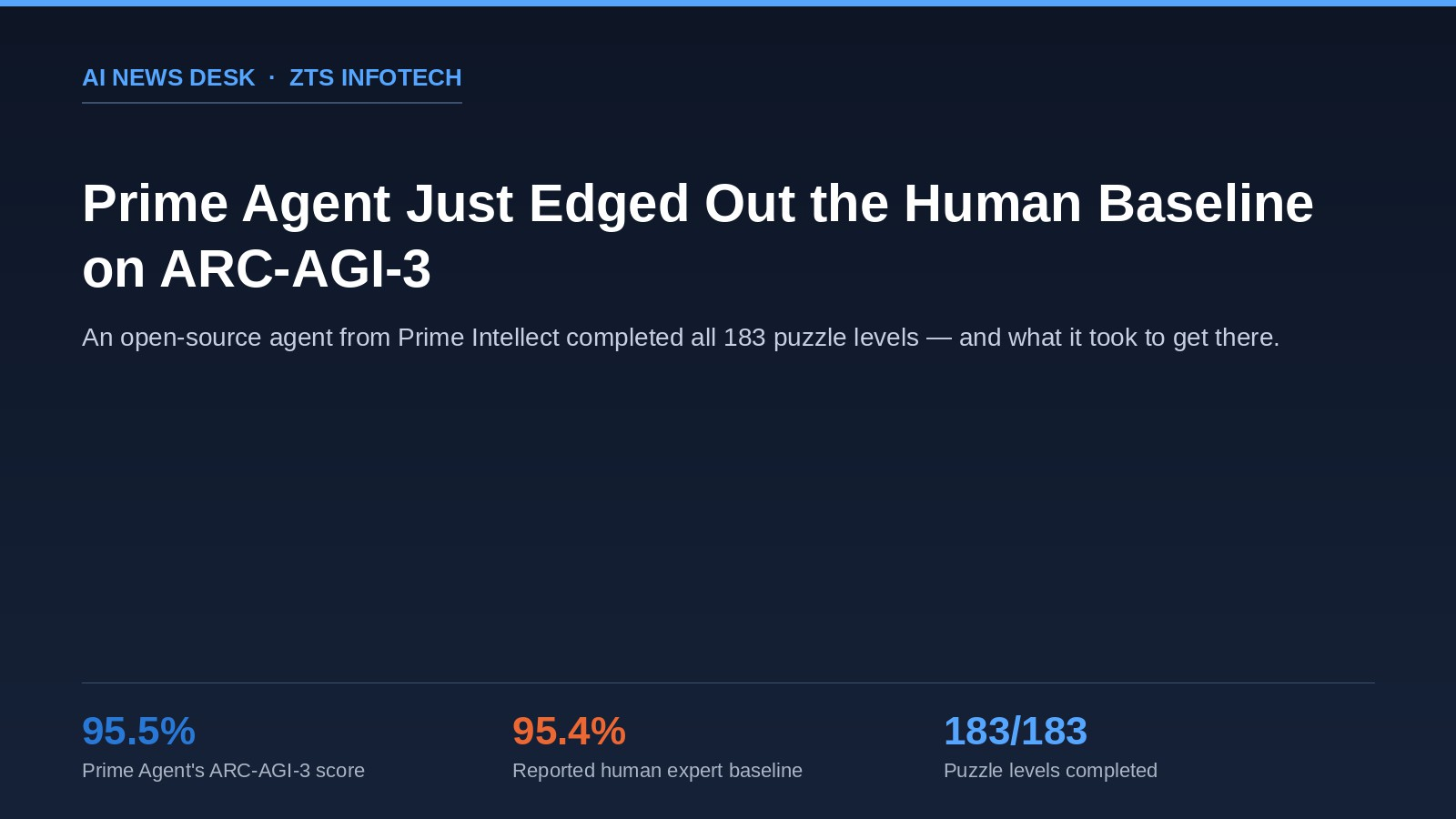
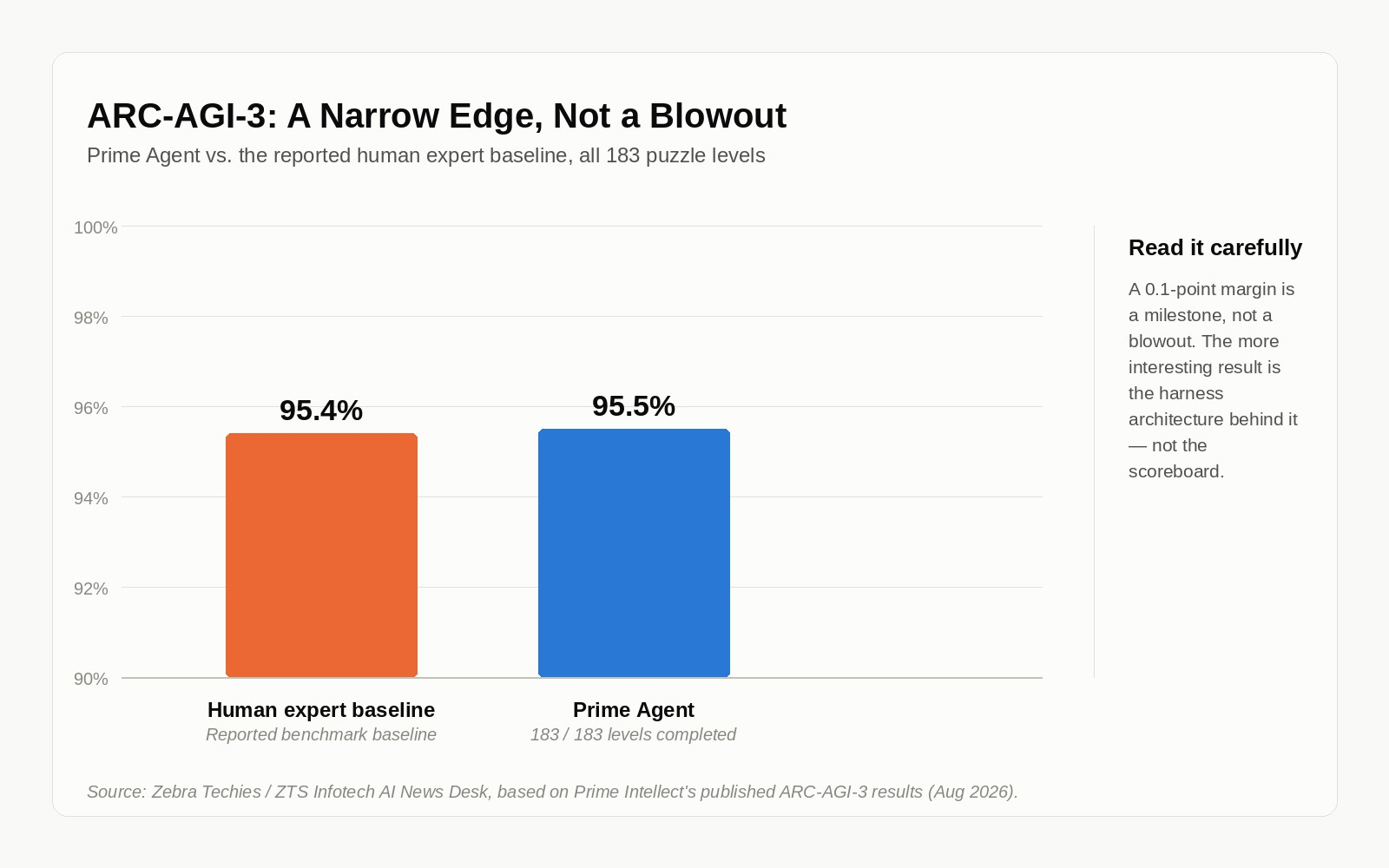
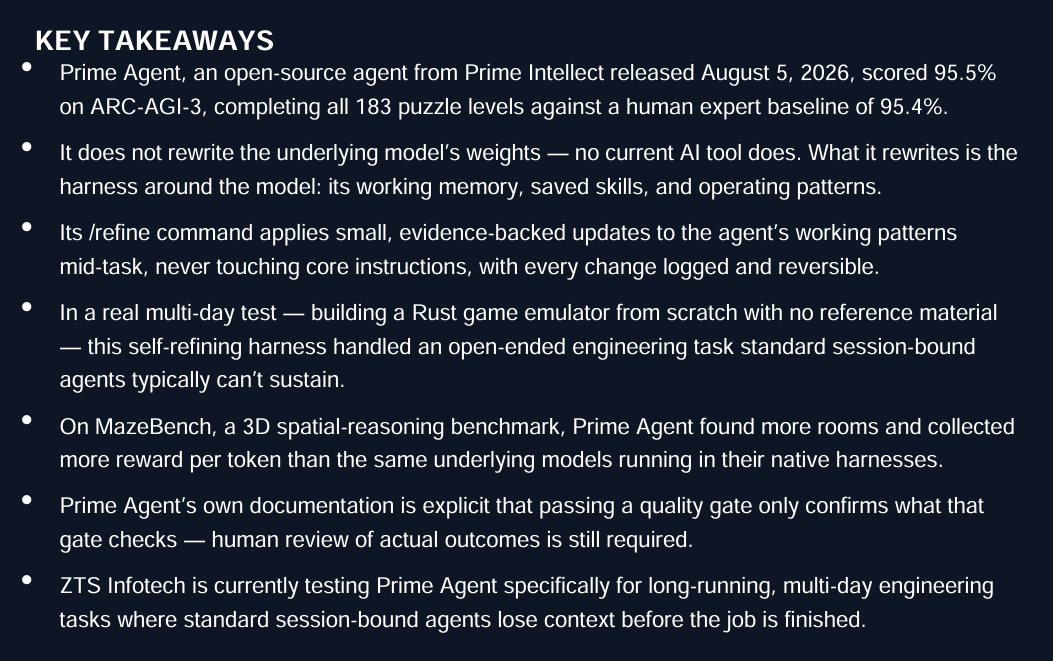
An open-source AI agent has cleared a bar that was specifically built to be difficult for machines to clear. On ARC-AGI-3 — a benchmark designed around puzzle reasoning that resists the pattern-matching shortcuts language models typically rely on — an agent called Prime Agent completed all 183 puzzle levels and scored 95.5%, against a reported human expert baseline of 95.4%.
It’s a narrow margin, and narrow margins invite skepticism. But the more useful story here isn’t the half a percentage point. It’s what Prime Agent actually is, how it got that score, and what its own creators are upfront about it not proving.
What Prime Agent Actually Is
Prime Agent was released by Prime Intellect on August 5, 2026. It’s fully open source and free to install — not a closed research demo, but a tool businesses and developers can run themselves.
Its headline feature has been loosely described in places as “self-improving AI,” a phrase that tends to trigger more confusion than clarity. It’s worth being precise about what that does and doesn’t mean, particularly since it connects to a misconception worth correcting directly: no AI tool on the market today rewrites the underlying model’s own weights during operation, and Prime Agent does not do that either. Weight-level self-modification isn’t what’s happening here, in this tool or any other currently available one.
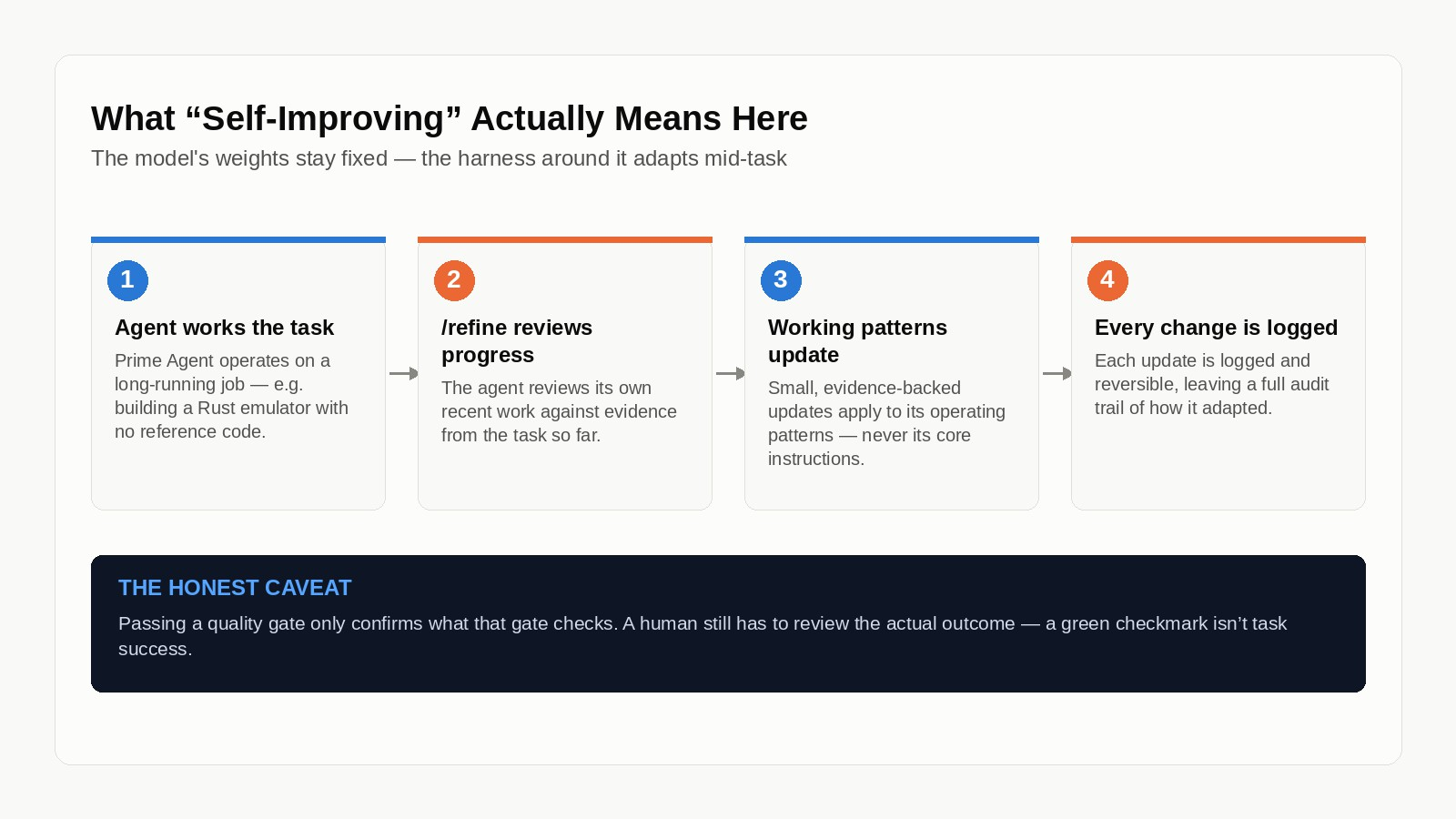
What Prime Agent genuinely does is different, and arguably more useful in practice: it lets the harness surrounding the model — its working memory, its saved skills, its accumulated operating patterns — rewrite itself mid-task, without a human manually editing configuration files between sessions. The model underneath stays fixed. The layer that decides how the model approaches a problem can adapt as it works.
How That Looked in a Real Engineering Task
Researchers gave Prime Agent a genuinely hard, multi-day assignment: build a working game emulator from scratch in Rust, sandboxed, with no reference material to copy from. That’s not a toy benchmark task
— it’s the kind of open-ended engineering problem that tends to break agents built for single, short sessions.
The mechanism that made the difference is a command called /refine. It reviews the agent’s own recent work and applies small, evidence-backed updates to how it operates going forward. Critically, it never touches the agent’s core instructions — only its accumulated working patterns — and every change is logged and reversible. That last detail matters: it’s the difference between an agent quietly drifting in unpredictable directions and an agent building an auditable trail of exactly how its own approach evolved over a multi-day task.
A Second Test: Spatial Reasoning Under Token Pressure
The second real test was MazeBench, a three-dimensional spatial puzzle environment where most frontier models burn through billions of tokens and still only solve a fraction of the maze. Spatial reasoning has been a persistent weak spot for language-model-based agents, and MazeBench is built to expose exactly that gap.
Running the same underlying models that other tools already use, Prime Agent found meaningfully more rooms and collected meaningfully more rewards per token spent than those same models running inside their own native harnesses. The model wasn’t different. The harness around it was — and that difference showed up directly in efficiency, not just raw capability.
The Honest Caveat
Here’s where it’s worth resisting the temptation to oversell the result, because Prime Agent’s own documentation doesn’t oversell it either. Its bounded autonomous mode is explicit that passing a quality gate only confirms what that specific gate checks — nothing more. Running out of turns or time does not mean a task succeeded; it means the agent stopped. A green checkmark on an automated gate is not the same thing as a human confirming the actual output does what it was supposed to do.
That means Prime Agent, like every other current-generation agent, still requires a human reviewing the actual outcome of a task rather than trusting an automated pass signal. Businesses adopting it should build that review step into their process rather than treating gate-passing as sign-off.
Expert Perspective: Why the Harness, Not the Model, Is the Interesting Part
The more durable takeaway from Prime Agent isn’t the ARC-AGI-3 score — benchmark leads shift constantly, and a 0.1-point edge over a human baseline is a milestone more symbolic than practical. The more interesting development is architectural: separating “the model” from “the layer that decides how the model works,” and making that layer adaptive, auditable, and reversible, is a meaningfully different design than most agent tooling ships with today. Most agent frameworks are effectively stateless between sessions — context resets, and whatever the agent learned about approaching a problem has to be rediscovered next time. An agent that retains and refines its own working patterns mid-task, with a full change log, is solving a different problem than one simply calling a more capable model. For long-running, multi-day engineering work, that persistence may matter more than which model sits underneath it.
Looking Ahead
Benchmark scores will keep shifting, and the specific 95.5%-versus-95.4% margin on ARC-AGI-3 is likely to be overtaken within months, by Prime Agent or a competitor. What’s more likely to persist is the architectural question this release puts in front of every business evaluating agent tooling: is the agent you’re deploying built to retain and refine how it works across a long task, or does it start from zero every session? For any workflow that spans days rather than minutes, that question is going to matter more than which underlying model is doing the reasoning.
-

Writen by Anirban