USA:
USA:  India:
 By ZTS Infotech News Desk
A 2.4-trillion-parameter open-weights model from Alibaba is beating Claude and GPT on several agentic coding benchmarks — at a fraction of the price. Here is what the verified numbers actually show, and where the frontier labs still hold their ground.
For two years, businesses building on large language models have accepted a simple trade-off: pay premium prices to Anthropic or OpenAI, or settle for a model that falls noticeably short on real engineering work. That trade-off got harder to justify this month. On August 3, 2026, Alibaba released Qwen3.8-Max, a 2.4-trillion parameter model that beats Claude and GPT on several of the benchmarks that matter most for production coding work — and does it at a fraction of the cost, with open weights arriving the same week.
This isn’t a marginal research paper claim buried in a technical appendix. It’s a model any development team can test this week, priced to undercut the frontier labs by a wide margin. For CTOs, engineering leads, and founders currently budgeting for Claude or GPT API access at scale, that combination — competitive performance plus an open-weights option — is worth pausing on before the next contract renewal.
What Alibaba Actually Shipped
Qwen3.8-Max is Alibaba’s latest flagship release in its Qwen model family, and the headline spec is scale: 2.4 trillion parameters, positioning it among the largest models currently in general availability. More consequential for buyers is the licensing model. Alibaba is releasing the weights openly this week, meaning organizations will be able to download, self-host, and fine-tune the model on proprietary codebases rather than routing every request through a third-party API. That is a structural option neither Anthropic nor OpenAI currently offers at the frontier tier.
Where Qwen3.8-Max Wins — And By How Much
The benchmark results, reported by ZTS Infotech’s AI News Desk from Alibaba’s release data, show a consistent pattern: Qwen3.8-Max isn’t just competitive, it’s ahead on several tests specifically designed to measure agentic, tool-using AI behavior rather than isolated question-answering.
Terminal-Bench 2.1 and PaperBench
On Terminal-Bench 2.1, which evaluates how well a model operates inside a live terminal environment — navigating file systems, chaining commands, recovering from errors — Qwen3.8-Max scored 86.6, ahead of both Claude Opus 4.8 and Claude Fable 5 at 84.6. On PaperBench, a tougher test of whether a model can reproduce complex research results end to end, the gap widens: Qwen3.8-Max scored 93.0, ahead of GPT-5.6 Sol at 90.5, Claude Fable 5 at 88.8, and Claude Opus 4.8 at 80.3.
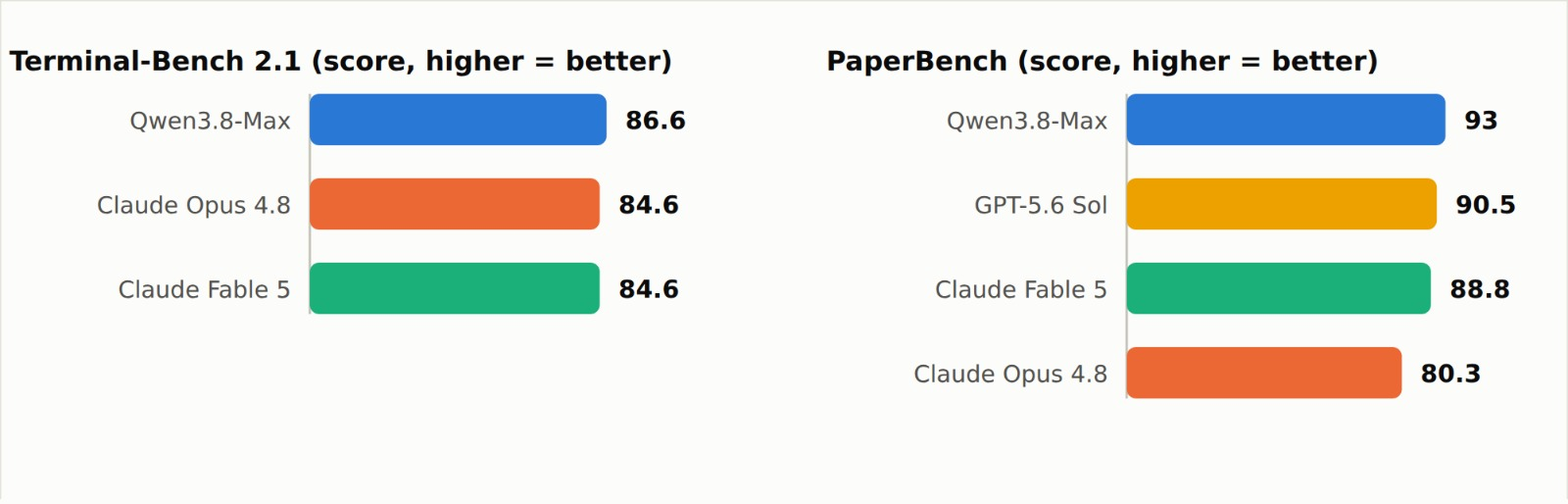
Figure 1. Qwen3.8-Max leads on Terminal-Bench 2.1 and PaperBench, two benchmarks that emphasize agentic, tool-using behavior over isolated Q&A. Source: Alibaba release data, reported by ZTS Infotech AI News Desk.
Alibaba’s own AndroidBench and coding-suite benchmarks show the same trend, with Qwen pulling ahead of GPT-5.6 Sol consistently. Taken together, the pattern points to a specific strength: terminal-driven, agentic, multi-step tasks — exactly the kind of workflow that autonomous coding assistants and DevOps automation tools now depend on.
The Number That Matters Most: Price
Benchmark scores make headlines, but pricing is what shows up in a monthly invoice. Qwen3.8-Max runs at roughly $2 per million input tokens and $6 per million output tokens. Alibaba has not published Claude or GPT’s exact comparable rates in this release, but frontier pricing from both labs runs significantly higher for comparable workloads. For a team running thousands of coding tasks a day — code review, test generation, agentic debugging — that per-token gap compounds into a materially different monthly bill, before even accounting for the option to self-host and eliminate the API cost entirely.
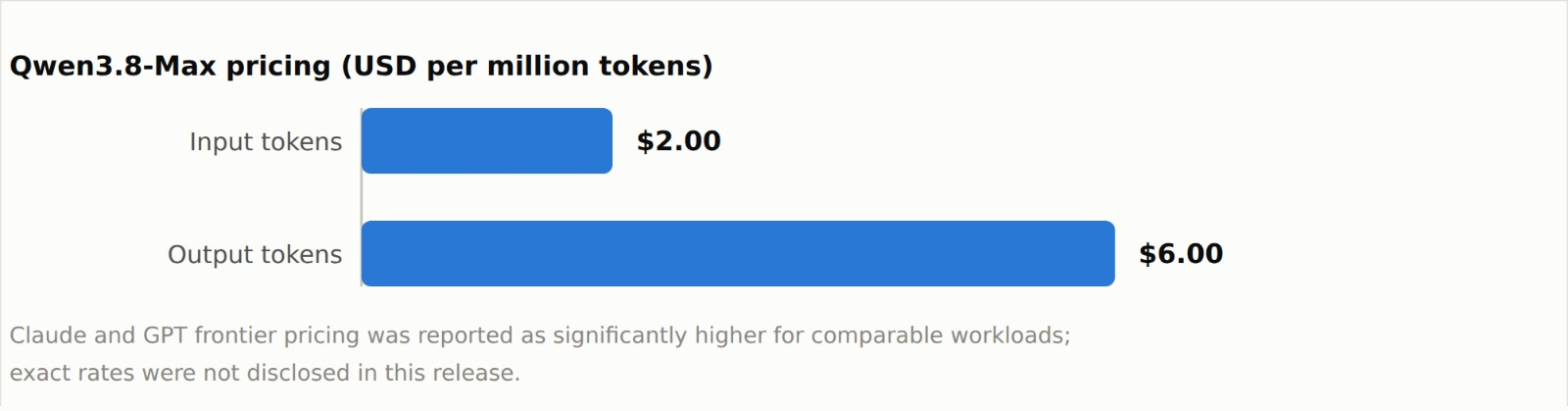
Claude and GPT frontier pricing was reported as significantly higher for comparable workloads; exact rates were not disclosed in this release.
The Honest Caveat: SWE-bench Pro
No credible read of this release claims total dominance, and the data backs that restraint up. On SWE-bench Pro — widely regarded as the hardest real-world software engineering benchmark, because it tests whether a model can resolve genuine, unsimplified GitHub issues — Claude Fable 5 still leads decisively, scoring 80.0 against Qwen3.8-Max’s 67.7.

Figure 3. Claude Fable 5 keeps a decisive lead on SWE-bench Pro, the toughest unsimplified real-world coding benchmark. Source: Alibaba release data, reported by ZTS Infotech AI News Desk.
That’s not a close gap. It suggests Qwen’s strengths are concentrated in agentic, terminal- and research-heavy tasks rather than the messiest, most ambiguous end of real-world bug fixing, where Claude’s edge remains substantial.
Bottom line for buyers: Qwen3.8-Max wins on agentic and research-heavy workloads at a much lower price. Claude Fable 5 still wins on the hardest, most ambiguous real-world engineering tickets. The right move for most teams isn’t replacement — it’s task-level routing.
Expert Perspective
The interesting story here isn’t which lab has “the best model” — that question resets every few months and always will. It’s that the market for frontier-adjacent AI coding tools now has a credible, open-weights competitor priced well below the incumbents, with verified wins on the benchmarks that map most directly to agentic developer tooling. That changes procurement conversations.
Engineering leaders no longer have to choose between “pay premium API rates” and “accept a materially worse model” — there is now a third option worth piloting: route terminal-heavy, research-heavy, and high-volume tasks to a cheaper, open-weights model, while keeping the highest-stakes, most ambiguous engineering work on the model that still wins there. Expect procurement teams at mid-size and enterprise companies to start asking vendors for task-level benchmark breakdowns, not just an overall leaderboard score, because this release proves the two don’t move together.
Key Takeaways
- Alibaba’s Qwen3.8-Max launched August 3, 2026, with 2.4 trillion parameters and open weights arriving the same week.
- Qwen3.8-Max outscores Claude Opus 4.8 and Claude Fable 5 on Terminal Bench 2.1 (86.6 vs. 84.6).
- On PaperBench, Qwen3.8-Max leads GPT-5.6 Sol, Claude Fable 5, and Claude Opus 4.8.
- Pricing runs roughly $2 per million input tokens and $6 per million output tokens — well below reported frontier rates.
- Open weights let businesses self-host and fine-tune on proprietary code, removing API dependency entirely.
- Claude Fable 5 still leads decisively on SWE-bench Pro (80.0 vs. 67.7), the hardest real-world engineering test.
- The practical takeaway is task-specific routing, not wholesale model replacement.
Conclusion
Qwen3.8-Max doesn’t end the debate over which AI model belongs in a production coding stack — it complicates it in a way that should benefit buyers. Verified wins on agentic and research-heavy benchmarks, a meaningfully lower price point, and an open-weights option together give engineering teams real leverage in a market that, until now, has largely been a two-lab conversation. ZTS Infotech’s AI team is running Qwen3.8-Max against live client coding tasks this week, focused specifically on the terminal-driven and research-heavy work where its benchmark lead is strongest. Businesses evaluating their own AI coding spend should watch this space closely — the gap between “frontier-only” and “open-weights-competitive” just got a lot smaller.
-

Writen by Anirban Das