USA:
USA:  India: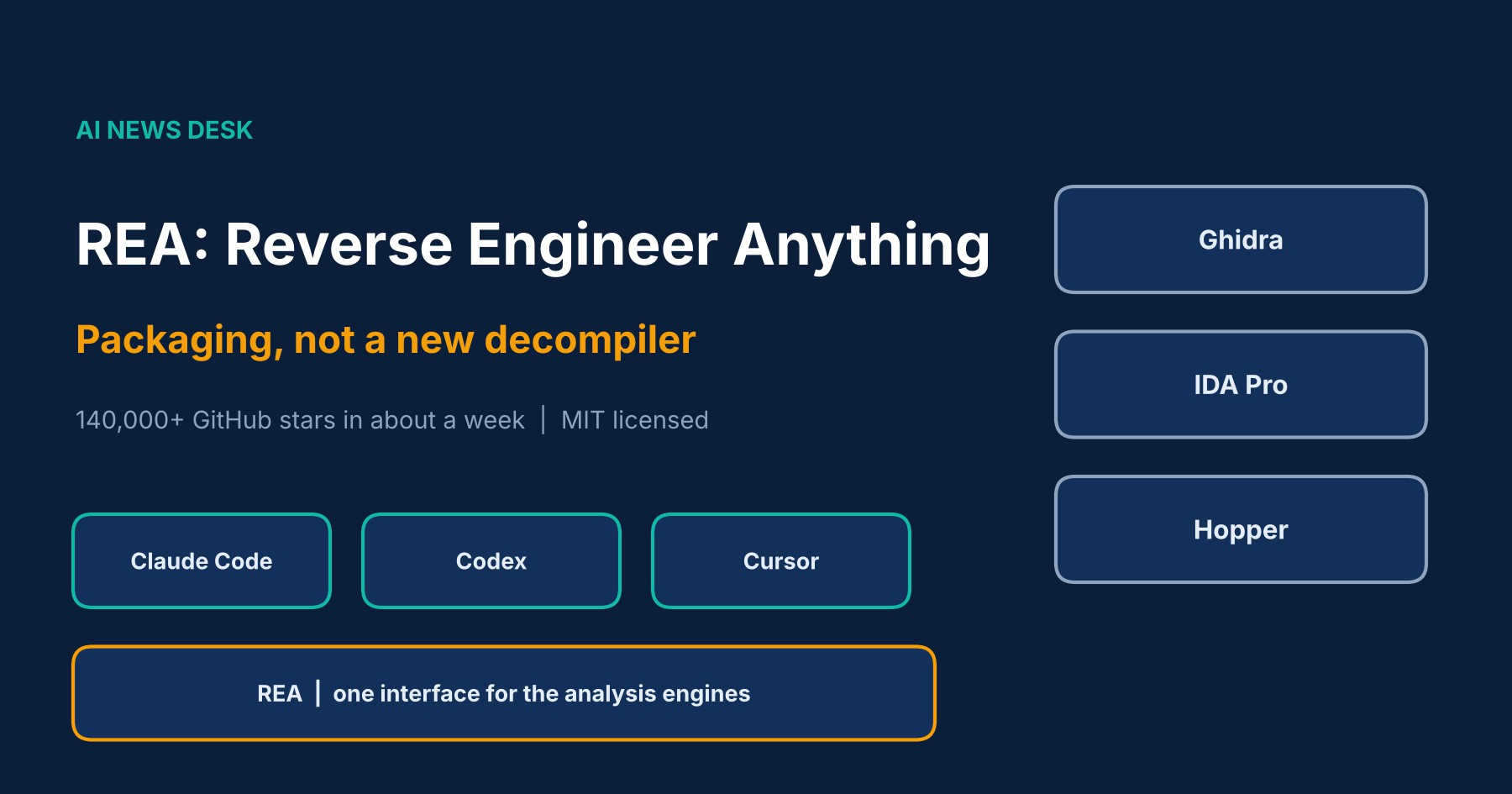
A GitHub repository called REA, short for Reverse Engineer Anything, passed 140,000 stars in about a week. The pitch is hard to ignore: hand any application to an AI coding agent and ask it to rebuild the best feature inside, with no source code required.
For business leaders, the real story is quieter than the headlines, and more useful. REA is not a new decompiler. It is a connector. Knowing the difference helps decision makers judge where it can trim the cost of legacy software work, and where it can create legal exposure instead.
What REA Actually Does
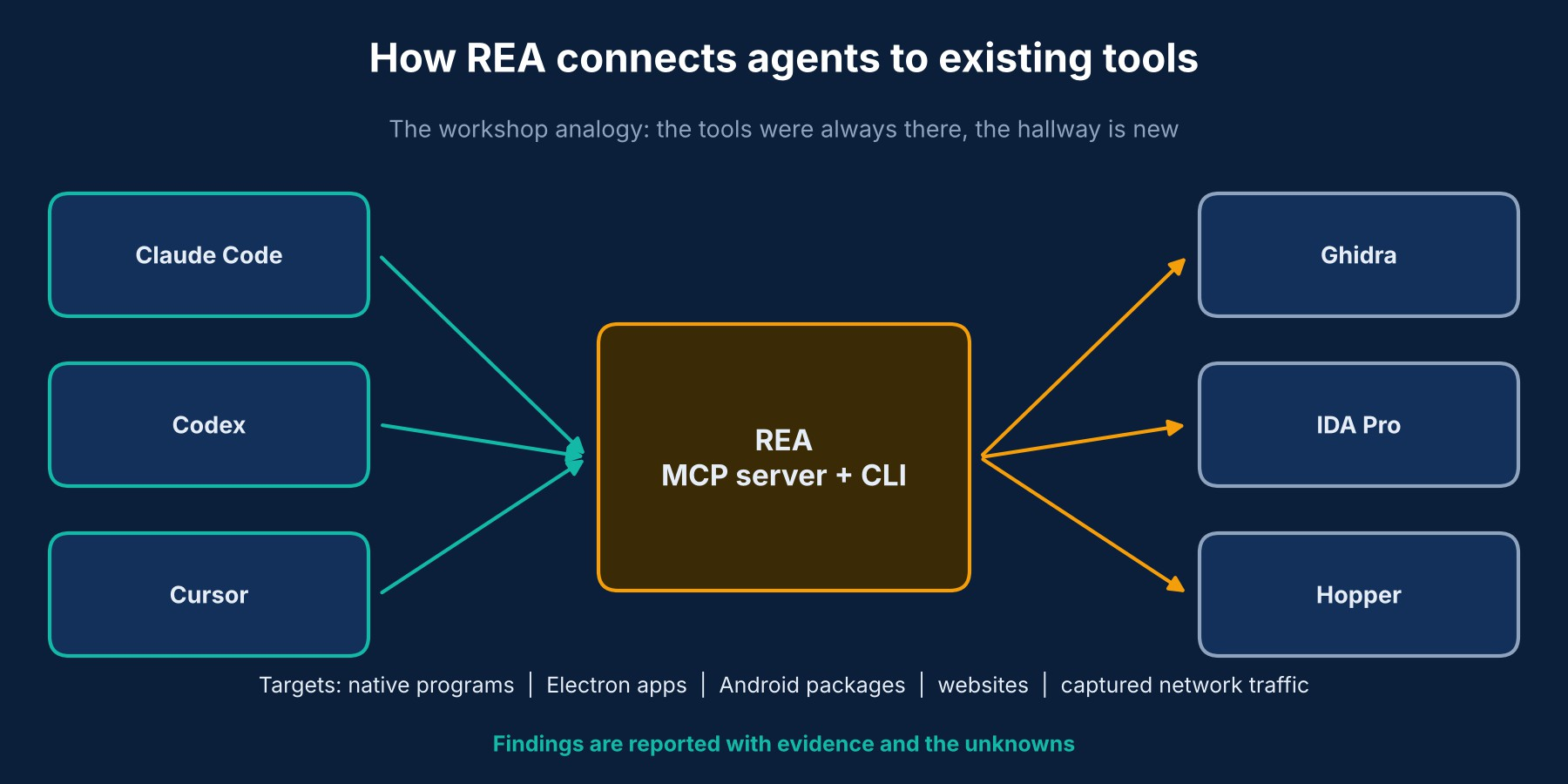
REA is an open-source MCP server and command-line tool. It lets coding agents such as Claude Code, Codex and Cursor call analysis engines that already exist. Ghidra, IDA Pro and Hopper are the best known of them. For years each sat in its own environment and called for a specialist who knew its quirks.
Picture a workshop where the finest tools were kept in separate rooms for decades. REA is the hallway that lets the agent walk between them.
What an agent can investigate
According to the project's description, the agent can be pointed at a range of targets:
- Native programs and binaries
- Electron desktop apps
- Android packages
- Websites
- Captured network traffic
How findings come back
The agent reports what it found, the evidence behind each finding, and the unknowns it could not resolve. That last element deserves attention. A report that separates confirmed facts from open gaps is far easier to act on than a confident narrative with no footnotes.
Cost and setup
The code is MIT licensed, so the tool itself carries no licence fee. Your model provider is a separate cost. The repository lists a one-line setup, npx rea-agents setup, and the guidance is sensible: review the proposed changes before approving them.
A Reality Check on the Hype
One creator put the claim to a simple test. An agent equipped with REA and a plain Claude agent with no library were each asked to rebuild the same app. The plain agent finished first, by a few minutes.
It is a single test, and it should not be read as a benchmark. Still, the lesson is fair. The tool helps. It is not magic. Executives evaluating it should budget for experiments, not miracles.
Where It Earns Its Keep: Legacy Migration
Consider a client with an old desktop inventory application. The developer who wrote it has left, and the source code is lost. Before moving the system to the web, the team needs to know how it talks to its database.
With the client's written permission, an agent can investigate that question and report back with evidence. Work like this used to require a specialist engagement. Now it can start as a supervised agent task, with human engineers reviewing what comes back.
Practical takeaways for operations and technology leads
- Confirm ownership and written permission before any analysis begins.
- Define one narrow question, such as how the application reaches its database, rather than asking for a full rebuild.
- Insist on evidence and listed unknowns in every finding, and have an engineer verify them.
Track model-provider costs from the first pilot, since they sit outside the open-source licence.
The Legal Line You Must Not Cross
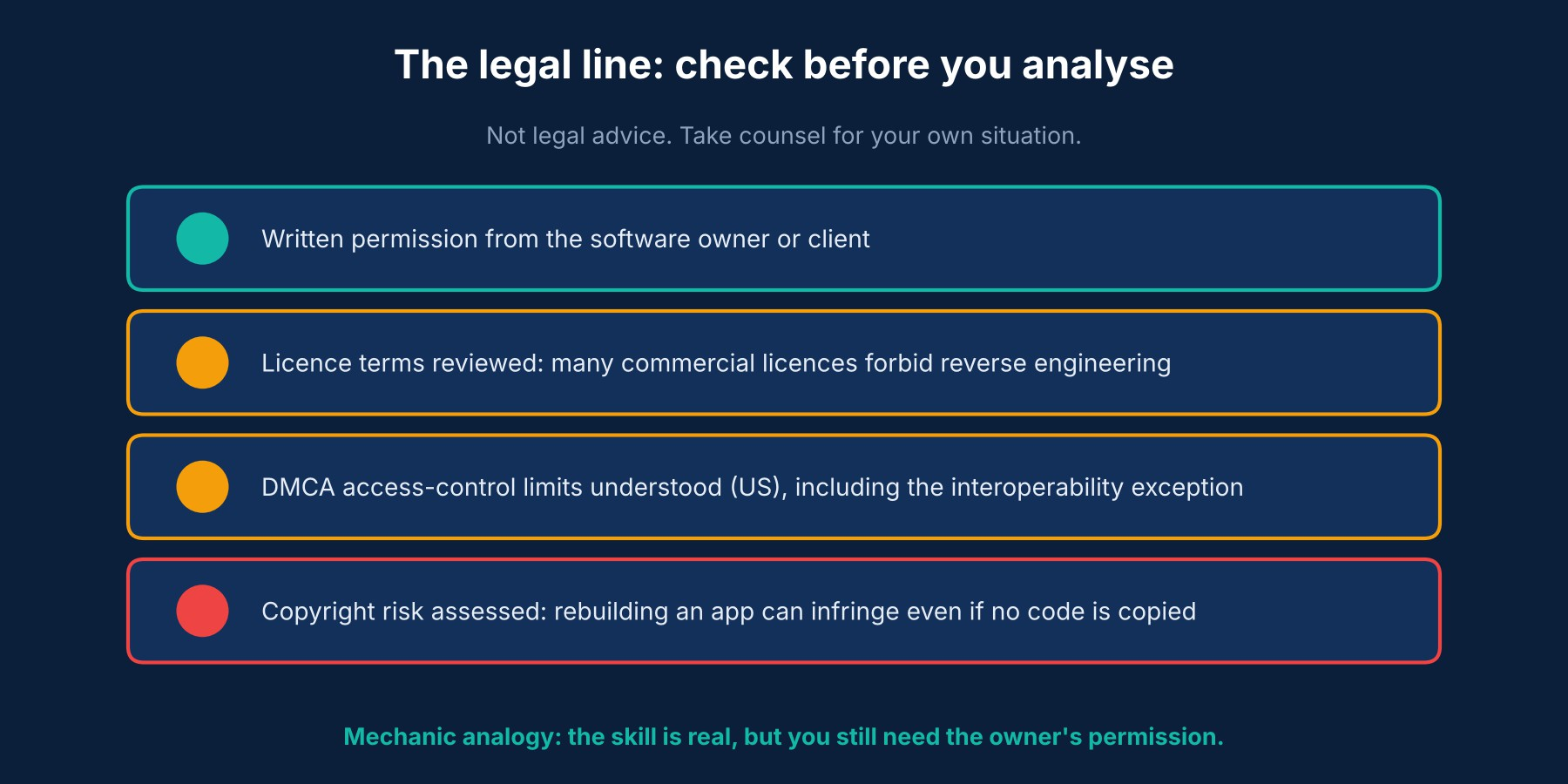
Many commercial software licences forbid reverse engineering. In the United States, the Digital Millennium Copyright Act restricts getting around access controls, with an exception for interoperability. And rebuilding someone's application can still infringe copyright even if you copy none of its code. This is not legal advice, and companies should take counsel on their own circumstances.
A mechanic who can open any sealed engine has a real skill. That does not remove the need for the owner's permission.
ZTS Infotech says it is testing REA on authorised legacy-migration work only, and never on a competitor's product.
Expert Perspective
This section is editorial analysis rather than reporting from the video.
A star count measures attention. It does not measure production readiness, and the creator's head-to-head test is a useful reminder of that gap. What REA does show is where AI tooling is heading: the value is moving from building new engines to wiring existing ones together so an agent can use them. The market impact is most visible in the discovery phase of modernisation projects. Understanding an undocumented system is often the slow, expensive start of a migration. If agents shorten it, agencies and in-house teams can scope legacy work with firmer numbers.
The differentiator, though, will be governance. Teams that document permission, scope and verification will move faster than those that treat the tool as a shortcut. We expect procurement and legal teams to start asking vendors how they use such tools, and the agencies with clear answers will be better placed.
Key Takeaways
- REA, short for Reverse Engineer Anything, passed 140,000 GitHub stars in about a week.
- It is packaging, not a new decompiler: one interface to engines such as Ghidra, IDA Pro and Hopper.
- It works with coding agents including Claude Code, Codex and Cursor, and is MIT licensed; model costs are separate.
- Agents report findings with evidence and the unknowns, which supports human verification.
- In one creator's test, a plain Claude agent beat an agent with REA by a few minutes.
- A strong use case is legacy migration where source code is lost, with written client permission.
- Licence terms, DMCA access-control rules and copyright all apply. Seek legal advice.
What to Watch Next
Expect more connectors like REA, and more scrutiny of how they are used. For leaders weighing a legacy modernisation, the sensible path is a small, authorised pilot with clear scope and human review. Follow the ZTS Infotech News Desk for verified updates on AI and developer tools as this space develops.
-

Writen by Anirban