USA:
USA:  India: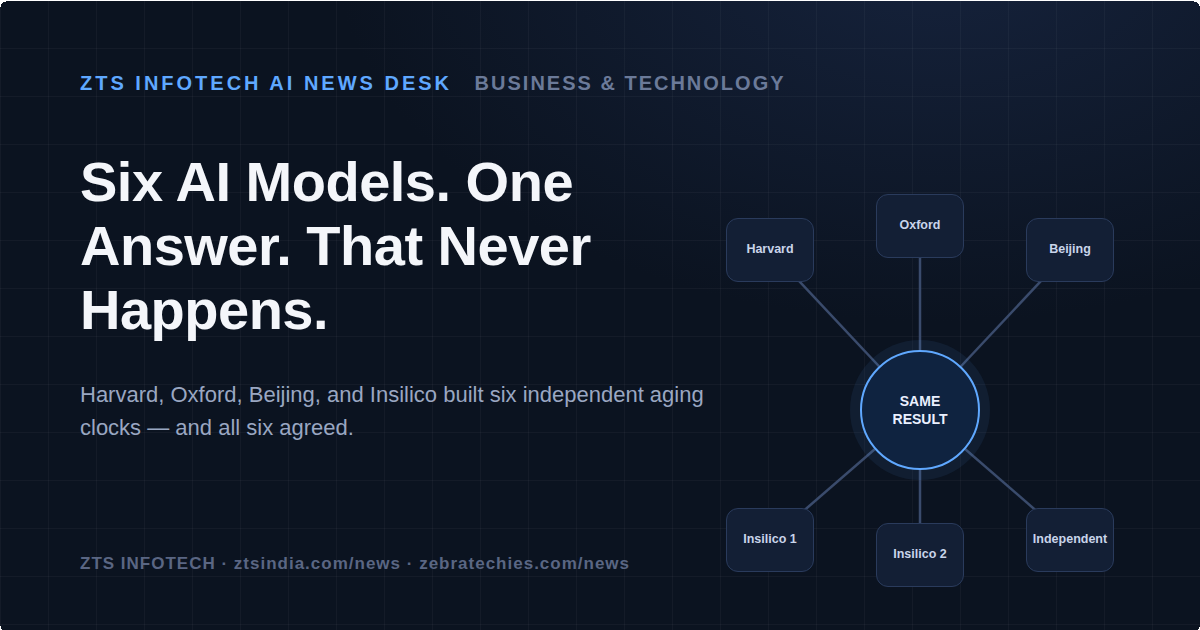
When Six Rival AI Models Agree, That Is the Story
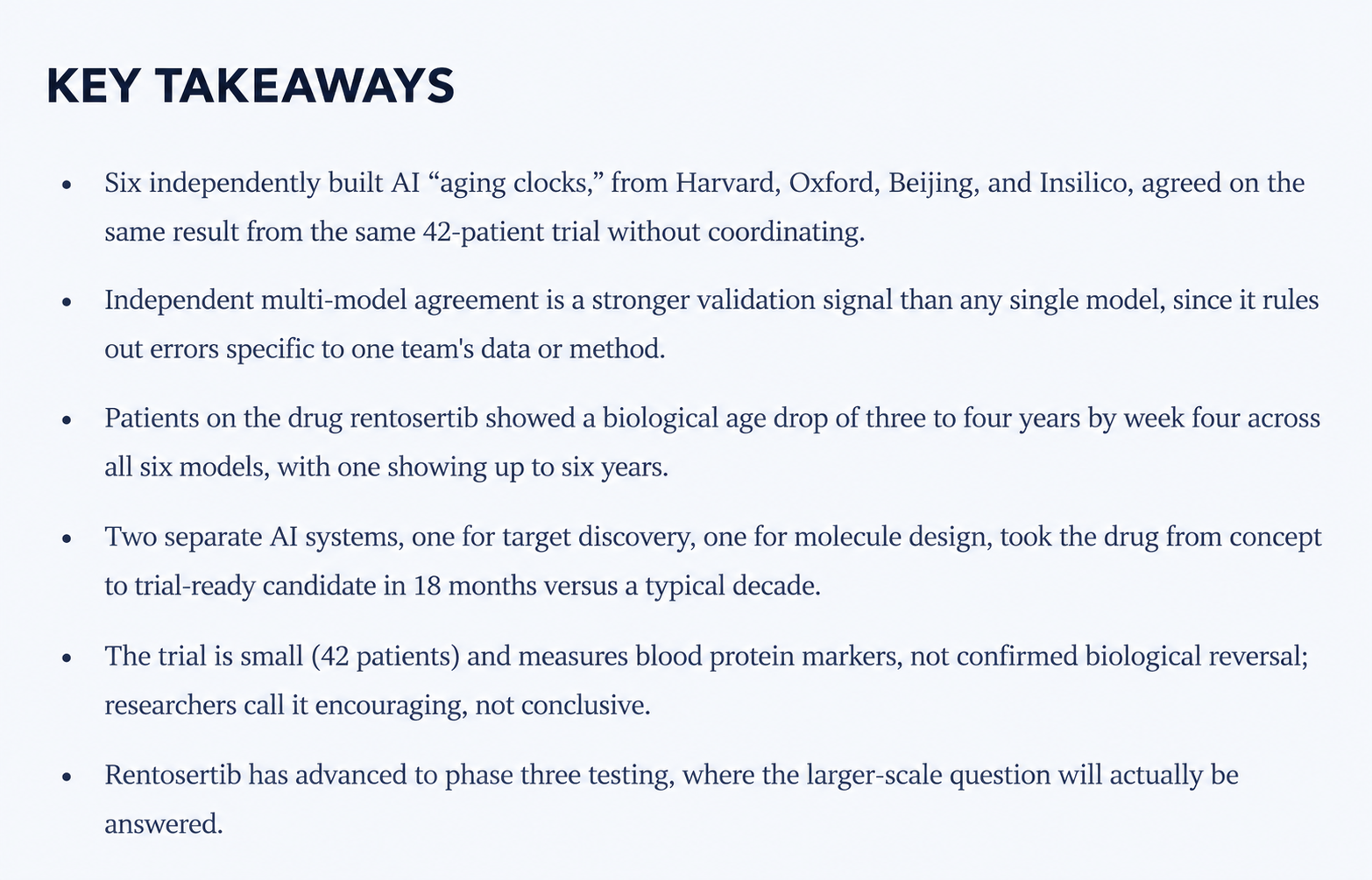
Independent research groups rarely agree on anything in biology, let alone six of them working from different data, different methods, and no coordination. But that is what happened when teams from Harvard, Oxford, Beijing, and drug developer Insilico Medicine each built their own “aging clock” — an AI model that estimates how old a person's body actually is, biologically, from a blood sample. Given results from the same 42-patient trial, all six models pointed to the same conclusion.
That convergence, more than the drug it was measuring, is what should catch the attention of business leaders watching how fast AI is moving from research curiosity to operational tool. Six models built for different purposes, some tuned for chronological age, others for mortality risk, arrived independently at matching numbers. In a field where a single study result is often treated with caution, six-way agreement is close to unheard of.
Six Appraisers, One House, No Conversation
The clearest way to understand why this matters is the comparison ZTS Infotech's AI news desk uses:
imagine six independent appraisers, who have never spoken to each other, each valuing the same house and landing within a few thousand dollars of one another. That is not coincidence. It suggests something real and measurable is underneath the estimate, rather than an artifact of one team's particular model or dataset.
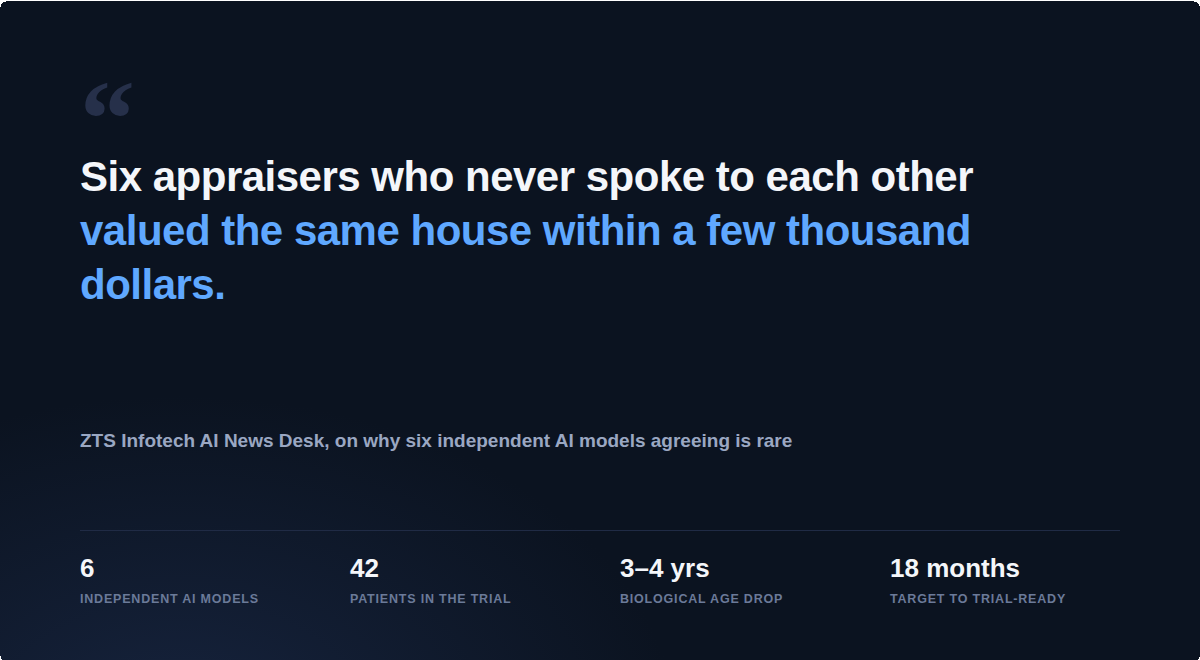
What all six clocks were measuring was the effect of rentosertib, a drug developed for idiopathic pulmonary fibrosis, a scarring lung disease. Patients taking the drug showed a biological age drop of three to four years by week four, according to every one of the six models. One clock measured a drop as large as six years. Six differently built instruments, pointed at the same 42 patients, reading the same direction.
The Drug Took 18 Months. That Is the Part Executives Should Notice.
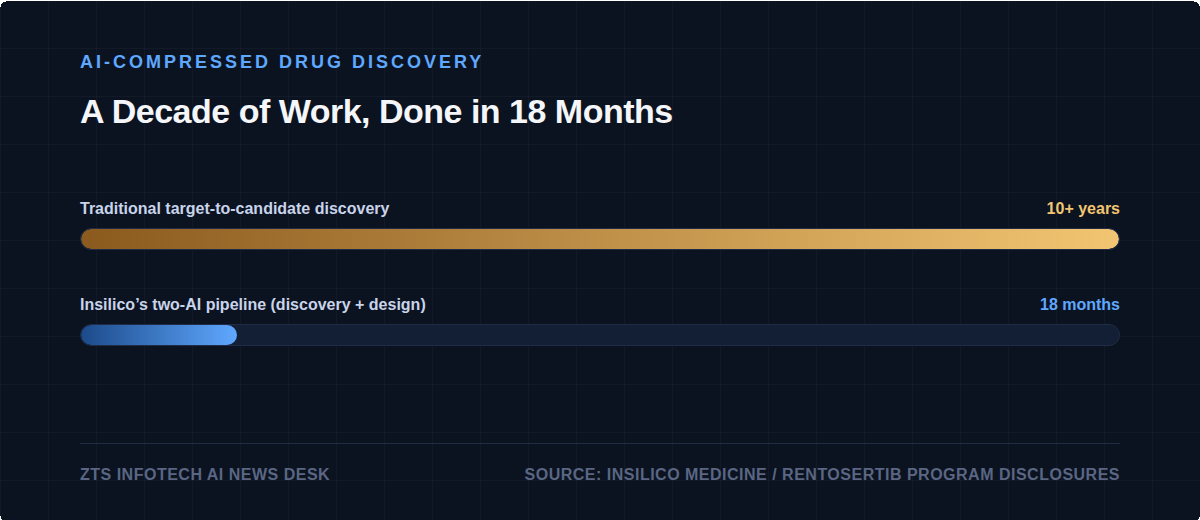
Where rentosertib came from is arguably the more consequential business story. Insilico's AI system reviewed existing medical research and health data and identified TNIK, a protein already linked to six separate biological aging pathways. A second, entirely different AI system then designed a custom molecule built specifically to act on that protein. From target identification to a drug candidate ready for trials took eighteen months.
Traditional drug discovery for a new molecular target typically takes over a decade. That gap, a decade versus a year and a half, is the number worth sitting with. It represents two distinct AI systems handling two distinct jobs, discovery and design, each compressing a stage of the pipeline that has historically been the slowest and most expensive part of bringing any new therapy to market.
The Honest Caveat, Stated Plainly
None of this is being oversold by the researchers involved, and it should not be oversold here either. Forty-two patients is a small trial. What the six clocks detected were shifts in blood protein markers, not independent proof that patients biologically got younger in any complete sense. Researchers describe the result as encouraging, not conclusive, and rentosertib has now moved into phase three testing, the stage designed to answer exactly that question at scale.
Expert Perspective
What makes this story worth tracking is not the drug alone but the structure of the evidence around it. Six independently built models agreeing is a stronger signal than any single model's output, because it rules out the most common failure mode in AI-driven research: a model finding a pattern that exists only inside its own training data. When methodologically unrelated systems converge on the same answer, the odds that they are all making the same mistake drop sharply.
For business leaders, the more transferable lesson sits in the second half of the story. Two AI systems, one for discovery and one for design, took a process that reliably consumes a decade and delivered a testable candidate in under two years. That is not a promise that every AI-accelerated pipeline will move this fast,and the small trial size is a real limit on what can be claimed today. But it is a concrete, verifiable example of AI systems doing two different kinds of intellectual work in sequence, discovery and verification, each cutting a timeline that used to be measured in years down to months. Expect more industries, not just pharmaceutical research, to look at this kind of multi-model, cross-checked approach as a template for validating AI output before acting on it.
Looking Ahead
Rentosertib's phase three results, whenever they arrive, will matter less as a verdict on one drug and more as a test of the method behind it: AI systems handling discovery and design in sequence, checked against each other by independent models rather than trusted on the strength of one. That combination, speed paired with cross-validation, is the part likely to spread beyond biotech. ZTS Infotech's AI news desk will keep watching how these dual-AI pipelines perform as more candidates reach later-stage trials, and what it takes for a result this early to hold up at scale.
-

Writen by Anirban