USA:
USA:  India: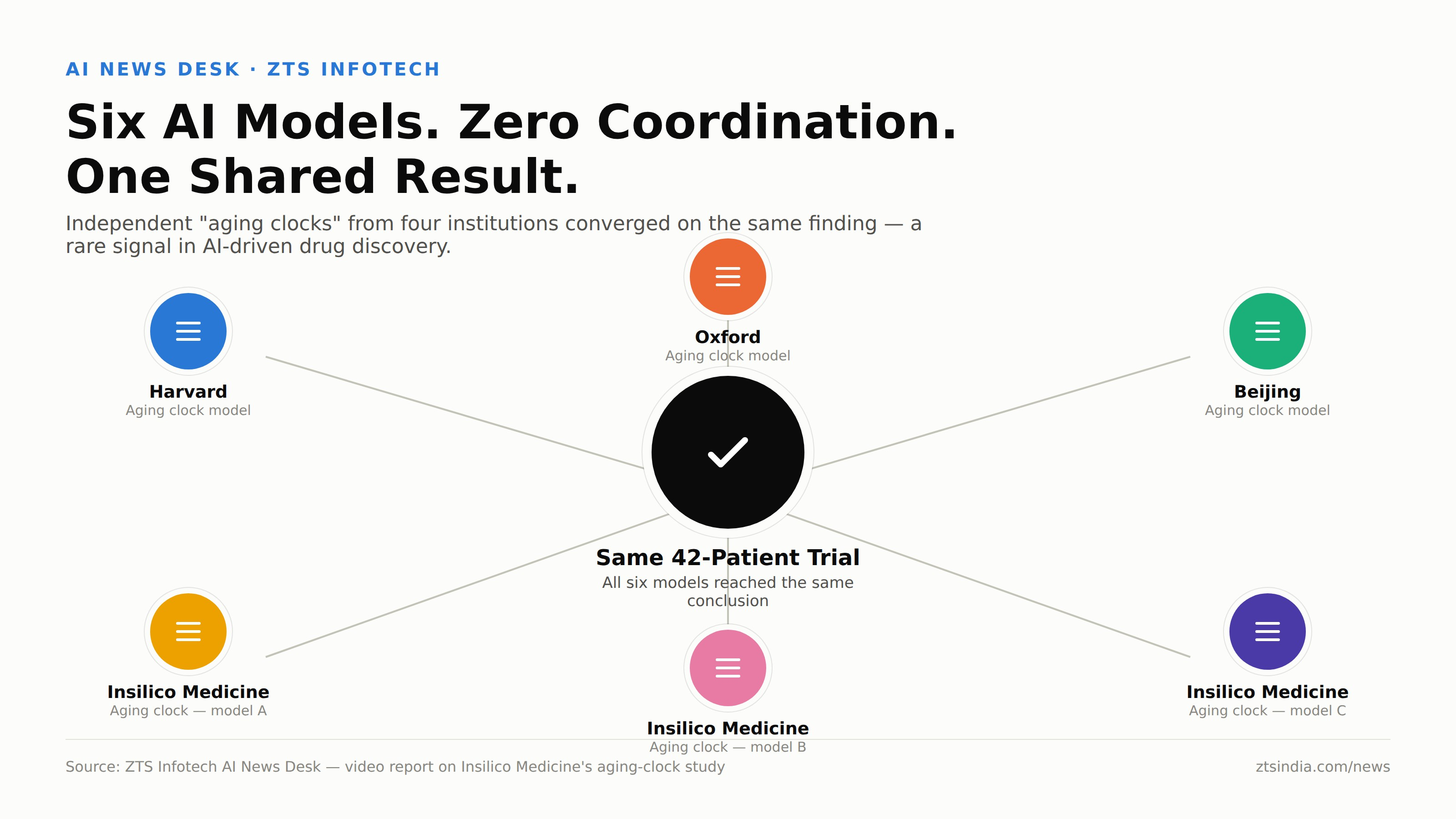
When Six AI Systems That Never Spoke to Each Other Reach the Same Conclusion
Independent verification is the quiet engine behind good science and good business decisions alike. It is also hard to get from artificial intelligence, where different training data and modeling assumptions tend to produce different answers. That is what makes a recent result out of the longevity-research world worth a second look from anyone tracking where AI is delivering, rather than promising, value.
Four research groups — teams at Harvard, Oxford, and in Beijing, alongside AI-drug-discovery company Insilico Medicine — each built their own “aging clock,” an AI model trained to estimate biological age from blood protein markers. The efforts used different training data and methodologies; some targeted chronological age, others mortality risk, and none of the teams coordinated with one another. Run against blood samples from the same 42 patients, all six clocks pointed to the same conclusion — a level of agreement that is unusual enough to merit scrutiny.
What the Aging Clocks Actually Measure
An aging clock does not read a calendar; it reads biology. By scoring blood proteins tied to cellular aging, these models estimate how “old” a person’s physiology looks, independent of birth date. If a therapy can measurably shift that score, it offers an early readout on whether treatment is working, long before a slower clinical endpoint could confirm it.
Picture six appraisers who have never met, independently valuing the same house and landing within a narrow range of each other. A single model reaching a striking conclusion could be an artifact of its own design choices; six differently built models converging on the same number suggests something real is being measured.
The Drug Behind the Data: Rentosertib
The therapy under test is rentosertib, developed for idiopathic pulmonary fibrosis, a progressive
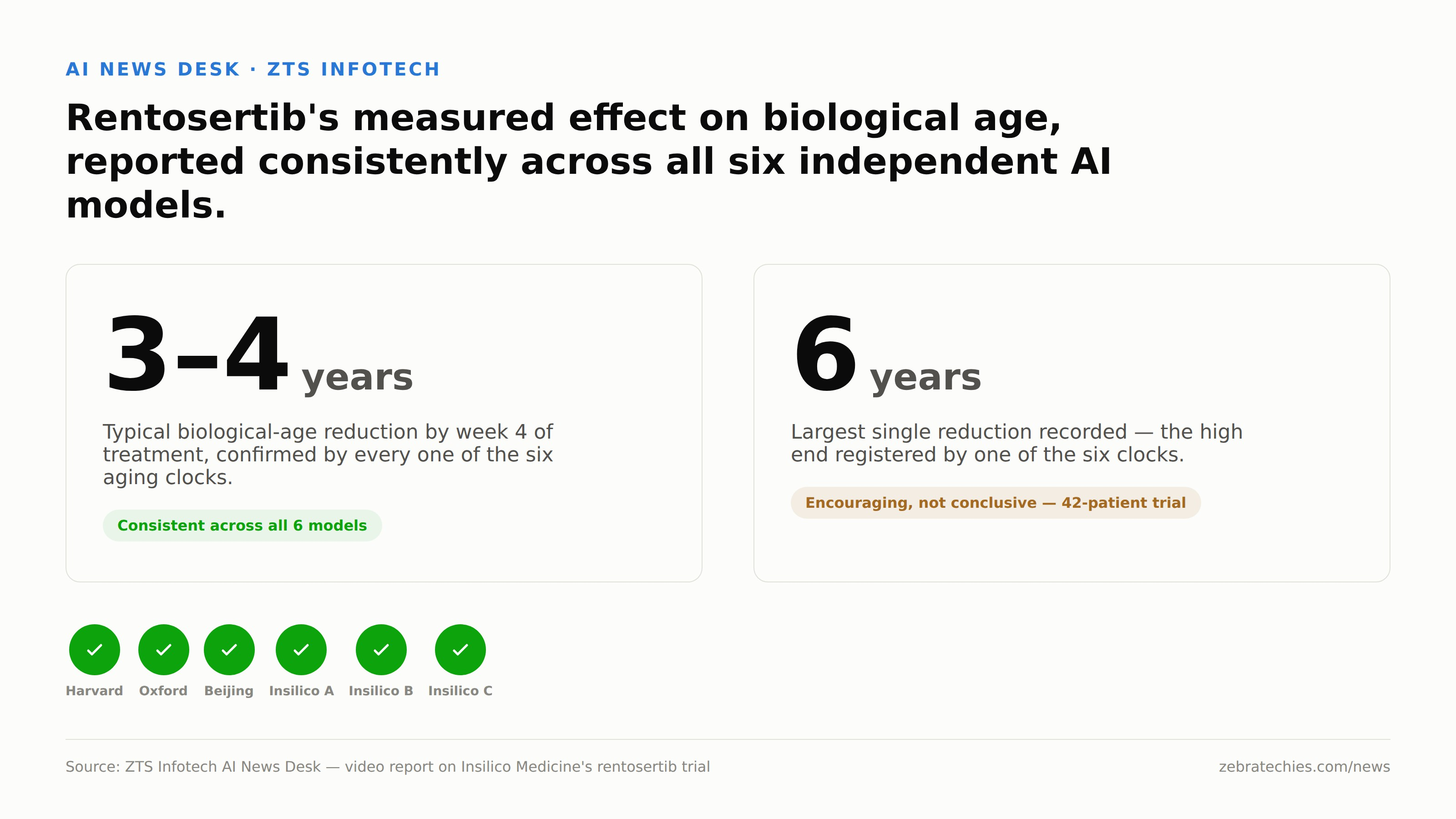
lung-scarring disease. Patients on the drug showed a biological age reduction of three to four years by week four, according to every one of the six clocks; one clock registered a shift as large as six years.
From Target to Trial in 18 Months
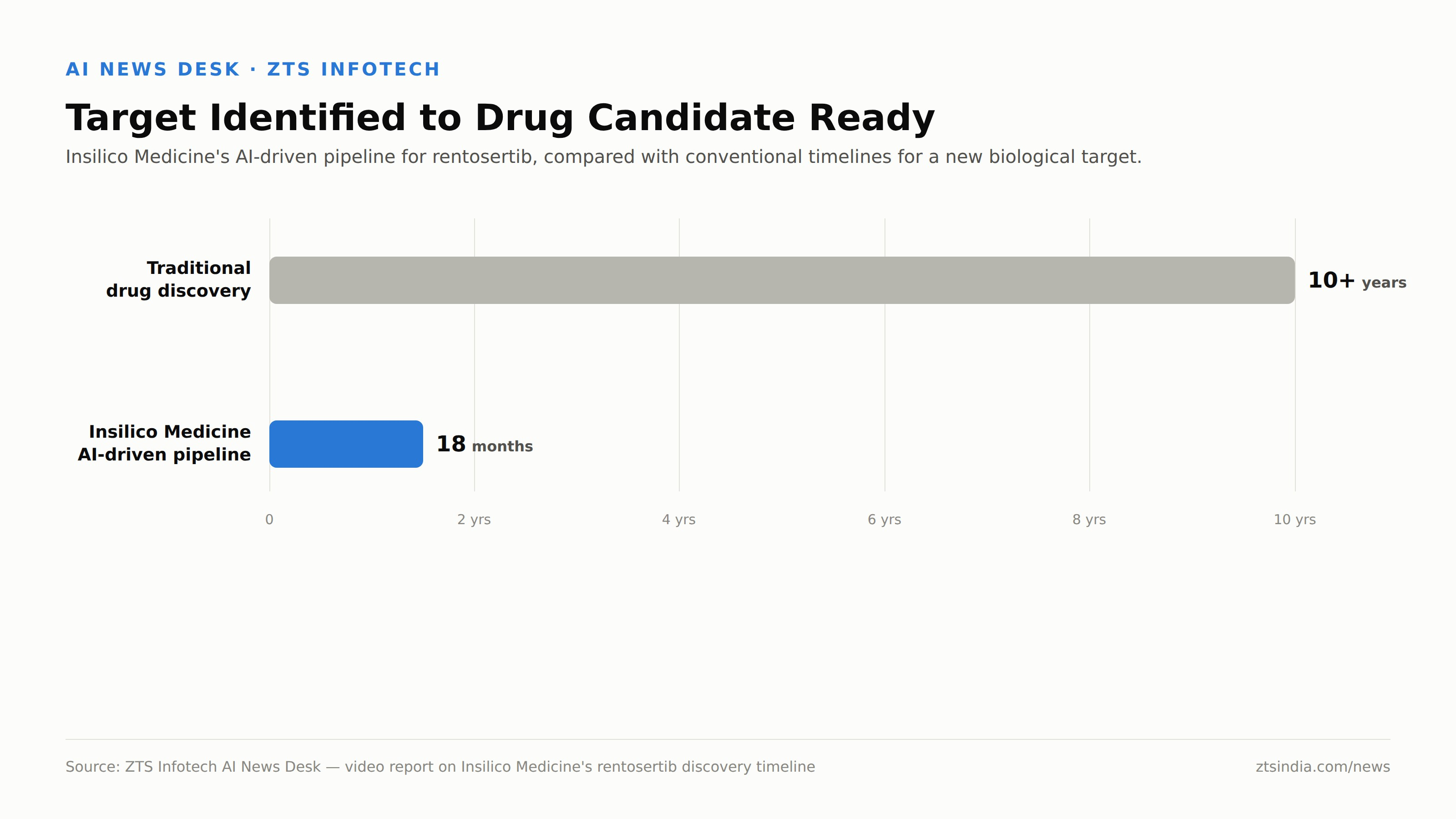
The more consequential business story is how rentosertib came to exist. Insilico Medicine’s AI systems first scanned existing medical research to flag a specific protein, TNIK, already implicated in six distinct aging pathways. A second, separate AI system then designed a custom molecule to act on that protein. The distance from identifying the target to a drug candidate ready for testing was eighteen months — against a decade or more for conventional discovery of a new biological target.
Why This Matters for Business Leaders
For executives outside biotech, the takeaway is not “invest in aging clocks.” It is a working case study in what AI-compressed R&D timelines look like once they leave the pitch deck and reach a clinical trial. Pharmaceutical development is among the most regulated, capital-intensive R&D processes in any industry, and it is now producing evidence, not projections, that AI can cut years out of the front end of that pipeline.
Discovery and Verification, Compressed
The pattern splits into two capabilities that generalize well beyond biotech: AI systems that generate a hypothesis or design, and separate AI systems that verify the result independently. Any organization evaluating where AI can shorten its own R&D cycle should ask the same questions Insilico’s teams effectively answered here — where can a model generate candidates faster than a human team, and where can a second, independent model confirm the result without sharing its assumptions?
The Caveats No One Should Skip
None of this is a green light to treat the science as settled, and the researchers are not claiming otherwise. Forty-two patients is a small trial, and a shift in blood protein markers is not independently confirmed proof that patients biologically got younger. Researchers describe the result as encouraging, not conclusive, and rentosertib has now moved into Phase 3 testing to see whether the early signal holds up at scale.
Expert Perspective
The business significance here is less about longevity medicine than about what it demonstrates regarding AI’s reliability under independent scrutiny. Skepticism about AI-generated results is well earned; models trained on overlapping or biased data can produce confident answers that don’t hold up. What changes the calculus is the structure of the test itself — six models, four institutions, zero coordination, one result. That is a harder bar to clear than a single vendor’s benchmark, and it should carry more weight in enterprise AI decisions than a demo or a press release.
The more durable signal is the 18-month timeline. Drug discovery has been one of the slowest, highest-cost corners of corporate R&D for decades, largely immune to software-driven speedups. If AI
can compress even the early stages of that process, the implication for other long-cycle, high-cost R&D functions — from materials science to complex engineering — is that the compression is structural, not sector-specific. The Phase 3 outcome will determine whether rentosertib itself succeeds; it won’t undo the fact that the discovery pipeline behind it already ran several times faster than the industry norm.
Key Takeaways
- Six independent AI “aging clocks” from Harvard, Oxford, Beijing, and Insilico Medicine agreed on the same result in a 42-patient trial.
- Rentosertib cut biological age by three to four years by week four on every clock; one clock showed up to six years.
- Insilico’s AI identified the drug’s protein target, TNIK, and designed the candidate molecule in 18 months, versus a decade-plus conventionally.
- The result pairs two distinct AI capabilities: hypothesis generation and independent verification.
- Researchers call the finding encouraging, not conclusive; the trial is small, and rentosertib has now advanced to Phase 3.
- The clearest business lesson is process-level: AI-compressed R&D timelines are showing up in outcomes, not just vendor projections.
- Leaders evaluating AI for R&D should look for that same pairing — a generative model plus independent verification — not a single model’s output taken at face value.
Conclusion
Rentosertib’s Phase 3 trial will take time to read out, and biological age will likely stay a contested, evolving science for years. What is already on the record is harder to dismiss: four institutions, six models, one independently confirmed result, produced through a discovery pipeline that moved several times faster than industry norms allow. Leaders tracking where AI investment is translating into measurable outcomes should watch how this trial, and the process behind it, develops from here.
-

Writen by Anirban Das