USA:
USA:  India:
.jpg)
Tesla stopped trying to build a robot that does backflips and started trying to build one that can pick up an egg without breaking it. That shift in priorities is the real story behind Optimus Gen 3, and it says more about where humanoid robotics is headed commercially than any dance routine could. While competitors have spent two years showing robots running, dancing, and doing kung fu on stage, Tesla went the other direction: delicate, repeatable work, because that is what actually gets paid for on a factory floor. Behind the headline number — Elon Musk’s claim that Optimus could eventually run at roughly a dollar an hour — is a hardware story and a cost breakdown worth examining before any business treats it as a planning input.
From Spectacle to Utility: A Deliberate Strategic Pivot
The contrast Tesla is drawing is explicit. Chinese humanoid robotics competitors have leaned heavily on demonstrations designed to impress an audience — running, dancing, martial arts routines. Those demos are compelling on stage and largely irrelevant on a production line, where the actual value comes from a robot that can perform the same delicate, repetitive task thousands of times without variance. Optimus Gen 3 is built around that second goal: dexterity and reliability over athleticism.
The Hardware Behind the Dexterity
The Hand Redesign
The headline upgrade is in the hands. Gen 3 doubles hand dexterity from 11 degrees of freedom to 22, with 50 actuators relocated out of the palm and into the forearm, pulling each finger through cable tendons in a design that mirrors how a human arm works. Internal sensors have nearly tripled. The stated result: a robot that can lift 18 kilograms while still handling something as fragile as an egg without crushing it.
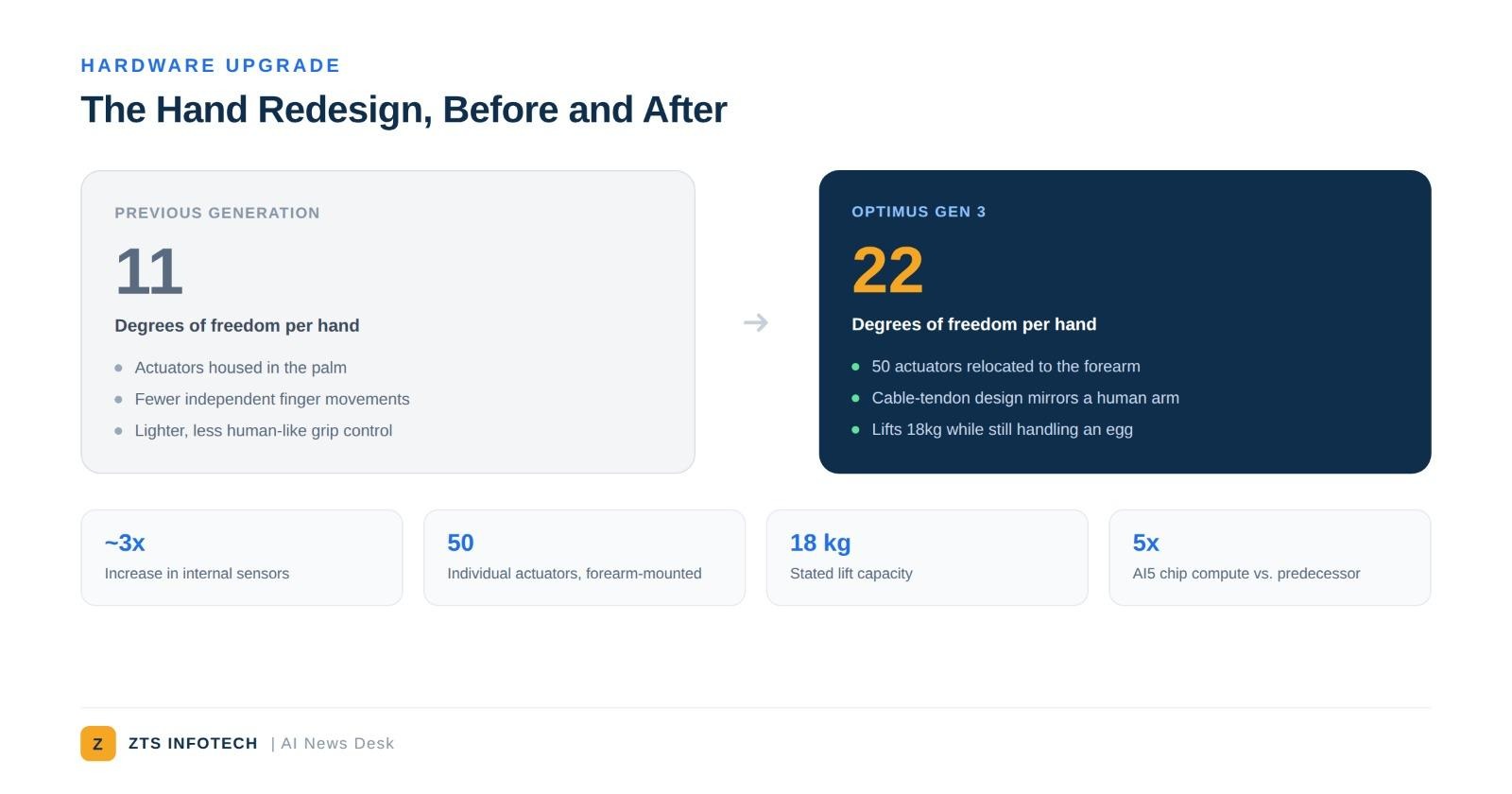
The hand redesign, before and after — 11 to 22 degrees of freedom, actuators moved to the forearm.
What’s Confirmed — and What Isn’t
One clarification: independent coverage notes the 22-degree-of-freedom hand upgrade was first demonstrated in late 2024, initially fitted to Tesla’s existing Gen 2 body — some industry tracking distinguishes that hand upgrade from a fully redesigned “V3” body built for mass production. Tesla also hasn’t officially confirmed Gen 3’s final weight, height, or complete spec sheet. The hardware picture is substantially real but not fully finalized.
The AI5 Chip and the Fleet Learning Loop
The AI5 Chip
Powering the system is Tesla’s new AI5 chip, offering roughly five times the compute bandwidth of its predecessor — enough to process vision, touch, and force feedback simultaneously while holding a live conversation through Grok integration. Worth noting: reporting on Tesla’s chip roadmap indicates AI5 only taped out in April 2026, with volume production targeted for 2027, so the earliest Gen 3 units may not ship with the finalized production chip.
The Fleet-Learning Loop
The more interesting mechanism is how Optimus learns. Each unit watches online tutorials and shadows real workers on Tesla’s Fremont factory floor. Whatever one robot learns gets uploaded to a central model and pushed to every other unit overnight — one robot’s Tuesday becomes every robot’s Wednesday, without each unit relearning the task from scratch.
The Honest Math Behind $1 an Hour
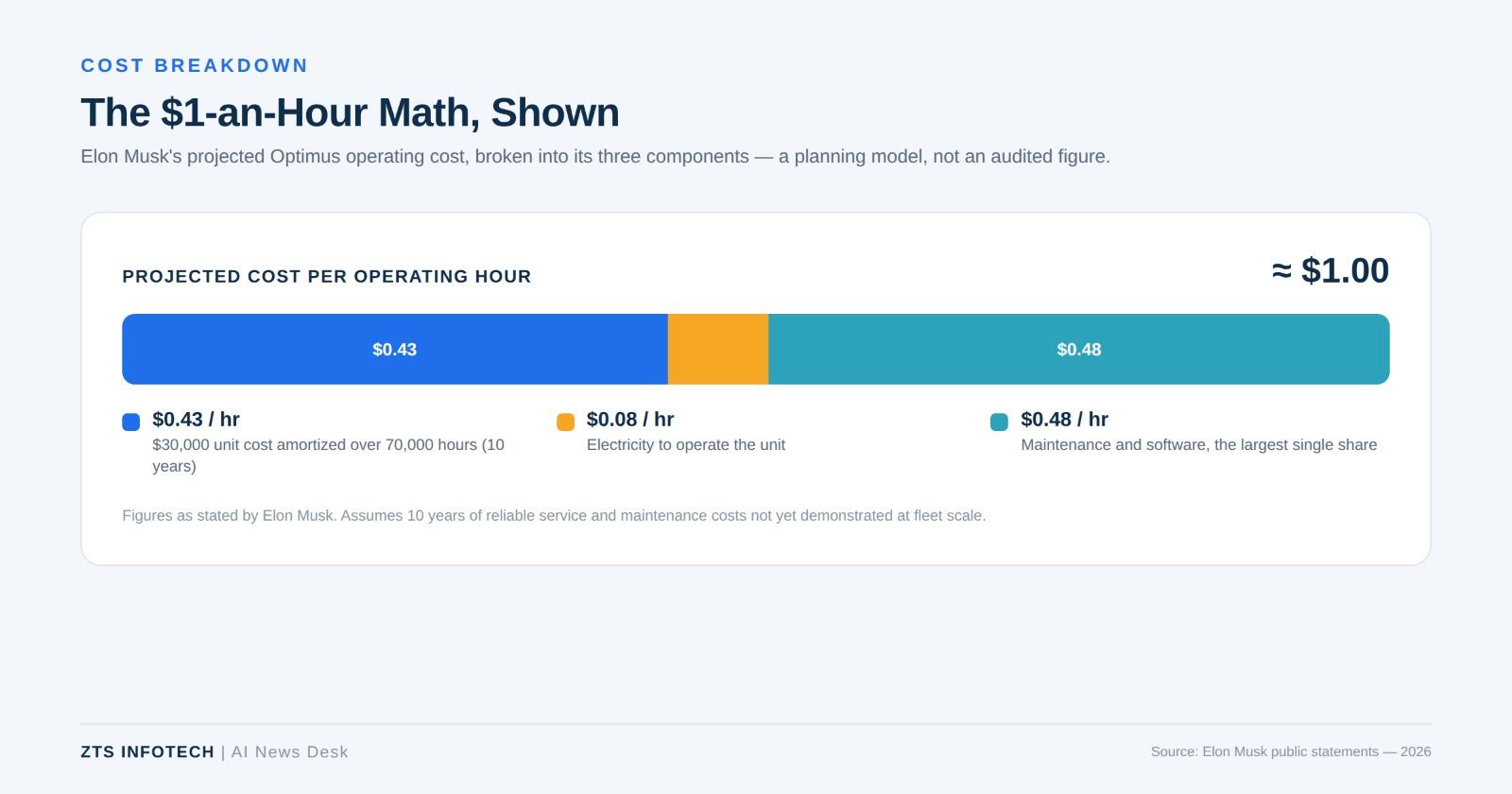
The $1-an-hour math, shown — amortized hardware, electricity, and maintenance (a planning model, not audited).
Musk’s operating-cost claim breaks down as follows: a $30,000 unit cost amortized across 70,000 operating hours over ten years works out to roughly $0.43 per hour. Electricity adds about $0.08. Maintenance and software account for the remaining roughly $0.48. Add it together and the total lands close to $1 an hour.
That is a coherent unit-economics model, not an audited operating cost. It assumes ten years of reliable service, a maintenance figure not yet demonstrated at fleet scale, and a $30,000 unit price that hasn’t shipped. Useful as a planning framework, not a number to build a budget around today.
What This Means for Business Leaders
The specific robot matters less than the pattern underneath it, and that pattern applies well beyond factory floors:
- Model long-horizon automation ROI now. Even directional unit-economics like this are worth building into manufacturing and logistics planning ahead of final product availability, not after.
- The fleet-learning architecture is the transferable idea. Train a capability once, push it to every deployed instance overnight — the same pattern applies directly to enterprise AI systems, not just physical robots.
- Treat the timeline with caution. Production is targeted for Fremont in 2026, but chip finalization and full specs are still pending — favor pilot planning over immediate large-scale procurement.
Expert Perspective
The more investable signal here isn’t the egg-holding demo — it’s Tesla choosing boring, repeatable competence over spectacle. Flashy demonstrations are easy to stage and hard to monetize; a robot that reliably performs one dull, delicate task all day is what actually shows up in a factory floor’s productivity numbers. That reframing should pressure competitors who have built their public narrative around athletic demonstrations rather than task reliability.
The fleet-learning loop deserves more attention than the chip specs or dexterity numbers. Centralized training with overnight distribution to every deployed unit is the same architecture increasingly used in enterprise AI rollouts — learned once, propagated everywhere without retraining each instance. Businesses evaluating AI or automation vendors should ask whether that loop exists in what they’re buying, not just whether the headline task works in a demo. None of this changes the fact that the $1-an-hour figure is a model, not a delivered result — maintenance costs at scale and real-world reliability over a ten-year service life will decide whether it holds once these robots work full shifts rather than appearing on stage.
Key Takeaways
- Optimus Gen 3 prioritizes delicate, repeatable dexterity over athletic demos like the running and dancing shown by competitors.
- Hand dexterity doubles to 22 degrees of freedom with 50 actuators moved into the forearm, enabling an 18kg lift while still handling an egg without crushing it.
- Tesla hasn’t confirmed Gen 3’s final weight, height, or full spec sheet; some coverage distinguishes the hand upgrade from a fully redesigned mass-production body.
- The AI5 chip offers roughly 5x the compute bandwidth of its predecessor but reportedly only taped out in April 2026, with volume production targeted for 2027.
- Optimus learns via tutorial videos and factory-floor shadowing, with learning pushed fleet-wide overnight via over-the-air updates.
- Musk’s roughly $1-an-hour cost claim breaks down to about $0.43 amortized hardware, $0.08 electricity, and $0.48 maintenance — a planning model, not an audited figure.
Conclusion
Optimus Gen 3 is a genuine hardware step forward, and the fleet-learning architecture underneath it is the more durable business idea, whether or not the $1-an-hour figure survives contact with real-world maintenance costs. ZTS Infotech builds AI systems rather than robots, but the pattern is identical: teach a system once, deploy the learning everywhere instantly. That is the economic story worth tracking — not the robot, but the learning loop underneath it.
-

Writen by Anirban Das