USA:
USA:  India:
 .jpg)
A business invests in a new website.
The design looks sharp. The pages load. Everything seems in place.
But after launch, results don’t move the way they expected.
Traffic increases slightly. Conversions stay flat. Marketing costs keep rising.
At this point, most teams assume they need:
- a redesign
- more ads
- better content
But the real issue is often overlooked.
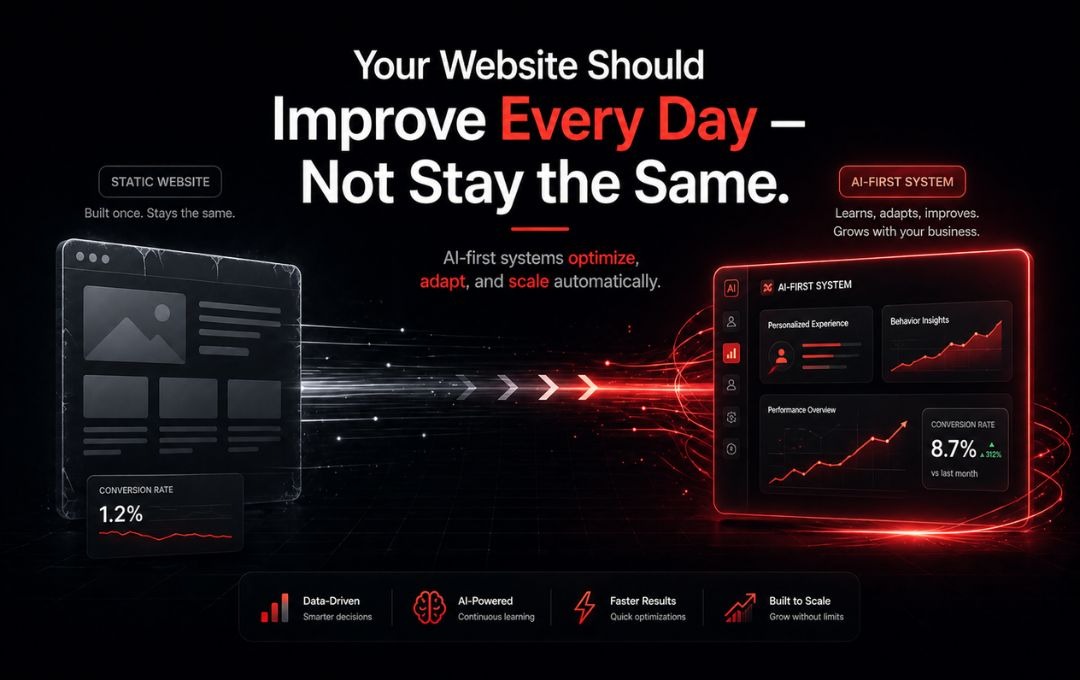
The website is built as a static product, not a system that improves over time.
This is where the gap between traditional agencies and AI-first web development companies becomes clear.
AI-first web development companies outperform traditional agencies because they build websites that learn, adapt, and improve continuously, rather than delivering a fixed product that remains unchanged after launch.
Traditional Agencies vs AI-First Companies (Core Difference)
Before going deeper, you need a clear framework.
Traditional Agencies
- project-based delivery
- fixed website structure
- manual updates
- limited post-launch optimization
AI-First Web Development Companies
- system-based approach
- adaptive user experience
- automated optimization
- continuous performance improvement
This is not a small difference.
It changes how your website performs over time.
Why AI-First Companies Are Winning (Real Reasons That Impact Results)
Most blogs stop at “AI is faster.” That’s surface-level.
Here’s what actually drives results.
1. Continuous Optimization (Not One-Time Delivery)
Traditional agencies:
- build → launch → maintain
AI-first companies:
- build → launch → analyze → improve → repeat
Your website doesn’t stay the same.
It evolves based on real usage.
Outcome: steady improvement in conversions and engagement.
2. Data-Driven Decisions Instead of Guesswork
Traditional approach:
- design decisions based on experience or assumptions
AI-first approach:
- decisions based on user behavior, patterns, and real data
Examples:
- where users drop off
- what they click
- what they ignore
Outcome: smarter changes that actually improve performance.
3. Faster Iteration Cycles
Testing changes manually takes time.
AI reduces:
- testing cycles
- optimization delays
- development bottlenecks
Outcome: quicker improvements and faster results.
4. Personalization at Scale
Traditional websites:
- same experience for every user
AI-driven websites:
- different journeys for different users
Examples:
- returning users see different content
- location-based adjustments
- intent-driven recommendations
Outcome: higher engagement and better conversion rates.
5. Compounding ROI Over Time
This is the most important point.
Traditional websites:
- performance plateaus
AI-first systems:
- performance improves continuously
Outcome:
- better long-term ROI
- lower cost per lead
- stronger growth curve
Before vs After (Simple Reality Check)
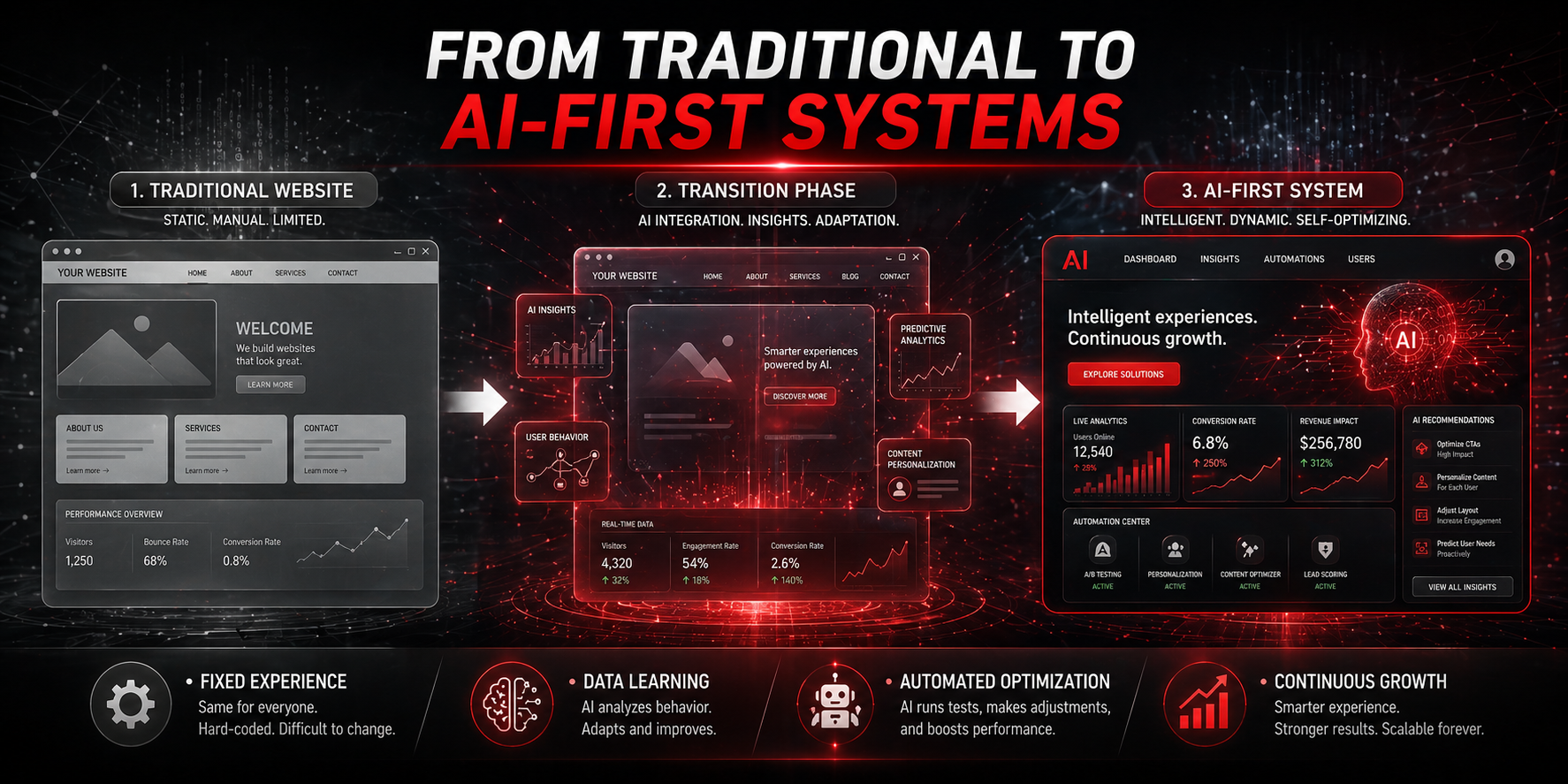
| Traditional Website | AI-First Website |
| Fixed user journey | Adaptive user journey |
| Manual updates | Automated optimization |
| Limited insights | Real-time data |
| Static performance | Continuous growth |
This is why businesses are shifting.
Common Misconceptions About AI-First Development
To stand out, you need to correct what others get wrong.
“AI means chatbots.”
AI is much broader. It includes analytics, personalization, and optimization systems.
“AI replaces developers.”
It doesn’t. It enhances how developers build and optimize systems.
“AI is only for big companies.”
Small and mid-sized businesses benefit just as much, especially in efficiency and cost control.
Clearing these builds trust and authority.
Real-World Scenarios (Same Goal, Different Outcomes)
Scenario 1: Traditional Agency Approach
A company invests in design-heavy development.
The site looks polished but lacks a conversion strategy.
Result: low engagement, weak ROI.
Scenario 2: Poor AI Implementation
A business adds random AI tools without structure.
No clear integration or purpose.
Result: confusion, no measurable improvement.
Scenario 3: Structured AI-First Approach
A company works with an experienced AI-first partner.
Clear goals, data tracking, continuous optimization.
Result:
- improved conversions
- better user engagement
- scalable growth
Same objective. Different executions.
What a High-Performing Setup Actually Includes
Instead of thinking in services, think in systems.
A strong setup may include:
Website Design
Focused on user journeys and conversion flow, not just visuals.
WordPress or CMS Development
Flexible and structured for performance.
E-commerce Development
Designed to reduce friction and improve purchase behavior.
Platform Optimization (e.g., Shopify)
Focused on speed, checkout experience, and revenue.
Full-Stack Development
Handles integrations, scalability, and ongoing improvements.
The goal is alignment, not complexity.
The Process That Delivers Results
Execution is where most projects fail.
A structured AI-first process includes:
1. Planning
Define goals, audience, and success metrics
2. Design
Create user-focused, conversion-driven layouts
3. Development
Build scalable, performance-ready systems
4. Testing
Ensure reliability and usability
5. Launch
Deploy with tracking and monitoring
6. Continuous Optimization
Improve based on real data
Without the last step, everything else loses impact.
Why Execution Matters More Than Location
Many businesses compare:
- local agencies
- offshore teams
But the real difference is not location.
It’s:
- process
- communication
- experience
A structured AI-first team will outperform an unstructured agency anywhere.
The Risk of Staying with Traditional Models
Choosing not to adapt leads to gradual decline:
- lower engagement
- rising marketing costs
- slower growth
- reduced competitiveness
These are not immediate failures.
They build over time.
Frequently Asked Questions
1.Is AI-first web development expensive?
It depends on the scope, but it often delivers better long-term value than repeated redesigns.
2.How long does it take to see results?
Initial improvements can appear within weeks, with continuous gains over time.
3.Is it suitable for small businesses?
Yes. It helps improve efficiency and performance without large overheads.
4.Do I need technical knowledge?
No. A well-structured system is built to be manageable.
Final Perspective
This shift is not about adopting new tools.
It’s about changing how websites contribute to business growth.
- A traditional website delivers information.
- An AI-first system improves performance continuously.
That difference is already shaping which businesses grow faster.
Ready to Rethink Your Website?
If your website is not delivering results, don’t start with a redesign.
Start with clarity:
- what’s not working
- where users drop off
- what needs improvement
A structured, AI-first approach can turn your website into a system that actually drives growth.
-

Writen by Anirban Das