USA:
USA:  India:
 The eCommerce sector of Dubai is anything but stagnant; it is moving faster than that of most global markets in terms of consumer expectations, platform capabilities and technology standards due to a digitally driven population, fierce retail competition, a government-supported digital infrastructure investment, and an unprecedented transition to mobile-first commerce by all demographics.
As such, for business owners/founders/marketing managers working in this fast-paced environment, it is essential that your company stays on top of current e-commerce development trends — e-commerce development trends that are directly relevant to you — as they will affect your company's strategic direction over the next three to five years. Your choices about platform architecture, UX investment and technology integration in 2026 will directly affect your ability to compete over the next three to five years.
This article will give you an overview of current eCommerce development trends most relevant to you as a Dubai business — trends with clear commercial implications versus speculative technological predictions. As an experienced eCommerce website development firm based in Dubai, ZTS Infotech Pvt. Ltd. develops and invests heavily in each of these areas for our current clients.
Trend 1: E-commerce Driven by AI Is Transitioning from Novelty to Infrastructure
The novelty era of artificial intelligence in eCommerce has passed. As of 2026, AI e-commerce development in Dubai will be focused on incorporating intelligence throughout all functional levels of the store instead of just adding a chatbot to the product pages.
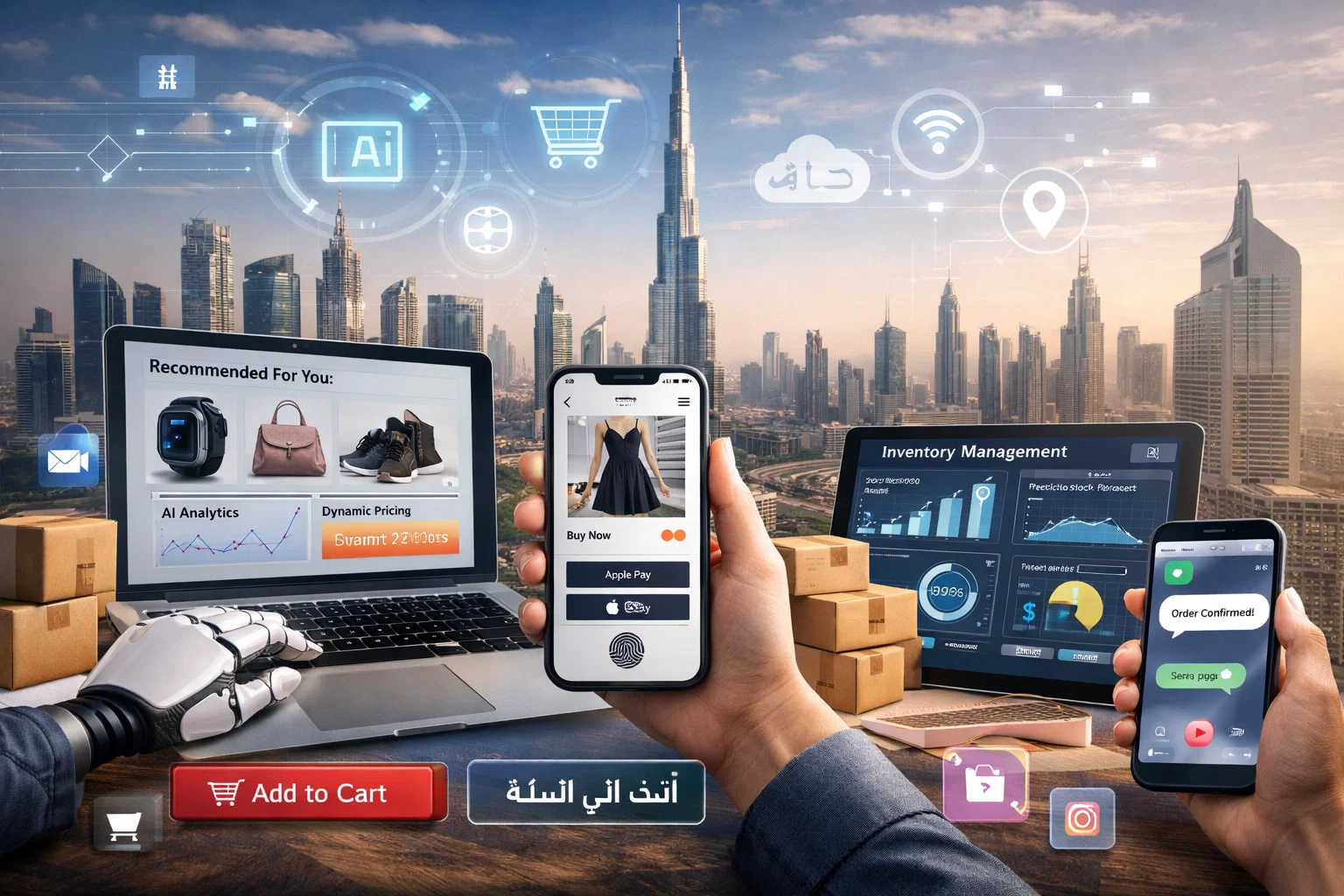
At present, some of the most commercially valuable uses of AI within UAE e-commerce include the following:
1. Personalised product recommendations that react dynamically to customer browsing behaviour, previous purchases, and session context, far outperforming static ‘related products’ types of logic.
2. Natural Language Processing AI-driven search for stores with extensive product catalogues where customers conduct conversational queries using mobile devices instead of standard keyword searches, thus failing to help customers find what they are looking for.
3. Dynamic pricing and margin optimisation tools that use real-time demand, as well as competitor pricing and inventory data, to adjust pricing.
4. Predictive inventory management that reduces the costs of stockouts or excess inventory by using historical and seasonal forecasting models when predicting future sales patterns.
5. Automated customer segmentation tooling which is used in conjunction with personalised email/WhatsApp/SMS marketing and is particularly effective within the UAE’s high mobile-usage culture.
These applications are not limited to enterprise solutions but can be accessed through adequately integrated third-party tools or custom development within the Shopify, Magento, or headless commerce platform environments. Businesses cultivating AI-powered e-commerce today in Dubai are creating a better experience.
Trend 2: Once more, Mobile Commerce Optimisation Has Raised the Bar
Mobile-first has been around for some time now, but its requirements are changing rapidly and continuing to rise in importance. In the United Arab Emirates, the use of mobile devices is the leading cause of eCommerce activity and is rapidly growing just as quickly as eCommerce transactions are. Consumers are not only looking for a responsive design when shopping on mobile but are also looking for a mobile shopping experience that is faster and more intuitive compared to traditional desktop shopping (fewer steps to complete the purchase process, faster load times, etc.).
The following concepts will be important for custom eCommerce development in Dubai in 2026:
• Progressive Web Apps (PWAs) will continue to gain traction with UAE retail customers because they create app-like experiences (can work offline, allow push notifications, and be installed onto the home screen) without having to create a separate application or distribute through an application store.
• UAE mobile shoppers expect single-click checkout and biometrically-verified checkouts through services such as Apple Pay, Google Pay and device-native authentication on their devices. They should be well-integrated into an e-commerce store, rather than hastily added on after the fact.
• Designing the navigation layout of an eCommerce store with thumb zones and placing the critical interactions within thumb range on large smartphones can greatly reduce mobile cart abandonment.
• The performance standards for Core Web Vitals on mobile are becoming stricter, and stores with low scores for Largest Contentful Paint and Time to Interactive will be heavily penalised when considering their ranking in Google.
Trend 3: Mid-Market Dubai Businesses Are Starting to Profit from Headless Commerce
Historically, headless commerce (the separation of front-end presentation from back-end commerce engines) has been a significant investment for large organisations. However, headless solutions are evolving, with Next.js and Nuxt.js, composable APIs for commerce, and Shopify’s Hydrogen/Oxygen stack now providing headless architecture to forward-thinking mid-market businesses in Dubai.
There is no one-size-fits-all approach to headless commerce, but here are several key scenarios when headless makes sense:
You want to build a performance-optimised and highly customised front-end experience; your traditional theme architecture cannot support it.
• You want to sell through multiple channels (web, app, kiosk, digital signage) and have a single commerce engine to service all sales channels from one data source.
• You want your marketing team to update front-end content/layout rapidly without involving developers for every update to front-end content/layout.
• At scale, you need sub-second page load times – headless shopfronts are delivered via edge CDN, enabling them to deliver performance benchmarks that traditional template-based stores can’t compete with.
For any Dubai business investigating e-commerce platform build options, you should have an honest conversation about whether an investment in headless is warranted if you're either in the growth stage or expecting to scale significantly (in traffic, catalogue or channel expansion) within the next two years.
Trend 4: Bilingual and Localised UX Is a Conversion Need, Not a Nice-to-Have
If you're an online retailer in Dubai, offering a bilingual shopping experience is not only a matter of cultural sensitivity; it's also essential to your bottom line. As Arabic-speaking customers continue to make up a larger portion of the overall UAE online shopping base, it is important for retailers who do not provide them with a fully "native" Arabic experience (RTL layout that is correctly implemented, currency in AED, and localised product descriptions) to re-evaluate their e-commerce strategy because they are leaving measurable conversion rate points on the table.
Many developers still have little understanding of the substantial difference between a "technically compliant" bilingual e-commerce store and one that actually converts Arabic-speaking customers. A properly designed bilingual e-commerce store for Dubai includes much more than simply implementing a translation plugin. Bilingual e-commerce website design in Dubai must include the following:
• Proper implementation of the RTL layout at the CSS architecture level (as opposed to as an override layer) to ensure that all elements of a bilingual site (i.e., spacing, typography, icon placement, interactive elements) are correctly rendered in Arabic
• Accurate, natural Arabic copy (as opposed to machine-translated copy) for product descriptions, category names, checkout copy, etc., has a measurable positive impact on buyer trust and completion rates
• Arabic search behaviour varies greatly from English search behaviour; therefore, you must understand the different Arabic keyword variations and transliteration patterns when creating your product catalogue metadata and search indexing
• Localising images, promotional messaging and seasonal campaigns (e.g., Ramadan, Eid, UAE National Day) will drive significantly more engagement if they are done with true localisation (as opposed to tokenism).
Trend 5: The Buyer Journey Is Changing Due to Social Commerce and Omnichannel Integration
Social media and eCommerce are gradually becoming indistinguishable, with platforms like TikTok Shop, Instagram Shopping, and WhatsApp Commerce being both primary discovery and purchase points for a certain type of product or demographic.
So, what do scalable e-commerce solutions in Dubai need to consider in their omnichannel architecture?
• Unified inventory management across website, social commerce channels, and physical store/retail – real-time inventory syncing to avoid overselling through various channels.
• WhatsApp Business API integration for retrieving carts, notifying customers of orders and providing customer service – the UAE has the highest engagement rates of any market in the world with WhatsApp, thereby making it a high-return-on-investment commerce channel
• Syncing product catalogues from Google Merchant Center, Meta Catalogue, and TikTok Shop with proper product information, pricing, and availability across all surfaces.
• Unified customer data and purchase history by channel, allowing companies to treat customers that discover them on Instagram, research on the web, and purchase through WhatsApp as a single known customer instead of three separate, unknown web sessions.
Integrating these properly requires thoughtful architectural planning. An e-commerce website development company in Dubai that understands both the technical and commercial aspects of omnichannel will be able to create these connections so that they can scale seamlessly.
Trend 6: Security and Performance Engineering Are Now Standard Commercial Needs
In 2026, site performance and security have transformed from being considered technical factors to having a direct correlation to the profitability of all businesses. In the United Arab Emirates, site performance and security affect the site's search rankings, conversion rate, customer trust, and the site's compliance with regulations.
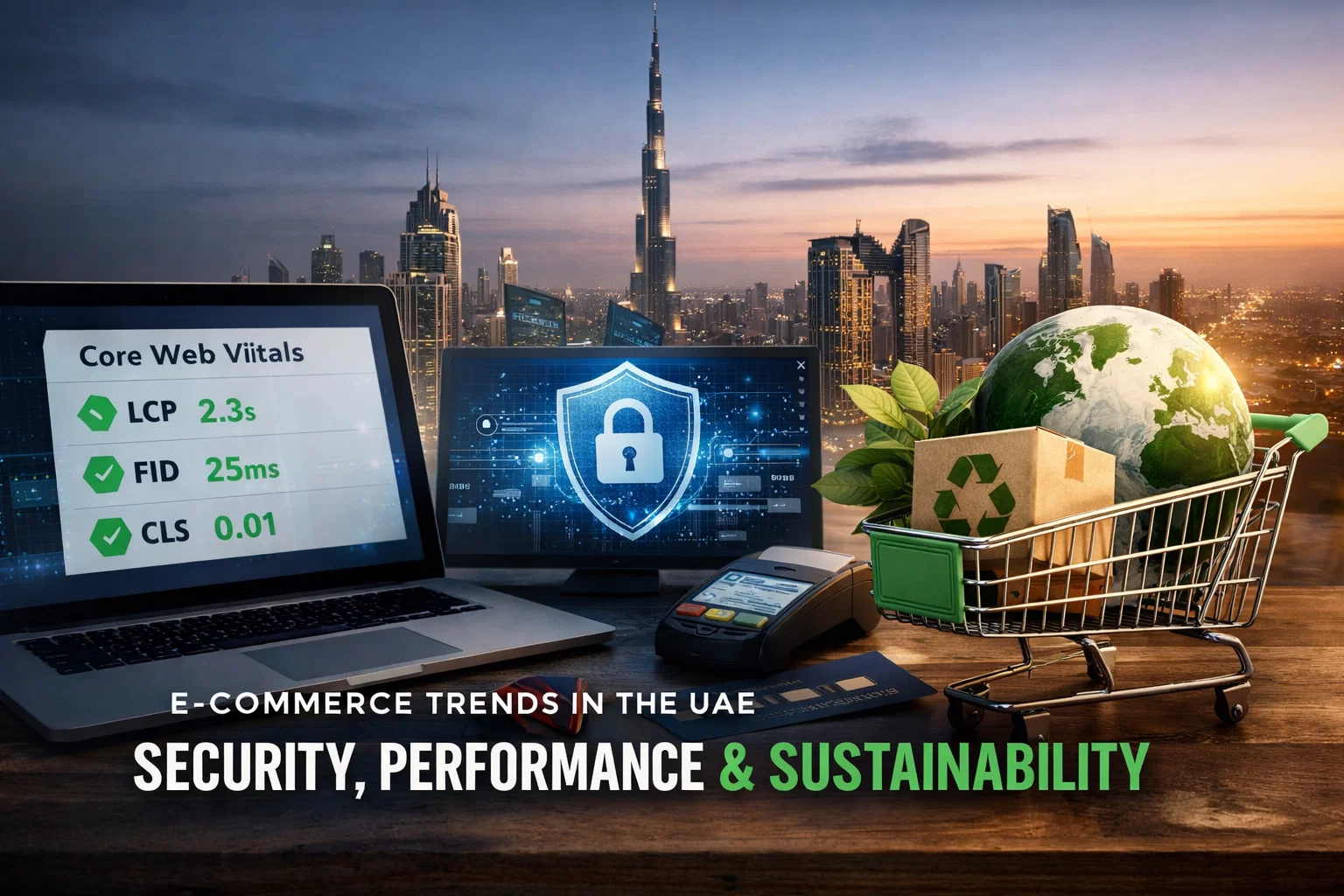
The performance of eCommerce websites is now closely attuned to Google's Core Web Vitals metrics, which are confirmed ranking signals. Mobile users in the UAE are demanding near-instantaneous page loads; an eCommerce website with a Largest Contentful Paint (LCP) greater than 2.5 seconds will lose approximately 50% of its organic search visibility and will convert at a much lower rate than anticipated. At ZTS Infotech Pvt. Ltd. , all custom-development eCommerce projects launched in Dubai are measured for performance and have specific CWV goals incorporated into their respective project briefs before they go live.
Like performance, data security is more important than ever before. eCommerce stores are targets for the theft of payment card information, personally identifiable information (PII) from customers, and pricing information from B2B clients. The UAE's Federal Decree Law No. 45 of 2021 will require all companies who collect, use, or store personal data to be compliant with the law when collecting, using, or storing personal data. This makes it mandatory for eCommerce sites that use transaction data to have SSL implemented, a web application firewall (WAF) implemented, PCI-DSS-compliant transaction processing methods, ongoing security audits, and a documented incident response plan.
For any eCommerce company in the UAE that processes customer personal data and financial information online, site performance and site security will be among the minimum requirements that every eCommerce business must meet.
Trend 7: Buyer Decisions in the UAE Are Affected by Sustainability and Ethical Trade
In the United Arab Emirates, awareness among consumers about sustainability is increasing among the key demographic segments in the region with a higher concentration of younger consumers compared to other demographics. Urban consumers appear to be making a greater number of decisions to buy products based on the brand's value system and not just on price or product itself. Although not yet entirely throughout the region, there is a clear trend and direction for the way buyers will make purchases, moving towards this direction.
For businesses in Dubai who are interested in developing eCommerce solutions, the implications of this shift in buyer purchasing behaviour are mainly practical in nature compared to philosophical.
• The carbon-neutral shipping options and the sustainable packaging options that can be clearly presented at the point of checkout will be one of the factors that will impact the purchase completion rates for UAE consumers who are environmentally conscious.
• Creating a transparent supply chain by presenting clear and complete information about the origin of the materials, manufacturing conditions and certifications, both on product detail pages and buyer review sites, is essential to building trust with the growing number of buyers who are scrutinising their purchasing behaviour.
• There are already examples of eCommerce businesses selling fashion and electronics using resale, rental and refurbished product business models; this is forcing these types of eCommerce platforms to create content and features that do not currently align with standard eCommerce platform architectures.
Designing your e-commerce website in Dubai with sustainability messaging and applicable product attributes will not only provide long-term value to your brand equity but will also increasingly influence Google's quality rating of e-commerce content.
How ZTS Infotech Pvt. Ltd. Develops for These Trends and How Much It Costs
The mentioned trends are not future predictions but current commercial realities to Dubai business owners. The question for business owners and company founders is not if they should engage with these trends, but how they will engage with these trends, and who they will partner with.
ZTS Infotech Pvt. Ltd. is an AI-driven digital engineer with more than 15 years of experience developing e-commerce platforms, websites, mobile applications, and full-stack solutions for clients in the UAE, KSA, India, the USA, Europe, and Australia. Our Dubai engagement focuses on actual know-how, such as platform selection, UX strategy, performance engineering, security configuration, and integration architecture – not just on "what looks good" from a theoretical perspective.
For Dubai business owners, our eCommerce packages start at 699AED for a professional web presence and 999AED for complete online stores, thereby providing growing businesses with the opportunity to build high-performance digital infrastructure without the need for an enterprise-sized budget. For more complex builds that include AI integration, headless architecture, bilingual stores, and/or omnichannel platforms, we determine scope after completing an extensive discovery process.
Get a Free Quote → ztsindia.com/service/ai-website-engineering-dubai
If you are considering your eCommerce platform options, looking to build a new eCommerce website, or evaluating whether your existing store is set up properly for trends that will be affecting how people shop and buy in the digital world, we are here to discuss this.
Frequently Asked Questions (FAQ)
1. Which eCommerce development trend is most crucial for Dubai companies to follow at the moment?
AI-enhanced personalisation and mobile commerce enhancement provide the fastest and greatest means of monetisation to the greatest number of businesses in Dubai, according to the trends in this article. Through integrated tools with Shopify, Magento and custom builds that are available to those without enterprise budgets, AI-based product suggestions and searches are becoming widely available (and measurable) within a short time frame after implementation. Given the transactional activity in the UAE, mobile-optimised websites are necessary, and if your mobile conversion rate is well below your desktop conversion rate, that is a revenue leak that can be rectified quickly by a mobile UX and performance audit. For help with mobile UX and performance audits, ZTS Infotech Pvt. Ltd. can perform an audit of your business's eCommerce performance currently (by benchmarking), create a list of improvement opportunities that will have the biggest impact on your business, and produce a list of priority actions to take — reach out for more information.
2.Given these tendencies, how can I determine which eCommerce platform is best for my Dubai business?
The selection of a platform should be based on your current needs, projected growth over the following 2 to 3 years, and your team's ability to support ongoing operational systems. Shopify/Shopify Plus will meet most of the needs for both retail and e-commerce while providing the lowest TCO and fastest time-to-market compared to all other platforms. Magento (Adobe Commerce) offers multiple store functionalities, complex B2B processes, and integrations with current ERP system(s), exceeding the capabilities of the Shopify ecosystem. Any of the platforms will support a headless commerce strategy when your expectations for performance and multiple channel experiences exceed the limitations of a traditional design-driven theme. The growing trends, such as AI features, bilingual user experiences and multiple channel integration, can be supported on any of these solutions; the question is, which one will help you to reach each of these points more easily based on your individual volume? ZTS Infotech Pvt. Ltd. will provide an expert opinion on the best platform for your business needs, not on which one we would prefer to build on.
3.How much money should a Dubai company set aside for a well-designed e-commerce store that uses the most recent best practices?
Budget ranges depend greatly on scope, but benchmarks for the Dubai market remain consistent and reliable. A professionally engineered eCommerce store with custom design, UAE payment gateway integration, mobile optimisation, bilingual support and analytics configuration on either Shopify or a similar platform can be built by ZTS Infotech Pvt. Ltd., starting around AED 999. Mid-range builds, with complete custom theme creation, third-party integrations and advanced functionality, will have a wider variety of price ranges based on the level of complexity. Enterprise Magento or headless builds – multiple store operations and B2B services, ERP-integrated, and equipped with AI functionality – will be scoped out as individual projects and priced accordingly. The important concept for any Dubai-based business owner is the total cost of ownership, not simply the build cost. A lower build and its associated costs of failure from poor mobile design, slow page load times and continuous developer intervention to retain it will cost more over 2 years than a properly engineered build that has been built at an appropriate budget level. You may obtain a free quote from ZTS Infotech Pvt. Ltd and mutually agree on appropriate scope-based pricing without any undue assumptions or unforeseen costs.
Final Thoughts
Successful eCommerce companies are those that view technology as a strategic investment rather than a straightforward website update in a market as rapidly changing as Dubai. AI-powered customisation, mobile-first performance, headless architecture, bilingual user experiences, omnichannel integration, and stricter security standards are examples of trends that are becoming essential to competitive online retail. Early adoption of these innovations will put businesses in a better position to provide modern UAE customers with quicker, smarter, and more customised purchasing experiences. Dubai businesses can make sure their digital shopfronts are not only suitable for the current market but also ready for the next wave of growth in the region's fast-increasing online economy by working with an expert e-commerce development team and creating with scalability in mind.
Ready to build for Dubai's eCommerce future? Contact ZTS Infotech Pvt. Ltd. at ztsindia.com/service/ai-website-engineering-dubai
-

Writen by Anirban Das