USA:
USA:  India:
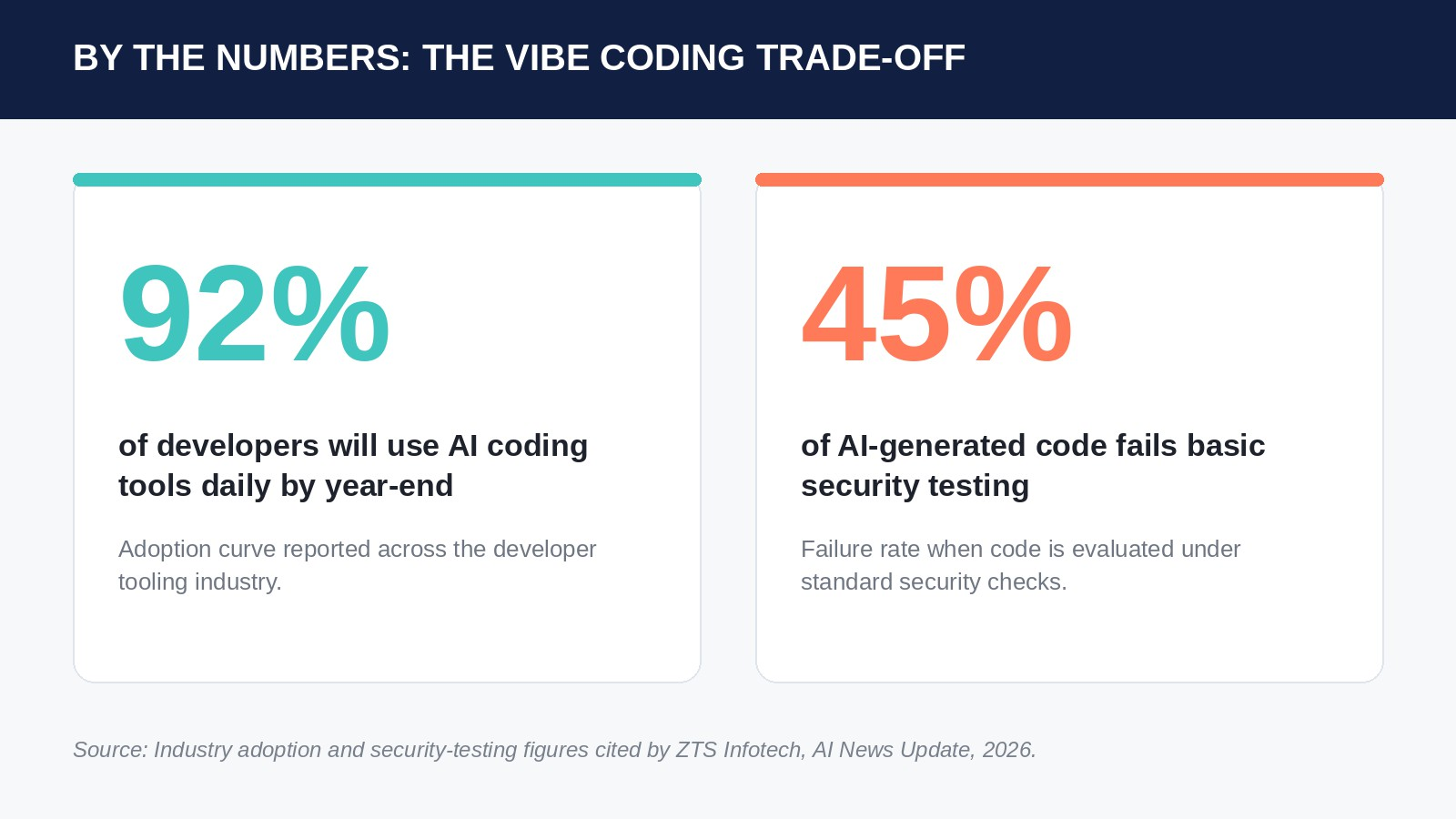
Vibe coding — the practice of letting an AI system generate working software from a plain-language prompt — has moved from novelty to default in a single year. According to ZTS Infotech founder Anirban Das, speaking on the company's AI News Update series, roughly 92% of developers are expected to be using AI coding tools daily by the end of 2026. For business leaders watching engineering costs and delivery speed, that number alone reads like an easy win.
The complication is a second statistic sitting right beside it: an estimated 45% of AI-generated code fails basic security testing when it is actually evaluated. Both figures, Das argues, are true at the same time — and the gap between them is exactly where an early-2026 breach involving a fully AI-coded application and 1.5 million exposed API keys took place. For CEOs, CTOs, and operations leaders currently deciding how much of their software roadmap to hand to AI, that gap is no longer theoretical. It is a governance question with a dollar figure attached.
Where Vibe Coding Has Already Won
Das is unambiguous about the low end of the work: for genuinely basic tasks — a landing page, a simple script, a standalone function — AI-first development is already the default inside ZTS Infotech's own delivery team, not an experiment on the side. That mirrors what most agencies and
in-house engineering teams are reporting this year: routine, low-risk, well-specified coding tasks are migrating to AI assistance because the cost of a mistake is trivial. If the output is wrong, someone notices within a day and fixes it.
This is the part of the story that gets the headlines and the productivity charts. It is also, according to Das, the easy part.
The Breach That Changed the Conversation
The harder part surfaced earlier this year, when a fully vibe-coded application — one in which, by the owner's own admission, not a single line of code had been written or reviewed manually — leaked 1.5 million API keys through a misconfigured database. Das cites the incident as representative of a pattern now showing up across the industry, rather than an isolated failure: AI systems reliably handle the "happy path," the scenario where a user does what the software expects. What they consistently miss is everything around it — edge cases, error handling, and the kind of security-critical logic that governs authentication and payment processing.
That distinction matters more to a board or an investor than it does to a developer. A broken landing page is an inconvenience. A misconfigured authentication layer or an exposed credentials store is a regulatory event, a customer-notification obligation, and, increasingly, a headline.
The Rule Enterprise Teams Are Actually Using
Rather than treating AI coding as an all-or-nothing bet, ZTS Infotech applies what amounts to a risk-based governance rule, and Das frames it in terms any executive would recognize from risk
management, not software engineering:
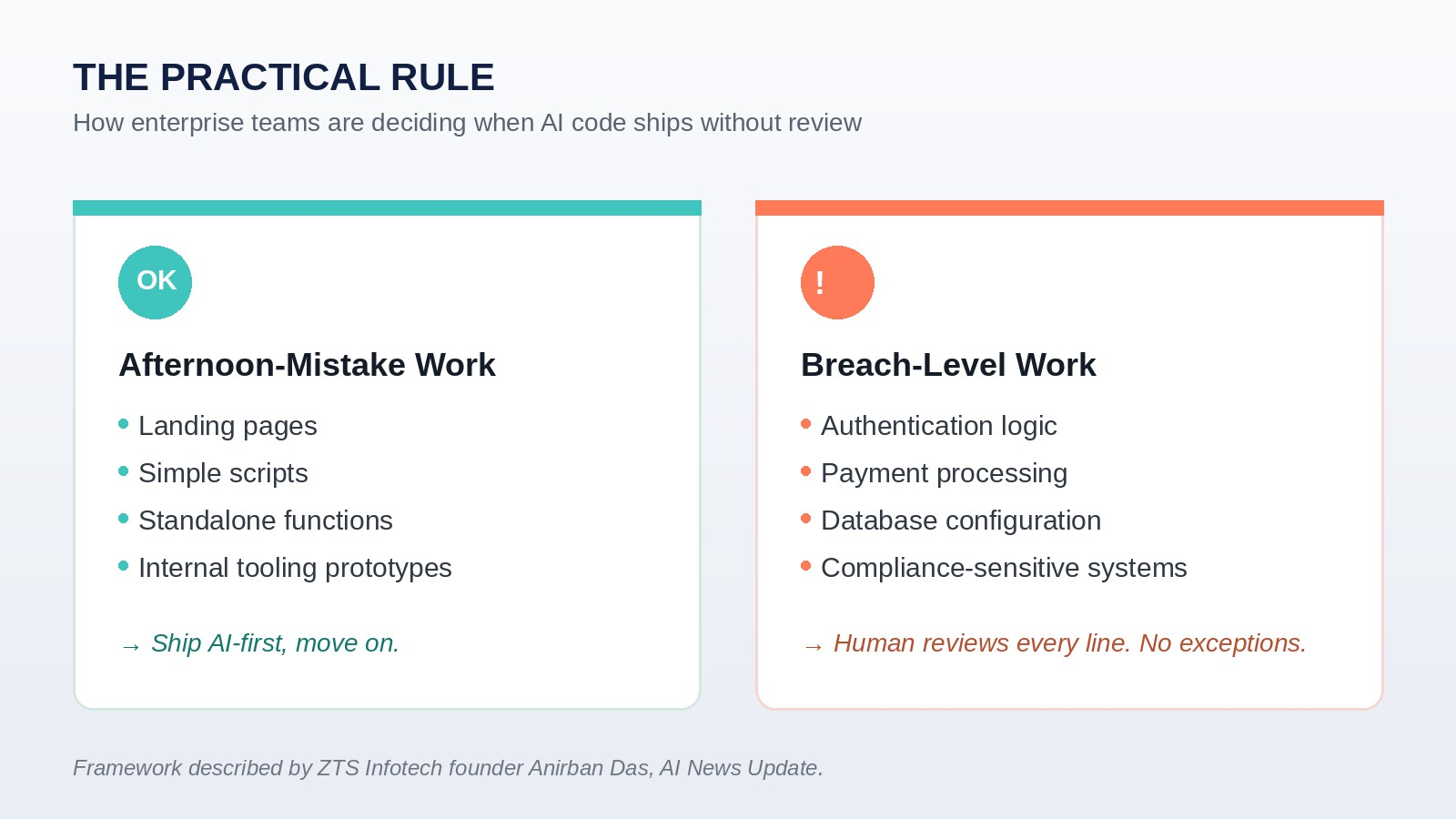
- If a mistake in the code costs an afternoon to fix, generate it with AI and move on.
- If a mistake could cost a data breach, a compliance violation, or client trust, a human reviews every line before it ships — no exceptions.
The threshold isn't the tool. It's the blast radius of getting it wrong. That framing gives leadership teams something more useful than a blanket AI policy: a single question to ask about any given piece of code before it goes to production — what does failure actually cost here?
Practical Takeaways for Business Leaders
Where the Risk Concentrates
The 45% security-test failure rate is not evenly distributed across a codebase. It concentrates precisely where the consequences are highest: authentication, payment flows, data storage configuration, and anything touching regulated customer data. Leaders auditing their own AI coding exposure should start there, not with the volume of AI-generated code overall.
The Opportunity Hiding Inside the Risk
None of this is an argument against adopting AI coding tools — Das's own team has already shifted its basic coding work to AI by default, and the productivity case is real. The opportunity for well-run organizations is to formalize the review threshold before an incident forces the issue, turning what is currently ad hoc judgment into a documented policy that satisfies auditors, clients, and cyber-insurance underwriters alike.
Expert Perspective: Why This Matters Now
The 1.5-million API key incident is unlikely to be the last of its kind, and that is precisely why it matters as a business signal rather than a technology footnote. Enterprise software risk has historically been managed through code review, staged deployment, and audit trails built around the assumption that a human wrote the code in the first place. Vibe coding breaks that assumption at scale, and most organizations' security processes have not yet caught up.
What ZTS Infotech's framework gets right is that it doesn't try to solve this with a tooling purchase or a blanket ban — both of which are common, and both of which tend to fail in practice. It solves it with a classification exercise: sort the work by consequence, not by how the code was produced. Expect this approach, or something close to it, to become standard practice across engineering organizations over the next 12 to 18 months, likely formalized into SOC 2 and ISO 27001 audit checklists as "AI-generated code review policy" becomes a line item insurers and enterprise procurement teams start asking about directly.
The market impact is already visible in adjacent numbers: as AI coding adoption approaches saturation among developers, the differentiator between vendors and in-house teams will stop being who uses AI and start being who can prove they know where not to trust it.
Key Takeaways
- AI-first coding is now the default for low-risk, well-specified tasks across much of the industry, including at ZTS Infotech.
- An early-2026 breach tied to a fully AI-coded application exposed 1.5 million API keys through a misconfigured database, with no manual code review in place.
- Roughly 45% of AI-generated code is reported to fail basic security testing when properly evaluated
— even as roughly 92% of developers are expected to use AI coding tools daily by year-end.
- AI systems reliably handle expected "happy path" behavior but consistently miss edge cases, error handling, and security-critical logic.
- The practical governance rule: low-cost mistakes can ship AI-first; anything that could cause a breach, compliance failure, or loss of client trust requires full human review before release.
- Risk, not code origin, should determine review intensity — authentication, payments, and data configuration warrant scrutiny regardless of how fast AI can produce them.
- Formalizing this threshold now, ahead of an incident, positions organizations better with auditors, enterprise clients, and cyber-insurance underwriters.
Looking Ahead
Vibe coding is not going away, and for the routine, low-stakes share of any engineering backlog, it has arguably already won. The organizations that come out ahead over the next year will not be the ones that adopted AI coding fastest, but the ones that drew the line between an afternoon's mistake
and a breach-level one before it was tested for them in production. As Das puts it, the technology has replaced the coding. It has not replaced the judgment. Business leaders evaluating their own engineering roadmaps should expect that distinction to keep showing up in board meetings, procurement reviews, and insurance renewals throughout the rest of 2026.
-

Writen by Anirban Das