USA:
USA:  India:
 A free, local voice-cloning app with 45,000+ GitHub stars is replacing paid subscriptions on marketing production floors — and one agency's client campaign shows exactly how.
By the Zebra Techies Solution AI News Desk | August 26, 2026
.jpg)
Why Every Marketing Team’s Voiceover Bill Eventually Becomes a Problem
Voiceover has always been one of those line items that quietly grows over time. A brand starts with one presenter for one campaign, then needs a second voice for a new market, then a third for a seasonal push — and before long, the subscription tier has crept up, the character limits are being rationed like a scarce resource, and every recording lives on a third-party server the client never explicitly agreed to.
That familiar friction is why a free, open-source tool called Voicebox is drawing attention from marketing and production teams well beyond its original developer community. Unlike commercial voice-AI platforms that charge by the character or the minute, Voicebox runs entirely on a local machine, has no subscription tier, and — according to its GitHub repository — has attracted more than 45,000 stars since launch.
For business leaders weighing where AI actually saves money versus where it simply adds another vendor, Voicebox is a useful case study in the quieter category: tools that reduce cost by removing a dependency rather than adding one.
What Voicebox Actually Does
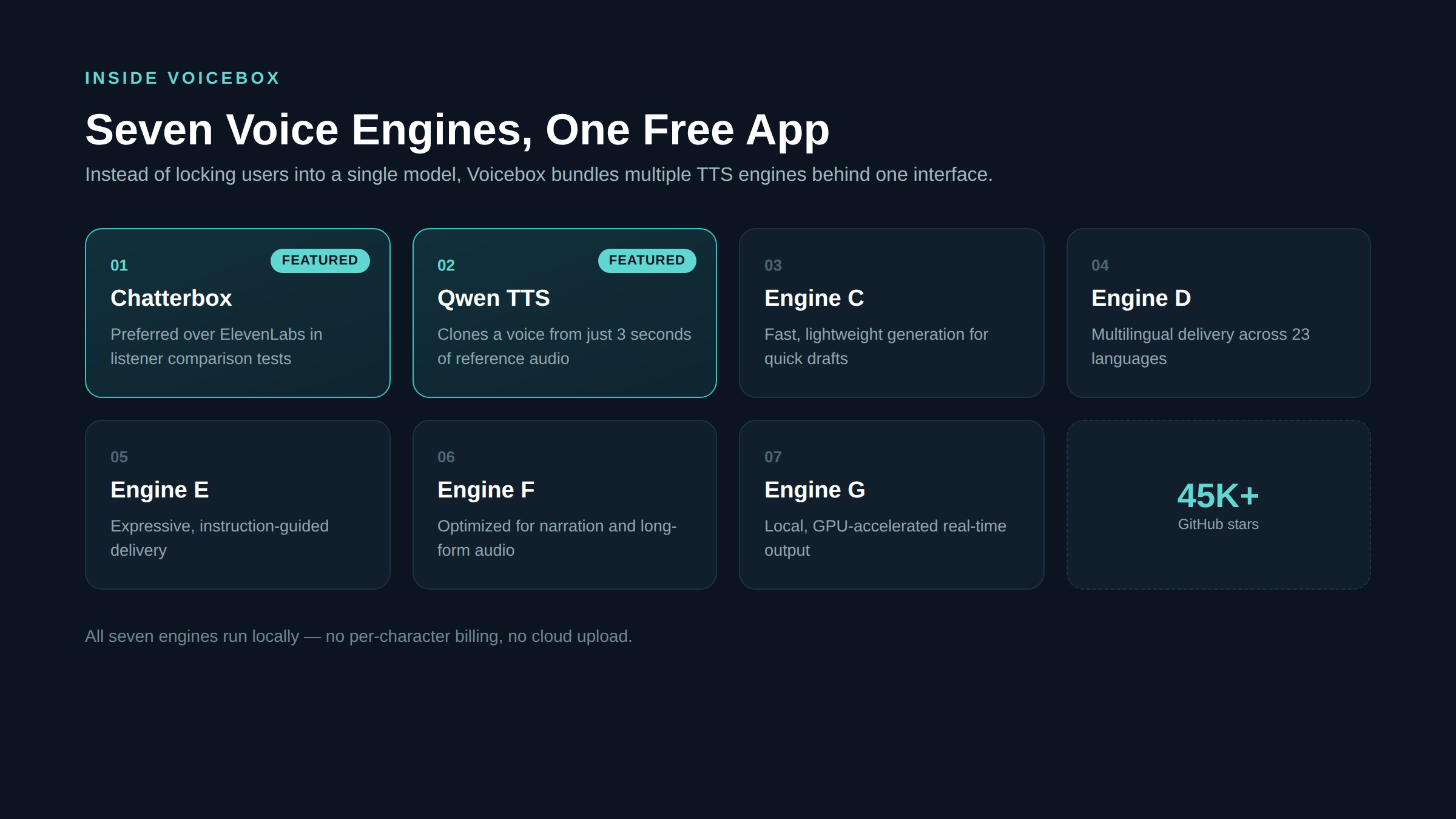
Voicebox is not a single voice model. It is a bundle of seven separate text-to-speech engines packaged into one local application, giving users a choice of trade-offs between speed, realism and language coverage rather than being locked into one vendor’s voice.
Two of those engines stand out for commercial use. Chatterbox, one of the bundled models, was preferred by listeners in blind comparisons against ElevenLabs, currently the dominant paid voice-AI platform. Qwen TTS, the second, can clone a usable voice from as little as three seconds of reference audio — a fraction of what most commercial cloning tools require. The platform also accepts
natural-language delivery instructions, such as “sound excited” or “whisper this line,” and supports 23 languages, which matters more to global marketing teams than the underlying model architecture ever will.
Because everything processes locally, no audio, script or cloned voice profile is transmitted to an external server — often the deciding factor for agencies handling client brand voices under strict confidentiality terms.
Inside a Real Campaign: How Zebra Techies Solution Used It
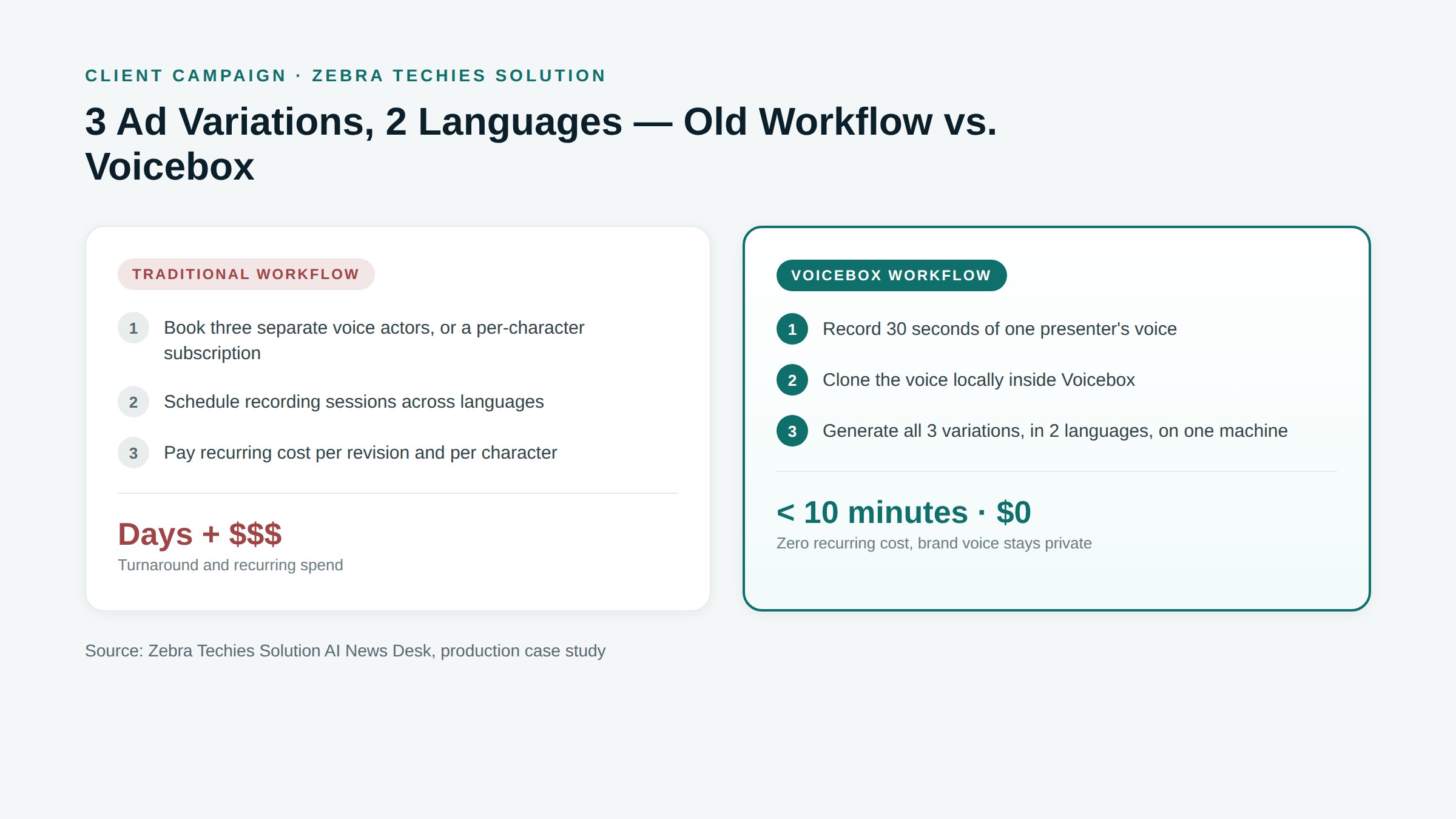
The clearest evidence of Voicebox’s business case comes from Zebra Techies Solution’s own production floor. A client requested voiceover for a UGC-style product ad: three creative variations, in two languages, intended for a paid social split test.
Under a conventional workflow, that brief means one of two costly paths — booking three separate voice actors, or paying for a subscription voice-AI service where per-character billing erodes the campaign budget with every script revision. Neither option is unusual, but both add days to turnaround and uncertainty to the cost line.
Instead, the production team recorded 30 seconds of a single presenter’s voice, cloned it inside Voicebox, and generated all three ad variations locally in under 10 minutes. The recurring cost was zero, and because the process never left the studio’s own machine, the client’s brand voice stayed private — a point the agency’s AI news desk was careful to underline on camera.
That kind of result reframes voice AI from a “nice to have” creative tool into a line-item reduction that a finance team can actually see on a production budget.
Beyond Cloning: Stories Mode and Multi-Track Assembly
Voicebox also includes a feature called Stories Mode — a multi-track timeline built for stitching narrated content together without switching to a separate audio editor. For teams producing podcast intros, explainer videos or narrated product walkthroughs, that consolidation removes a step that normally requires a second software license or an outsourced audio edit.
The Honest Caveats
No serious evaluation of an AI production tool is complete without its limitations, and Voicebox has two worth flagging.
First, output quality is hardware-dependent: clean, near real-time on a capable GPU, but noticeably slower on older laptops. Second, and more important, is the ethical boundary around consent. Cloning a voice without the speaker’s permission is not a gray area; it is the one rule the tool’s advocates describe as non-negotiable. Any organization adopting voice cloning technology should pair it with a clear internal policy on consent and usage rights before it reaches a production pipeline.
EXPERT PERSPECTIVE: Why This Signals a Broader Shift
The interesting story here is not really Voicebox itself — open-source AI tools with impressive GitHub numbers appear weekly, and most fade. The more telling signal is what its adoption pattern says about where marketing production budgets are heading.
For the past two years, the AI-in-marketing conversation has centered almost entirely on subscription tools: pay-per-seat platforms, pay-per-generation credits, pay-per-character voice APIs. That model works well for vendors and less well for agencies running multiple client accounts, where costs scale directly with output volume regardless of margin.
Local, open-source tools like Voicebox represent a counter-trend: production capability that scales with hardware investment rather than usage volume, and that keeps sensitive client assets off
third-party infrastructure entirely. For agencies managing multiple brand voices under confidentiality agreements, that data-residency argument may end up mattering more than the cost savings.
The likely trajectory is not that open-source tools replace commercial voice-AI platforms outright, but that production teams start running both — commercial APIs for speed and support, open-source local tools for cost-sensitive or confidentiality-sensitive work.
Key Takeaways
- Voicebox is a free, open-source, locally-run voice AI application with more than 45,000 GitHub stars.
- It bundles seven TTS engines, including Chatterbox, which outperformed ElevenLabs in listener preference tests.
- Qwen TTS can clone a voice from just three seconds of reference audio.
- The platform supports 23 languages and natural-language delivery instructions.
- Zebra Techies Solution produced three ad variations in two languages in under 10 minutes, at zero recurring cost, for a live client campaign.
- Because processing is local, client brand voices never leave the production machine — a meaningful advantage for confidentiality-bound agency work.
- Output quality depends on local hardware, and voice cloning without consent is treated as an absolute boundary, not a guideline.
What This Means Going Forward
Voicebox is now part of Zebra Techies Solution’s production stack, and its early results suggest a broader lesson for marketing leaders evaluating AI tools in 2026: the biggest savings are not always in the flashiest new model, but in the infrastructure decision behind it — local versus cloud, subscription versus one-time hardware cost, vendor-controlled versus client-controlled data. As more open-source voice and creative AI tools reach production-grade quality, expect more agencies to quietly run a hybrid stack, and expect procurement conversations with vendors to start referencing this exact kind of comparison.
-

Writen by Anirban Das