USA:
USA:  India:
Picture a straightforward request: an online store wants an AI agent to be able to add an item to a customer’s cart on its behalf. That’s a single, well-defined feature. What’s more interesting than the feature itself is that there are now two genuinely different ways to build it — and the choice between them says a lot about where AI-agent tooling for the web is heading in late 2026.
The Old Way: A Dedicated Backend Server
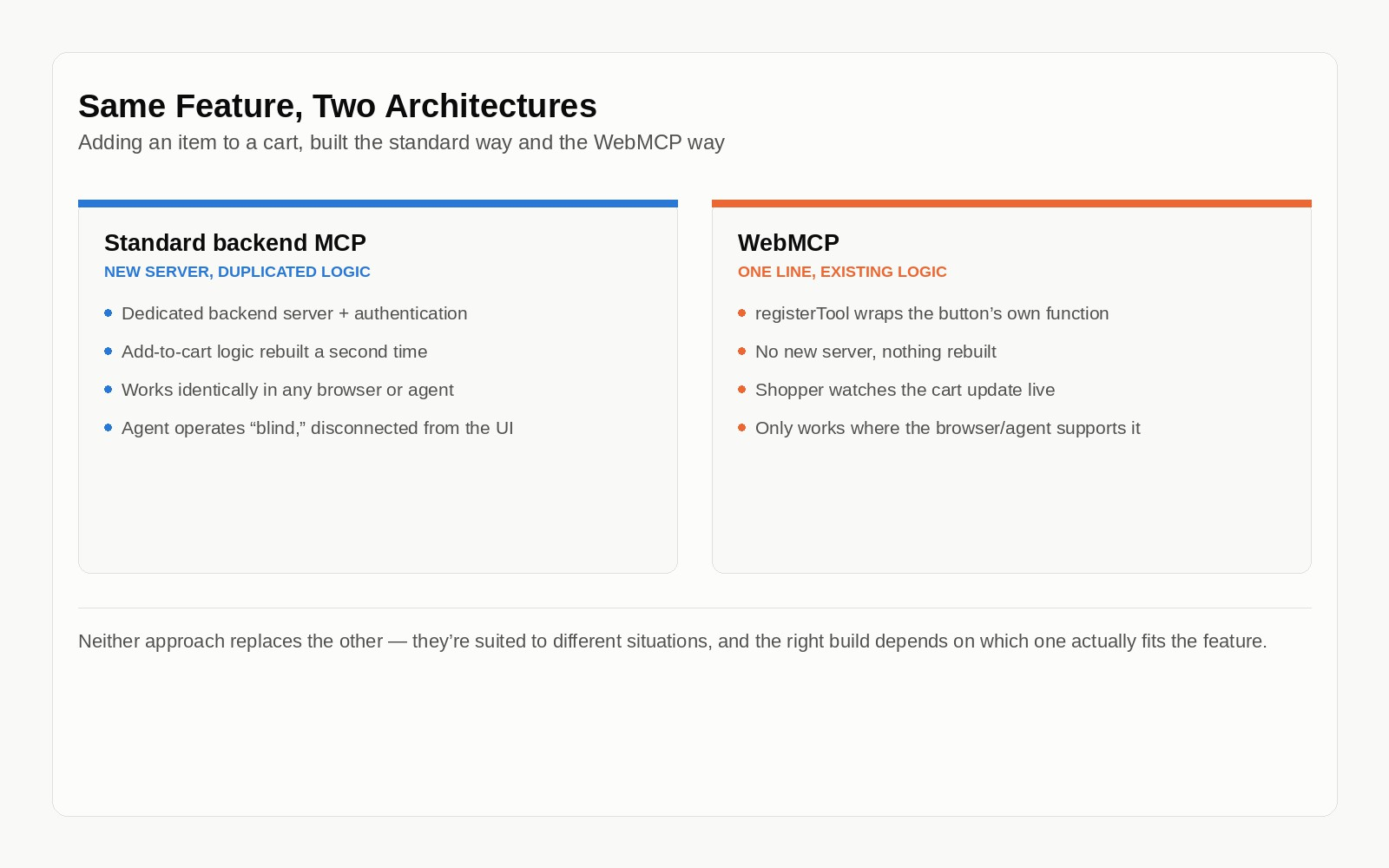
The established approach is standard backend MCP (Model Context Protocol). It works exactly the way most server-side integrations do: a developer builds a dedicated backend server, sets up authentication, and then rebuilds the add-to-cart logic a second time on that server — separate from the actual button the front end already has and already calls.
This approach is dependable in a specific, important way: it works reliably no matter what browser the visitor is using, because the logic lives on the server, not in the browser. The trade-off is equally specific. The add-to-cart logic now exists in two places — once in the front-end button handler a developer already wrote, and once again in the new backend service — which means two implementations to maintain, test, and keep in sync as the product changes.
The New Way: WebMCP
WebMCP takes a different approach entirely. Instead of rebuilding the logic on a server, it takes the exact function the add-to-cart button already calls and wraps it in one line of code — a call named registerTool, sitting directly inside the front-end JavaScript that already exists. There’s no new server to build and no logic to rebuild. The AI agent calls the same function the store’s own user interface already uses.
That’s a meaningfully smaller engineering footprint, but the more interesting difference shows up in what the shopper actually experiences.
The Practical Difference for the Person Shopping
With WebMCP, a shopper can type something like “add the blue one in size medium” and watch it happen live, right on the screen they’re already looking at — the cart updates in real time, in front of them, because the agent is operating through the same interface they can see. With standard backend MCP, the agent can technically perform the identical action, but it’s working blind: disconnected from whatever the customer happens to be looking at in that moment. The end state — an item in the cart — is the same either way. The experience of getting there is not.
The Honest Catch
Here’s where it’s worth being precise rather than promotional, because this is a real limitation, not a footnote: WebMCP only works in a browser or agent environment that actually supports it, and that support is still narrow.OpenAI turned WebMCP on inside ChatGPT’s desktop browser in August 2026, but with specific conditions — it requires GPT-5.6 Sol or Terra, and it is not available on Enterprise or Edu accounts. Chrome supports it as well, but only behind a manually enabled developer flag, running as an origin trial rather than shipping to every user by default.
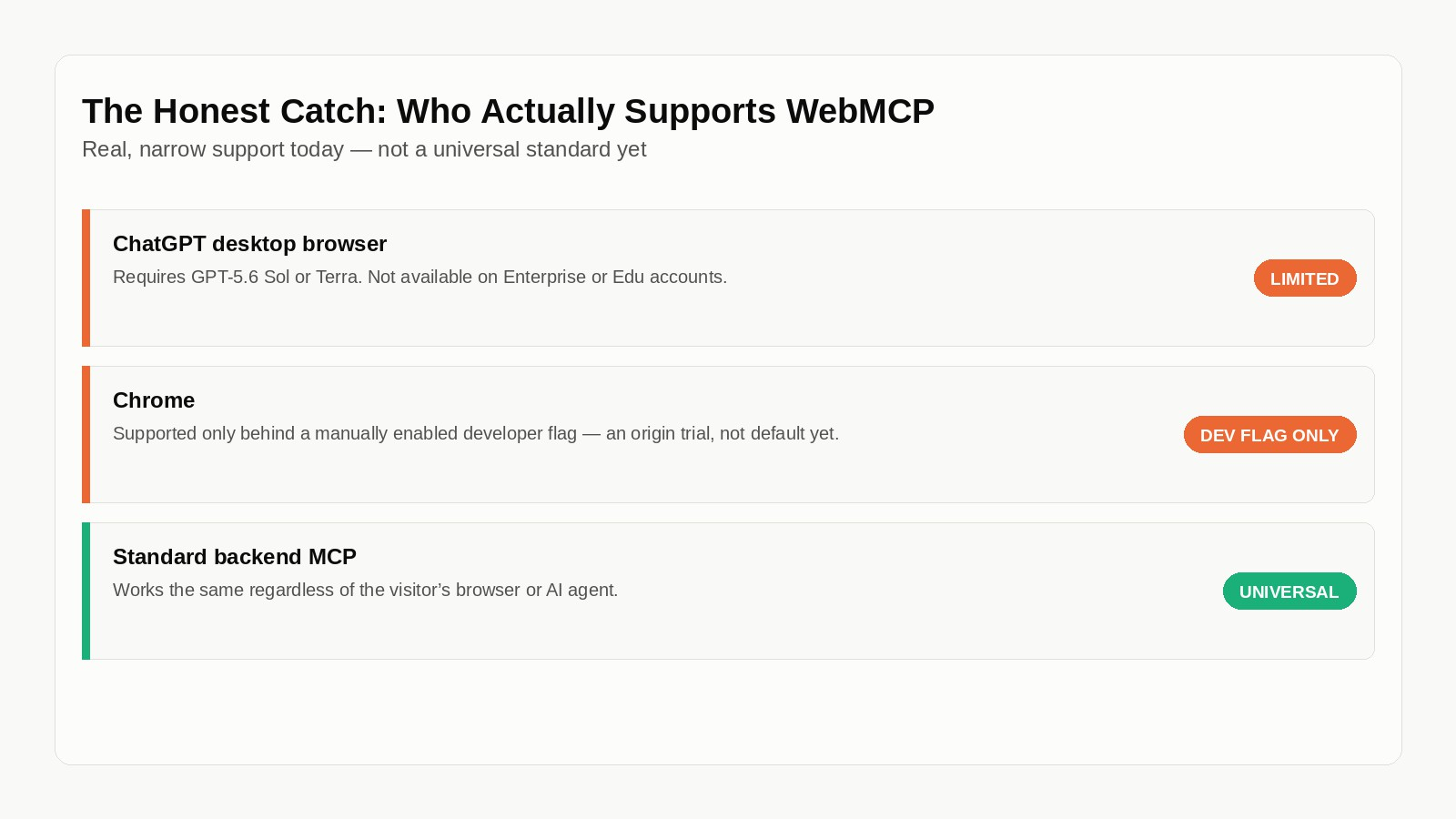
Standard backend MCP, by contrast, works the same regardless of the visitor’s browser or which AI agent they’re using. That consistency is exactly what a server-side approach is good for, and it’s not a trade-off WebMCP has caught up to yet.
The Honest Recommendation
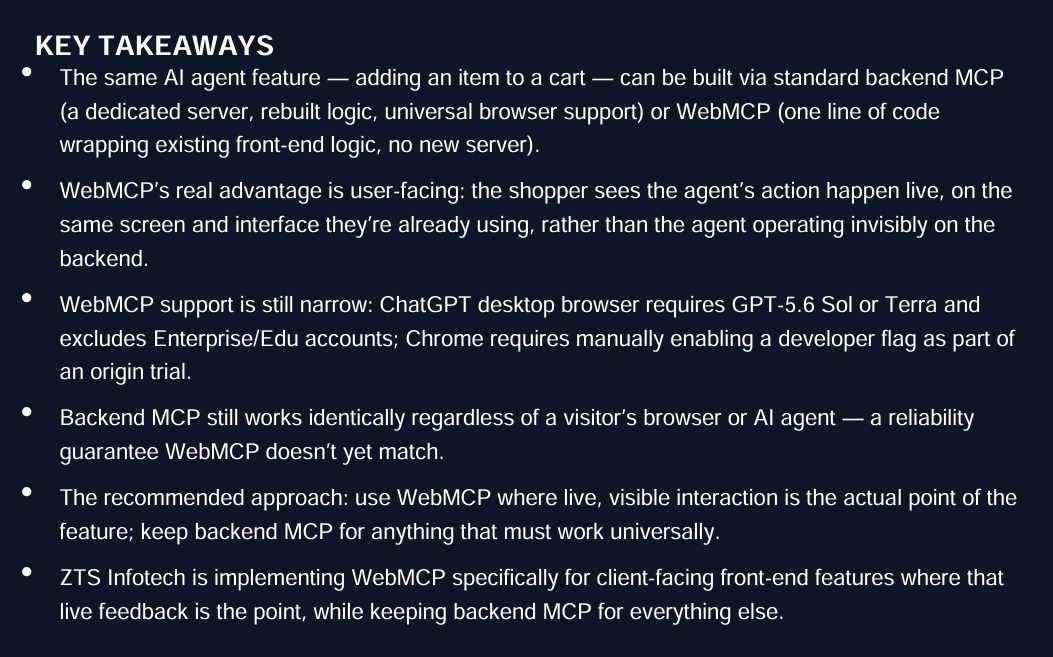
The practical guidance follows directly from that gap: build WebMCP for the features where live, on-screen interaction genuinely matters to the experience — the moments where a customer benefits from watching something happen in real time. Keep backend MCP for anything that needs to work no matter what browser or agent environment a given visitor happens to have, since that’s the scenario backend MCP was already built to handle reliably.
These aren’t competing standards headed toward one replacing the other. They’re suited to different situations, and the businesses building agent-facing features well in this window are the ones treating that as a genuine architecture decision rather than defaulting to whichever approach is newer or more talked about.
Expert Perspective: Why This Distinction Matters Right Now
The deeper significance here isn’t the add-to-cart example itself — it’s what the example reveals about a shift already underway in how AI agents interact with the web. For most of the last two years, agent-website interaction has meant agents operating on top of a site, through APIs or backend integrations built specifically for that purpose, invisible to the person actually using the site. WebMCP represents a different model: the agent operating through the same interface a human would, visible in the same interface a human is watching. That’s a meaningfully different trust and transparency posture, not just a technical shortcut.
The businesses that get ahead of this won’t be the ones that rip out working backend MCP integrations to chase the newer pattern. They’ll be the ones that map their own feature set against the real distinction — which interactions benefit from visible, real-time agent action, and which need to work identically regardless of a visitor’s specific browser or AI assistant — and build each piece against the standard actually suited to it. Given how narrow current WebMCP browser support still is, that mapping exercise matters more than the build itself for now.
Looking Ahead
WebMCP’s browser support is likely to widen well beyond a Chrome dev flag and a narrow ChatGPT model requirement over the coming months, and as it does, the calculus around which approach to build will shift with it. For now, the sound strategy isn’t picking a winner — it’s understanding that these are two different tools solving two different problems, and building the right one for each feature rather than the one that happens to be trending this quarter.
-

Writen by Anirban