USA:
USA:  India:
 AI-powered Android app development services are now a primary growth lever for New Zealand businesses. Unlike traditional apps, AI-driven mobile systems personalize experiences in real time, reduce friction, and improve customer retention. According to Salesforce, 73% of customers expect companies to understand their needs dynamically, making intelligent mobile apps no longer optional for Wellington businesses in 2026.
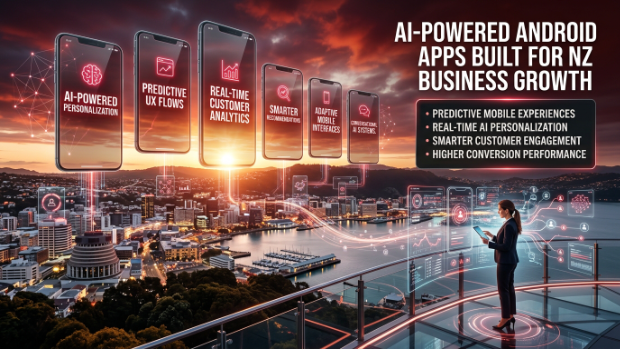
Why Are Wellington Businesses Moving Faster Toward AI-Powered Mobile Apps?
Wellington businesses are accelerating AI adoption because static apps can no longer keep pace with evolving customer expectations. Across fintech, ecommerce, SaaS, and service businesses, customer patience is shrinking, and digital experiences now influence purchase decisions within seconds of app launch.
People expect mobile apps to feel genuinely intelligent today. They want faster load times, smarter recommendations, frictionless navigation, and content that adapts to them, not a one-size-fits-all journey. A customer who opens a slow or irrelevant app will leave within seconds, taking their business elsewhere.
That shift changes everything for NZ brands competing in 2026.
For many Wellington businesses, mobile apps are no longer support tools. They are becoming primary revenue channels, and the businesses treating them that way are pulling ahead.
How Do AI-Powered Android Apps Create Better Customer Experiences?
AI-powered Android apps create better customer experiences by adapting to individual user behavior instead of locking every visitor into the same fixed journey. This is the single biggest difference between an AI-driven app and a traditional one.
Traditional apps follow static logic. Every user sees the same content, the same layout, and the same checkout flow regardless of their intent, history, or preferences.
AI-driven apps work differently. They continuously analyze behavioral signals, including browsing activity, purchase intent, session duration, engagement frequency, and navigation patterns, then respond intelligently.
A Wellington ecommerce store selling electronics, for example, can surface completely different product suggestions to two users based on their individual histories. A returning customer gets smarter recommendations, a faster checkout path, and personalized offers that actually feel relevant.
According to McKinsey, businesses that implement advanced personalization strategies can increase revenue growth by 10–15% and significantly improve customer retention. Users notice the difference quickly, and they reward it with longer sessions, more purchases, and higher loyalty.
Why Are Traditional Mobile Apps Losing Effectiveness in 2026?
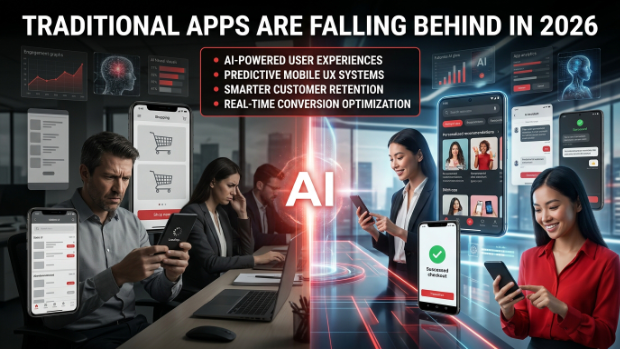
Traditional mobile apps are losing effectiveness because customer expectations have evolved far beyond what static systems can deliver. A few years ago, good design and basic responsiveness were enough. That era is over.
Modern users now expect predictive experiences, personalized content, faster mobile journeys, intelligent recommendations, and conversational support; all within the first few seconds of opening an app.
Search ecosystems have evolved, too. Google, Gemini, ChatGPT, and Perplexity AI now prioritize engagement quality, behavioral relevance, and semantic context when determining visibility. This means experience quality directly affects discoverability.
Google's mobile research found that 53% of mobile users abandon a site or app that takes longer than 3 seconds to load. For businesses relying on outdated mobile infrastructure, this is an urgent problem. Poor performance doesn't just hurt user experience; it actively suppresses rankings and AI search visibility.
Can AI-Powered Android Apps Improve SEO and AI Search Visibility?
Yes, AI-powered Android apps can meaningfully improve both SEO performance and AI search visibility by strengthening the engagement signals that modern search algorithms prioritize. Many businesses still think SEO is primarily about keywords, but that model is outdated.
Modern search engines analyze interaction depth, mobile responsiveness, retention signals, engagement patterns, contextual relevance, and user satisfaction. AI-driven apps perform better across all of these dimensions because they continuously optimize the experience in real time.
Predictive navigation and personalized recommendations keep users interacting longer inside apps. Stronger behavioral signals translate into better performance across AI-powered search ecosystems like Gemini and Perplexity, alongside traditional Google rankings.
BrightEdge reports that AI-generated search experiences now account for a growing share of organic traffic, making behavioral engagement signals more critical than ever for NZ businesses competing for digital visibility.
This is exactly why businesses investing in AI-powered website development services and AI digital engineering services are building stronger long-term competitive advantages.
How Does Predictive UX Increase Mobile Conversions?
Predictive UX increases mobile conversions by reducing the friction that causes customers to abandon their journey before completing a purchase. Most traditional apps wait for users to make every decision manually; predictive systems guide those decisions intelligently.
Imagine a customer who has browsed the same product category three times without checking out. A predictive AI system identifies the hesitation pattern and responds automatically with a simplified checkout flow, a personalized discount, or a targeted urgency prompt. The customer spends less mental energy and more time acting.
Adobe has highlighted how AI-driven personalization is becoming central to customer retention and conversion optimization, particularly as acquisition costs continue rising across digital channels.
For NZ ecommerce brands where every customer acquisition dollar matters more than ever, this shift from traffic-focused to retention-focused strategy is no longer optional; it's the competitive baseline.
Are AI-Powered Android Apps Now Affordable for NZ Startups and SMEs?
Yes, AI-powered Android app development is now far more accessible for New Zealand startups and SMEs because AI infrastructure and development frameworks have matured rapidly. What once required enterprise-level budgets is now available through scalable, startup-friendly models.
Modern NZ businesses can now access predictive analytics, recommendation engines, smart automation, and conversational AI support without the overheads of legacy enterprise contracts.
Statista projects continued growth in smartphone adoption across New Zealand, meaning the market opportunity for AI-powered mobile experiences is only expanding, making early investment increasingly valuable.
ZTS Infotech Pvt Ltd offers competitive, ROI-focused pricing designed specifically for growing NZ businesses:
| Service | Starting Price |
| Website Design | NZD 349 |
| WordPress Development | NZD 349 |
| Ecommerce Development | NZD 549 |
| Shopify Website Development | NZD 549 |
| Full Stack Web Developer | NZD 25/hr |
What Mistakes Are NZ Businesses Still Making With Mobile App Strategy?
The most common mistake NZ businesses make with mobile apps is building for functionality rather than intelligence, and paying for it in lost conversions they never trace back to the app. Many teams still treat apps as support tools rather than growth channels, and the gap shows in their engagement metrics.
Specific problems still widespread in 2026 include generic app experiences with no personalization layer, poor onboarding journeys that lose users in the first session, limited behavioral tracking, slow load performance, and no AI integration for recommendations or support.
Customers expect apps that adapt to them. Apps that feel static or repetitive fail to hold attention, and mobile users have no loyalty to a frustrating experience.
Why Will AI-Powered Mobile Ecosystems Define Business Growth Beyond 2026?
AI-powered mobile ecosystems will define business growth beyond 2026 because customer expectations are becoming more predictive, conversational, and personalized with every passing year, and the infrastructure to meet those expectations is already here.
Over the next three to five years, leading apps will increasingly feature predictive interfaces that anticipate user needs, conversational AI support embedded natively, adaptive user journeys that evolve based on lifecycle stage, real-time behavior-driven optimization, and intelligent automation replacing manual interaction steps.
Businesses adopting these systems now are not just improving their current user experience; they are building compounding advantages. Every interaction trains the system. Every retained user strengthens behavioral signals. Every AI-optimized session improves future discoverability.
The gap between AI-powered ecosystems and traditional apps is only widening. Wellington businesses that move early will find it increasingly difficult for competitors to close the distance.
How Is ZTS Infotech Helping NZ Businesses Build Smarter Mobile Ecosystems?
ZTS Infotech Pvt Ltd helps New Zealand businesses build AI-powered mobile ecosystems designed for scalability, engagement, and measurable conversion growth. Their team specializes in AI-powered Android app development, predictive mobile UX, conversion-focused optimization, and affordable development support tailored to the NZ market.
For businesses ready to build future-ready, AI-driven mobile and digital experiences in New Zealand.
FAQ
Can AI-powered apps improve mobile conversions?
Yes. Predictive UX, personalized recommendations, and intelligent engagement systems help improve customer retention and conversions.
Why are NZ businesses investing in AI-powered mobile apps?
NZ businesses are investing in AI apps because customers now expect faster, smarter, and more personalized mobile experiences.
How does predictive UX work in mobile apps?
Predictive UX analyzes user behavior and dynamically adjusts the app experience to improve engagement and reduce friction.
Are AI-powered Android apps affordable for startups?
Yes. Modern AI infrastructure and scalable development models have made AI-powered app development far more startup-friendly.
Which industries benefit most from AI-powered Android apps?
Ecommerce, fintech, SaaS, healthcare, logistics, and service-based businesses benefit strongly from AI-powered mobile ecosystems.
Final Thoughts: The Window for Competitive Advantage Is Open
AI-powered Android app development is no longer a future investment. It is the present standard for NZ businesses that want to grow, retain customers, and stay visible across both Google and AI-driven search ecosystems in 2026.
The most important shift happening right now is not simply about building a mobile app. It is about building a mobile experience that learns, adapts, and improves with every single user interaction. That is the difference between an app that costs money and an app that makes money.
Wellington businesses that move decisively toward AI-powered mobile ecosystems today are not just solving a current problem; they are building a compounding advantage that becomes harder for competitors to replicate with every passing month. Behavioral data accumulates. Personalization sharpens. Engagement signals strengthen. The system gets smarter, so the business grows faster.
The businesses waiting for "the right time" will find that the window has already closed around them.
If you are ready to stop treating your mobile app as a support tool and start building it as your most intelligent growth channel, ZTS Infotech Pvt Ltd is the team to make that happen, affordably, scalably, and with a clear eye on what NZ customers actually expect in 2026.
The gap between AI-powered apps and traditional ones is widening every quarter. The best time to cross it was last year. The second-best time is right now.
Explore AI-powered mobile and web development for your NZ business:
-

Writen by Anirban Das