USA:
USA:  India: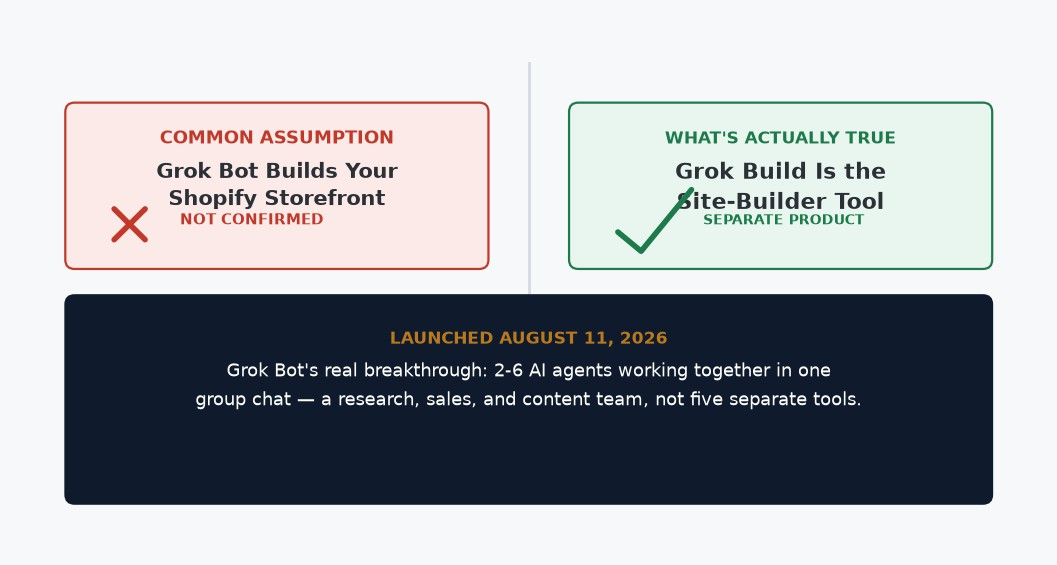
xAI launched something on August 11 that is easy to mistake for another chatbot release. It isn't one. Grok Bot lets business owners assemble two to six AI agents into a single group chat, where they operate as a coordinated team rather than as separate tools a person has to manage one at a time.
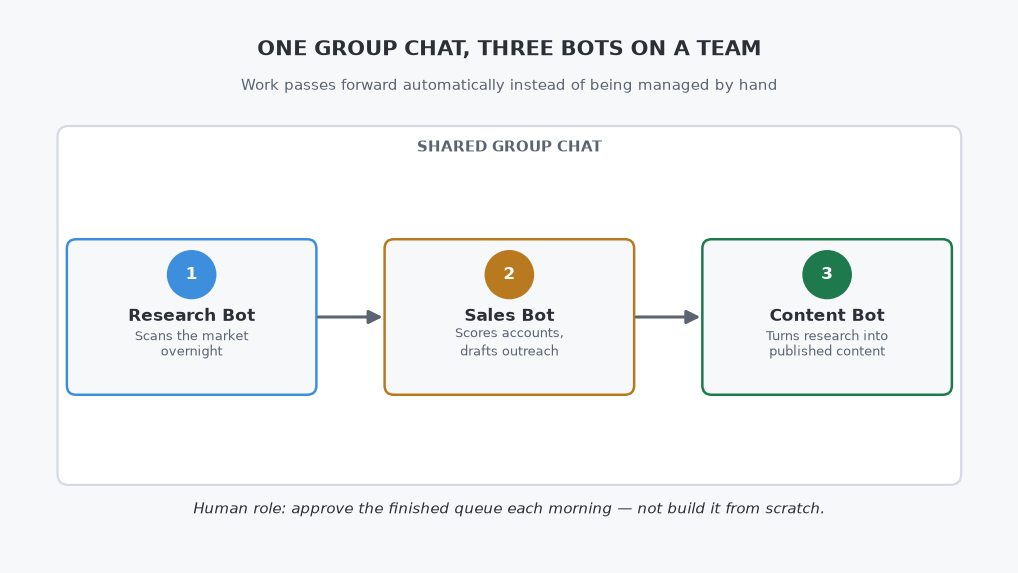
For a small business owner, the useful way to picture this is not "another AI assistant." It's closer to hiring a small research, sales, and content team — except the handoffs between roles happen automatically instead of requiring someone to copy findings from one freelancer and paste them into a brief for the next. One bot can research a market overnight. A second picks up that research and drafts sales outreach in the business owner's voice. A third turns the same research into content. All of it happens inside one shared conversation, with work passing forward on its own.
How the Multi-Bot Team Actually Works
The mechanic here is simpler than it sounds and more useful than a single, do-everything chatbot. Instead of running five disconnected tools and manually relaying context between them, a business owner assigns each bot a role inside one shared group chat. Because they share that conversation, each bot can see and build on what the others have already produced — research becomes outreach, outreach context becomes content, without a human acting as the messenger in between.
That distinction matters more than it might first appear. Most AI tools today are single-purpose: one for drafting, one for research, one for scheduling. Grok Bot's group-chat structure is a different shape entirely — a small team with defined roles, working inside a shared workspace, largely without a human coordinating every step.
A Real Example, From Inside xAI
xAI has described its own internal use of this system, and the example is concrete enough to be useful as a template. A sales bot researches accounts overnight, scores which ones are worth pursuing, and drafts personalized outreach messages for each — leaving a ready queue for a human to review and approve each morning, rather than starting from a blank page.
That is a meaningful shift in what the human is actually doing. Instead of researching accounts and writing first drafts, the person's job becomes reviewing finished work and deciding what goes out. For a small team without a dedicated research or SDR function, that is the difference between a task not getting done at all and a task getting done overnight.
The Honest Correction: Grok Bot Is Not a Website Builder
It's worth being precise here rather than letting an appealing story get ahead of the facts. Grok Bot is not confirmed to build a Shopify store, or any storefront, directly. That capability belongs to a separate xAI product called Grok Build: describe a website or app in plain language, and it builds and publishes it live, with the option of a custom domain.
If the goal is a functioning storefront-style website, Grok Build is the right tool to evaluate — not Grok Bot. Conflating the two would set the wrong expectation for anyone planning to use either product for a specific business outcome, and it's the kind of mix-up that spreads quickly once one piece of coverage gets it wrong.
What It Actually Costs
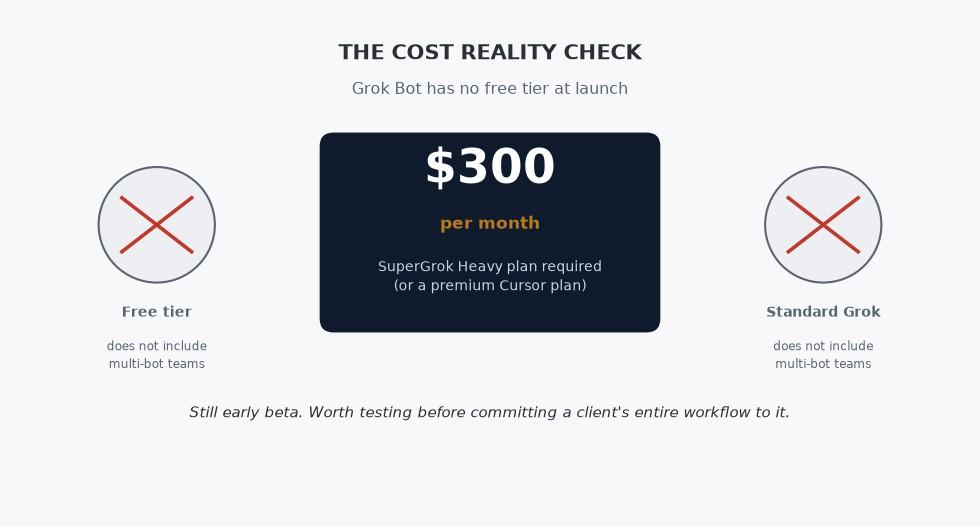
This is not a low-commitment experiment. Grok Bot currently requires a SuperGrok Heavy subscription at $300 a month, or a premium Cursor plan — there is no free tier at launch. That price point puts it well outside casual-trial territory and firmly into a category where a business needs a specific, budgeted use case before adopting it.
For context, that is a meaningfully higher price floor than most single-purpose AI writing or research tools on the market, which reflects the fact that a business is paying for coordinated multi-agent output, not a single chatbot subscription.
EXPERT PERSPECTIVE
The interesting shift here isn't that AI agents can research or draft outreach — those capabilities already exist scattered across other tools. What's new is the group-chat structure itself: multiple agents sharing one workspace, handing off context to each other without a human relaying it manually. That's a meaningfully different operating model than stacking single-purpose tools, and it's the part worth testing rather than the individual skills each bot has.
The correction about Grok Build is worth taking seriously rather than treating as a footnote. Product-naming confusion around a fast-moving AI company's release lineup is common, and it tends to cost real time and money when a business commits budget toward a capability that belongs to a different product entirely. At $300 a month with no free tier, that mistake is more expensive here than with most tools. The sensible path for a small business is to treat this the way xAI's own team appears to be treating it internally: pilot it on one workflow — research and outreach, or research and content —
with a human still approving the output queue, before expanding it into anything client-facing. Multi-agent team structures like this are early enough that the honest label is promising, not proven.
KEY TAKEAWAYS
- xAI launched Grok Bot on August 11, 2026, letting businesses combine 2-6 AI agents into one group chat that functions as a coordinated team.
- Bots hand off work to each other automatically inside a shared conversation — research feeds outreach, outreach context feeds content — without manual relaying by a human.
- xAI's own internal example: a sales bot researches and scores accounts overnight and drafts outreach, leaving a queue for morning human approval.
- Grok Bot is not confirmed to build storefronts directly; that capability belongs to a separate product, Grok Build, which creates and publishes websites and apps from plain-language descriptions.
- Grok Bot requires a SuperGrok Heavy subscription at $300/month or a premium Cursor plan — there is no free tier at launch.
- The tool is in early beta; businesses should pilot it on a single workflow with human approval built in before relying on it for client-facing work.
The core innovation is the shared-workspace, multi-agent structure itself, not any single bot's individual capability.
CONCLUSION
Grok Bot's launch is a useful signal of where AI tooling for small businesses is heading: away from single-purpose assistants and toward coordinated teams of agents that hand off work to each other with minimal human relaying. The $300-a-month price tag and early-beta status mean this isn't yet a tool to bet an entire client operation on, but the underlying structure — shared context, automatic handoffs, a human approving rather than producing — is worth testing now on a contained workflow. Businesses evaluating it should also keep the Grok Bot and Grok Build distinction straight, since assuming one product's capabilities apply to the other is the kind of mistake that gets expensive quickly at this price point.
-

Writen by Anirban Das