USA:
USA:  India: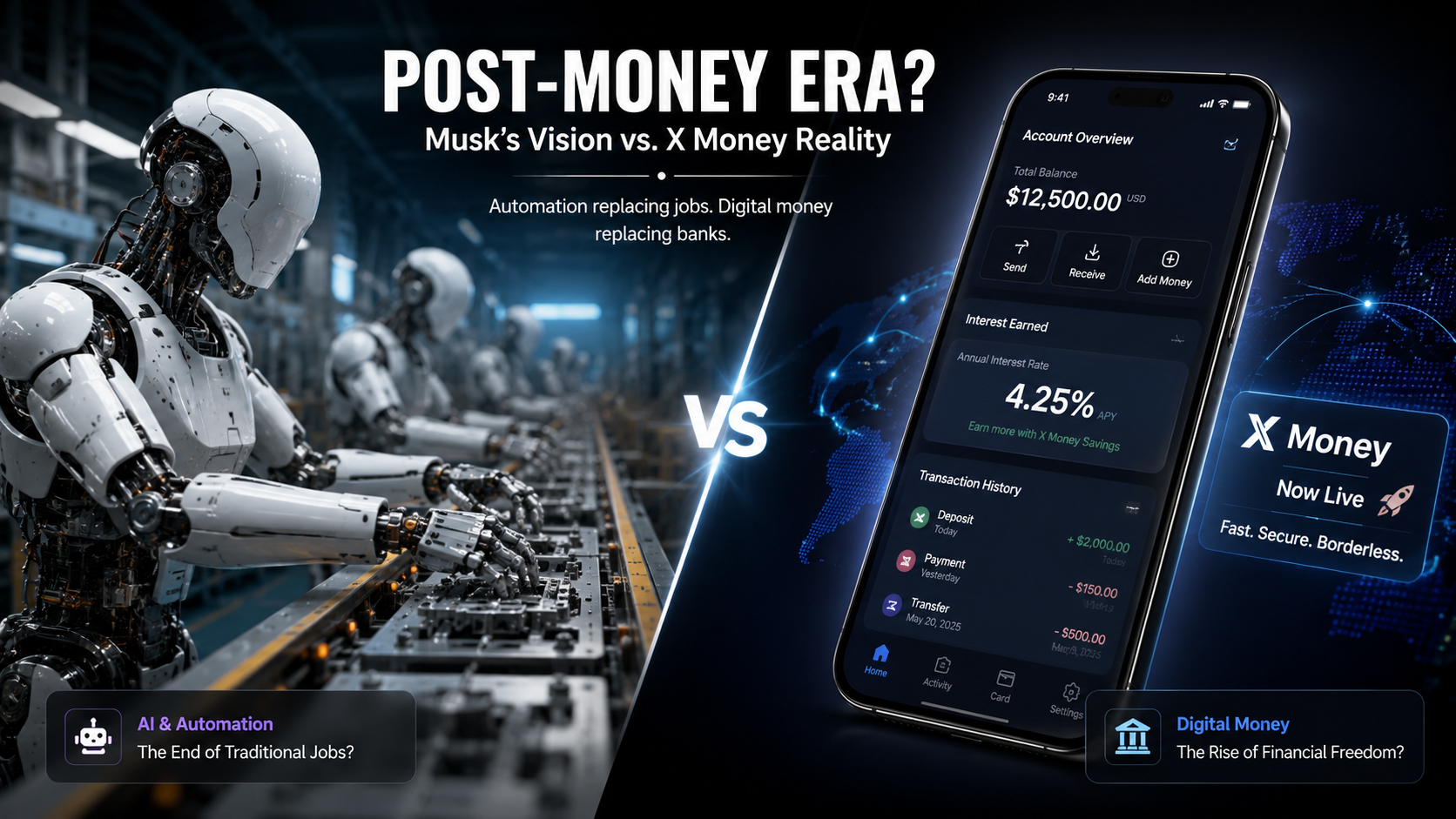
Elon Musk has never been shy about making sweeping predictions, but the one he delivered to The Economist on July 23 landed differently than most. Money, he argued, will stop mattering within a decade. By 2036, artificial intelligence and robotics will produce goods and services in such abundance that currency itself becomes close to irrelevant — not because people run out of things to buy, but because there will be too much available, too cheaply, for money to function as a meaningful constraint. He framed it as a deflationary future: too much output chasing too little need for cash, rather than the inflationary scenarios most economists worry about.
That claim would be notable on its own. What makes it worth a business leader's attention is what Musk did in the same week he said it: he launched X Money, a digital payments platform offering depositors up to 6% interest, built to compete directly with traditional banks and positioned as the financial backbone of an “everything app.” A founder forecasting the end of money while simultaneously building one of the more ambitious fintech platforms in recent memory is not a detail to skim past. For executives trying to separate genuine signal from strategic messaging, it is a useful case study in how to weigh big predictions from people who are also placing large financial bets on the opposite outcome.
A Prediction Built on Abundance, Not Scarcity
Musk's reasoning rests on a familiar theme in his public statements: scale production enough, and cost collapses. He pointed to food, housing, transport and entertainment as categories that could become so abundant — produced largely by AI systems and robotic labor — that scarcity, the basic condition money exists to manage, simply erodes. The production backbone behind this thesis is not abstract. Tesla's Optimus robot line at its Fremont facility is reportedly being scaled toward an annual output target of one million units, giving the abundance argument a concrete, if still unproven, manufacturing basis.
The Same Week, a New Bank
Days after the interview published, X Money went live, offering account holders a 6% interest rate on deposits — a rate that undercuts what most conventional banks currently pay and puts competitive pressure squarely on the retail banking sector. The platform is designed to sit at the center of X's broader “everything app” ambitions, tying payments, savings and, eventually, a wider suite of financial services into the same consumer ecosystem that already handles messaging, payments and commerce. It is difficult to read this as anything other than a bet that money — and control over where it sits — will matter a great deal for the foreseeable future.
An Economist Pushes Back
The contradiction did not go unnoticed. MIT Nobel laureate economist Daron Acemoglu responded publicly with a direct challenge: if Musk genuinely believes money will be worthless by 2036, he should donate his roughly $700 billion fortune to charity well before that date. Musk's reply was that he plans to do something similar, though no concrete pledge, timeline or mechanism has been announced. The exchange crystallized the core tension in the story: a prediction about the end of money's relevance, made by someone who is, at present, one of the wealthiest and most financially active people in the world.
Where Other Economists Land
Economists including Tyler Cowen have offered a more measured counterpoint. Their argument is not that abundance is impossible, but that scarcity does not vanish when robots make goods cheap — it relocates. Land remains finite. Human attention remains finite. Energy and compute capacity for running advanced AI systems remain constrained. Whatever people continue to find meaningful and limited will retain economic value, even in a world where basic goods become far cheaper to produce.
Expert Perspective: What This Actually Means for Business
At ZTS Infotech, our teams build AI systems for real, paying clients rather than theorize about them, and that vantage point shapes how we read a claim like Musk's. The abundance thesis may well be directionally correct over a very long horizon — AI-driven production almost certainly will push down the cost of many goods and services over the next decade. But “directionally correct eventually” and “operationally relevant now” are two very different things for a business leader building a five-year plan.
The more useful lesson from this episode is not the 2036 forecast itself, but the pattern behind it. Founders with large platforms increasingly pair bold, headline-grabbing predictions with concrete product launches that stand to benefit from the attention those predictions generate. X Money did not launch in a vacuum — it launched into a news cycle Musk himself created. Business leaders should separate the two signals: the prediction is a narrative that shapes investor sentiment and public attention; the product launch is the actual, actionable market move. Watching where AI companies are quietly expanding into financial services, payments and consumer deposits tells you more about the next eighteen months than a claim about the next ten years.
It is also worth noting where scarcity is genuinely shifting today: toward compute capacity, energy infrastructure, specialized AI talent and consumer trust. Companies that treat those as the new constrained resources — and plan hiring, infrastructure and partnerships accordingly — are positioning themselves more realistically than those waiting for a post-money economy to arrive.
Key Takeaways
• On July 23, 2026, Elon Musk told The Economist that money will not matter by 2036 because AI and robots will make goods and services abundant.
• Musk framed the shift as deflationary — too much supply rather than too little — covering categories like food, housing, transport and entertainment.
• The same week, Musk launched X Money, a digital payments platform offering up to 6% deposit interest and competing directly with banks.
• Tesla's Optimus robot line at Fremont is reportedly targeting production of one million units a year, forming the manufacturing basis for the abundance claim.
• MIT economist Daron Acemoglu publicly challenged Musk to donate his roughly $700 billion fortune to charity before 2036; Musk said he plans something similar, without specifics.
• Economists including Tyler Cowen argue scarcity will not disappear — it will shift toward land, human attention, energy and compute capacity.
• Business leaders should separate bold predictions from the concrete product moves that follow them, and watch the latter more closely than the former.
Looking Ahead
Whether money stops mattering by 2036 is not a question any business can answer today, and it is not one worth building a strategy around. What is answerable, and worth watching, is how quickly AI-driven companies are moving into the financial infrastructure that underpins commerce — payments, deposits, credit — while making very different claims about that infrastructure's future relevance. That gap between stated belief and actual investment is often where the real business story lives. As this debate plays out over the coming years, decision-makers who track the concrete moves — not just the headline predictions — will be better positioned to respond when the picture becomes clearer. Talk to our team about building a realistic AI strategy.
-
Writen by Anirban Das